
Google has introduced a new Project Bloks platform, open hardware platform which aims to teach students coding. Basically, this hardware platform allows developers and designers to build a physical programming experience which will help kids (5+) learn to code.
Project Bloks is about creating a tangible programming experience for kids. Kids use their hands to build things and this tangible programming makes code physical, so kids can play with it.

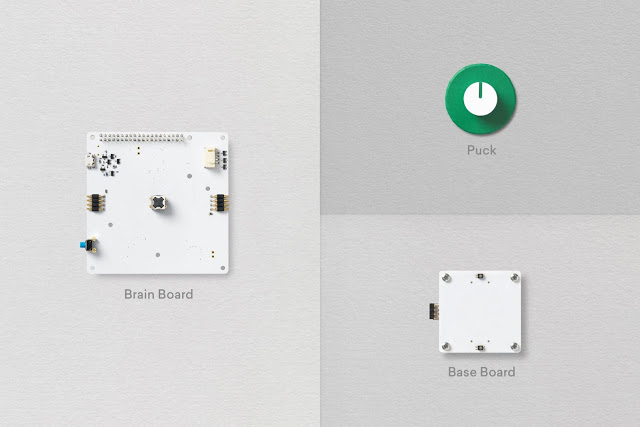
Google has developed a modular system for tangible programming. This system has electronic boards and programmable pucks. These pucks send instructions to device when connected together. There are two kinds of boards: Base board and brain board. Base board is where you put the pucks. It read the instructions from pucks and pass it to the main brain board.
Pucks are the main thing which makes this system so versatile. Pucks can be programmed with different kind of instructions such as ‘turn on or off’, ‘move left’ or ‘jump’. It can also be of various shapes to make the whole thing more interesting. Good thing is that plucks are cheap and easy to make. All you need a piece of paper and some conductive ink.
Base board reads the instructions given by Puck through a capacitive sensor and act as a conduit for a Puck’s command to the Brain Board. Base boards are modular and can take any kind of shape to create different experiences. Each base board is fitted with a haptic motor and LEDs that gives users real-time feedback on their programming. It can also trigger audio feedback from the speaker attached to brain board. The main processing system is brain board which can control any device that has an API of Wi-Fi or Bluetooth.

The main processing system is brain board which can control any device that has an API of Wi-Fi or Bluetooth.
It sends the instructions to any device with WI-Fi or Bluetooth connectivity.
So, now you know how the whole thing works. It only needs to create innovative problems which kids solve to learn how to code in tangible programming.
Google also encourages everyone—educators, manufacturers, researchers, parents to help shape the future of Computer Science education by remotely taking part in our research studies later in the year.