Brands may be visible to AI assistants without actually being discovered by them.
A new study from NeuroRank suggests that brands perform much better when their names are already included in a prompt, while their visibility drops sharply when ChatGPT, Gemini, Claude, or Perplexity has to choose brands on its own.
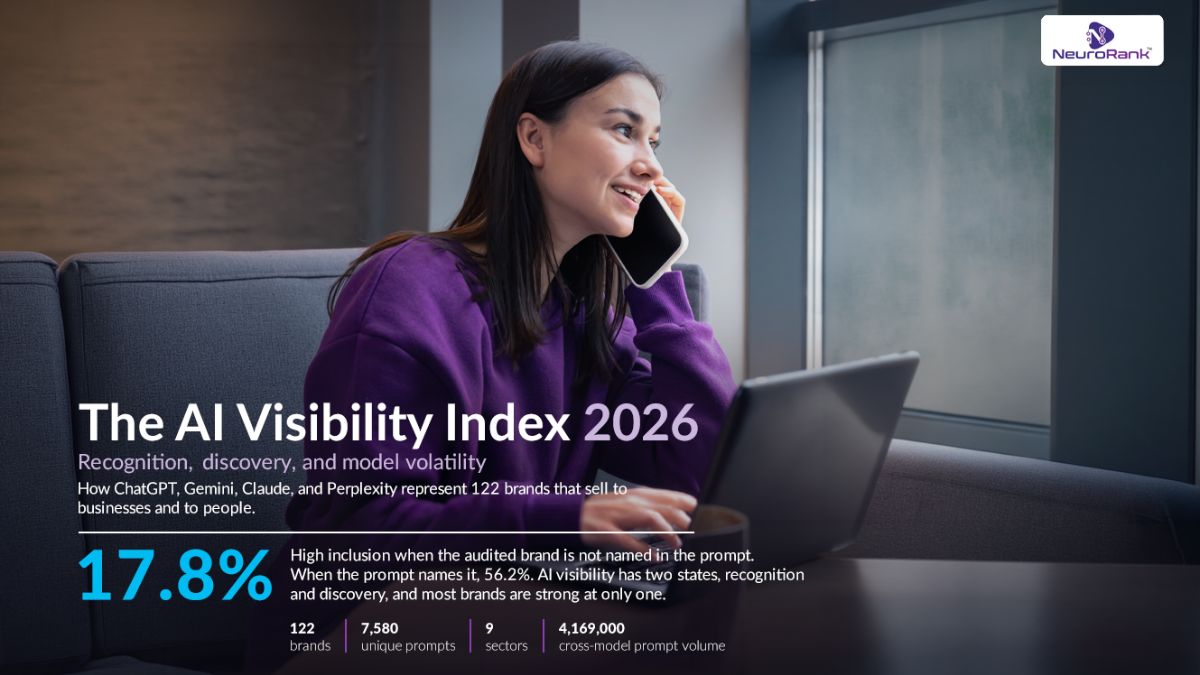
The NeuroRank AI Visibility Index 2026 analysed 7,580 unique prompts covering 122 brands across nine sectors between March and May 2026. The study found a 38.4 percentage-point gap in High inclusion between prompts that named a brand and those that did not.
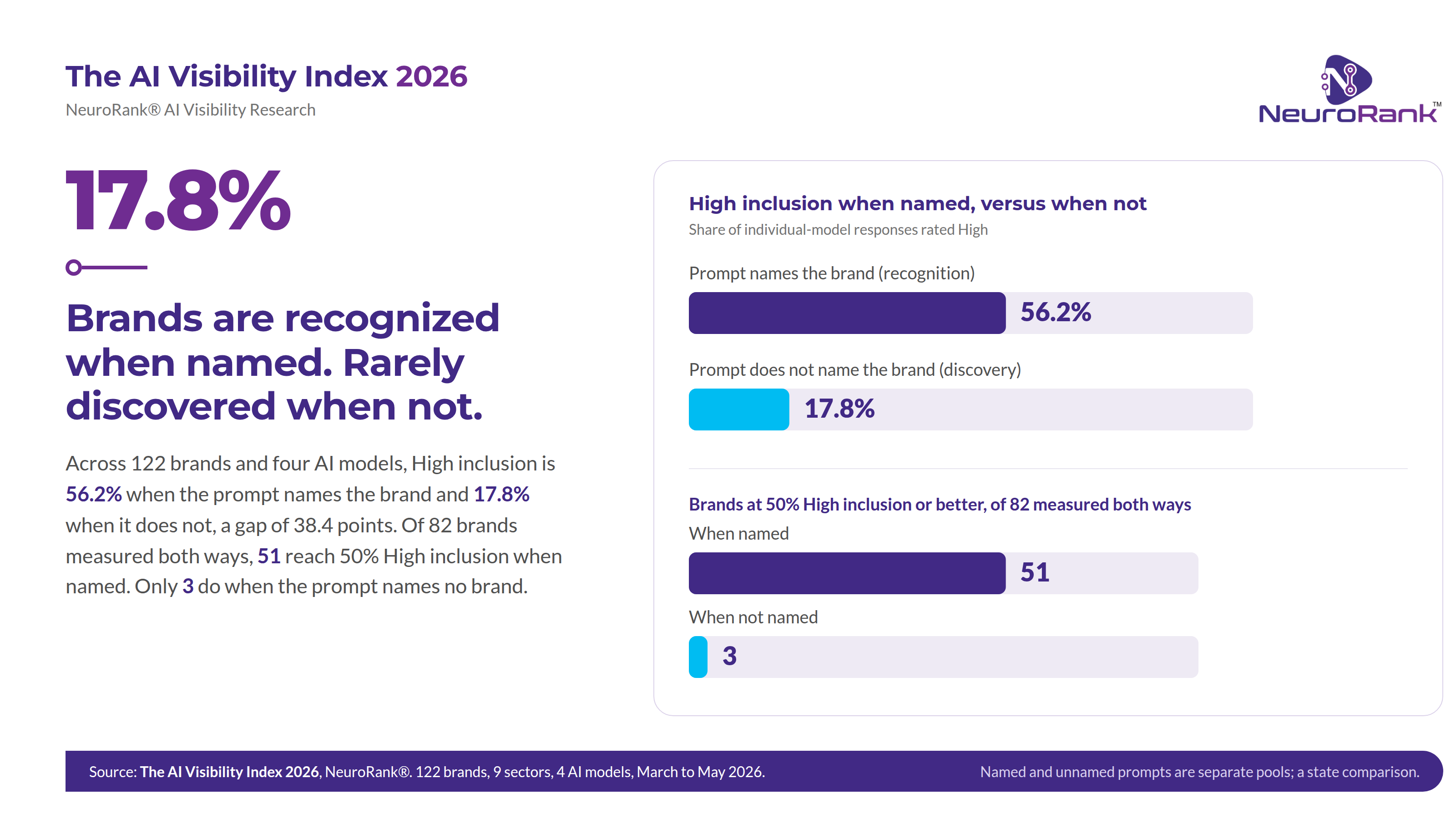
Across individual-model ratings, High inclusion stood at 56.2% across 2,298 results where the brand was named in the prompt. It dropped to 17.8% across 4,879 results where the brand was not named.
This suggests that a brand can appear to have strong AI visibility simply because users are already asking AI about that brand. The more difficult test is what happens when a consumer asks a general question and expects the AI assistant to suggest the brands worth considering.
The difference becomes particularly important with shortlist and recommendation prompts. These prompts accounted for 38.6% of all unique prompts in the study, making them the largest prompt category. However, only 5.9% of these prompts named the audited brand, and High inclusion was just 20%.
In other words, the type of AI query that most closely resembles product or service discovery appears to be a much harder visibility test for brands.
Comparison prompts produced a very different result. Brands were explicitly named in 84.8% of comparison prompts, and High inclusion reached 48.4%. This also shows why measuring AI visibility using only brand-specific or comparison queries can give a more positive picture than measuring whether an AI assistant will bring up the brand without being prompted by name.
The difference is even clearer when looking at individual brands. Of the 82 brands evaluated in both named and unnamed conditions, 51 reached at least 50% High inclusion when their names were supplied. Only three reached that level when the brand was not named.
The study also found that 22 brands crossed the 50% High inclusion mark when named but fell below 20% when their names were absent. That is a significant gap because it separates brand recognition from brand discovery.
The pattern was visible across sectors as well. No sector reached 30% High inclusion on prompts where the brand was not named.
BFSI had the strongest performance on named prompts, with 73.4% High inclusion, but the figure dropped to 24.8% when brands were not named. That was the widest sector-level gap at 48.6 percentage points. FMCG and personal care fell from 58.5% to 11.9%, while retail and lifestyle dropped from 59.0% to 13.8%.
There is also an important detail in the study’s commercial prompt data. Commercial prompts had 27.3% High inclusion compared with 35.2% for other prompts. However, when looking only at prompts that did not name a brand, the difference became much smaller at 17.4% versus 18.8%.
This suggests that the apparent difference between commercial and non-commercial queries is influenced heavily by whether the brand is already mentioned in the question. It is another reason why AI visibility cannot be reduced to a single overall score without considering the type of prompt being tested.
The findings point to a different way of measuring brand visibility in AI search. Instead of asking only whether ChatGPT or another AI assistant can describe a brand, marketers need to test whether the brand appears when the user does not mention it.
That matters because a consumer may not ask an AI assistant about a specific company in the first place. They may instead ask for the best smartphones, accounting software, insurance providers, healthcare companies, or other options in a category. At that point, the AI system is making the initial selection by using its own intelligence.
NeuroRank describes this as the difference between aided and unaided brand recall. The study’s findings suggest that the second category is considerably harder for brands, and may be a more useful measure of whether an AI system can actually help a brand enter a consumer’s consideration set.
“AI visibility is being measured too generously by marketers. If a brand looks strong only after its name is supplied, that is recognition, not discovery,” said Ambika Sharma, Founder and Chief Strategist at Pulp Strategy Communications and Product Architect of NeuroRank.
The study does not establish that appearing in an AI shortlist leads to sales, leads or other business outcomes. It also treats named and unnamed prompts as separate pools rather than a controlled experiment where the same question is tested with and without the brand name. The findings should therefore be read as a description of how brands appeared across different types of AI prompts, rather than proof that adding or removing a brand name directly caused the difference.
Still, the numbers show a growing measurement problem for AI search. A brand may be easy for an AI assistant to recognise once a user mentions it, while remaining difficult to discover when the AI has to decide which brands belong on the shortlist.