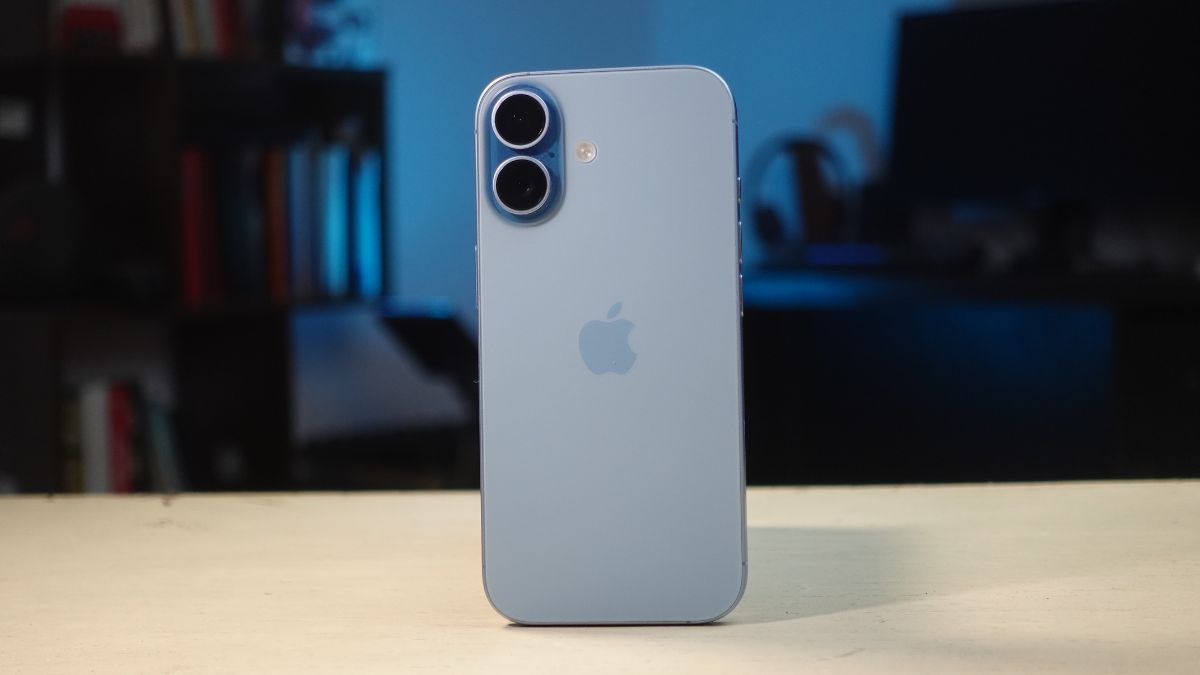

Apple’s iPhone 17 was the world’s best-selling smartphone in the second quarter of 2026, according to Counterpoint Research’s Global Handset Model Sales Tracker. The standard iPhone 17 captured 6% of global smartphone unit sales, while the iPhone 17 Pro Max and iPhone 17 Pro took the second and third positions.
The latest ranking shows how strongly Apple and Samsung are controlling the global smartphone market. Both companies placed five models in the top 10, with these devices together accounting for 26% of global smartphone unit sales. This was the highest share recorded by the top 10 in a June quarter and came at a time when the overall smartphone market declined 11% year over year.
The growing concentration is partly linked to the global RAM shortage. As memory costs rise and market conditions become more difficult, brands are putting more resources behind a smaller number of important models instead of trying to drive sales across a wide portfolio.
The iPhone 17 has now established itself as the strongest-selling model in Apple’s current lineup. It also held the top position in the first quarter, when it accounted for the same 6% share of global smartphone sales.
Read: iPhone 17 Review
Apple’s performance is notable because the company increased unit sales by 5% year over year despite the broader market contraction. Counterpoint says iPhone sales increased in India, Japan, and the Middle East and Africa region, while sales in South Korea nearly doubled during the quarter.
The standard iPhone 17 has benefited from upgrades that have reduced the gap between the regular and Pro models. This appears to have made the base model a stronger option for consumers who want the latest iPhone experience without paying the premium required for the Pro lineup.
At the same time, the iPhone 17 Pro and iPhone 17 Pro Max remained strong sellers. Trade-in programs, promotions and financing options have helped consumers manage the higher prices of these models. Counterpoint also points to rising smartphone prices as one factor pushing some buyers towards higher-end devices, where the additional cost can be easier to justify when the phone is expected to be used for several years.
Apple also had the iPhone 17e in the top 10, which gave the company another important volume driver. The model added MagSafe and higher internal storage while keeping the same starting price as its predecessor.
The iPhone 17e has been popular in the US and Japan, where carrier promotions have helped improve its value proposition. Its performance shows that Apple is not relying only on its flagship Pro models. The company is getting strong demand from both its mainstream and premium offerings.
This is important in a market where consumers are becoming more selective about upgrades. A model such as the iPhone 17e can attract buyers who want a newer iPhone but do not need the most expensive hardware.
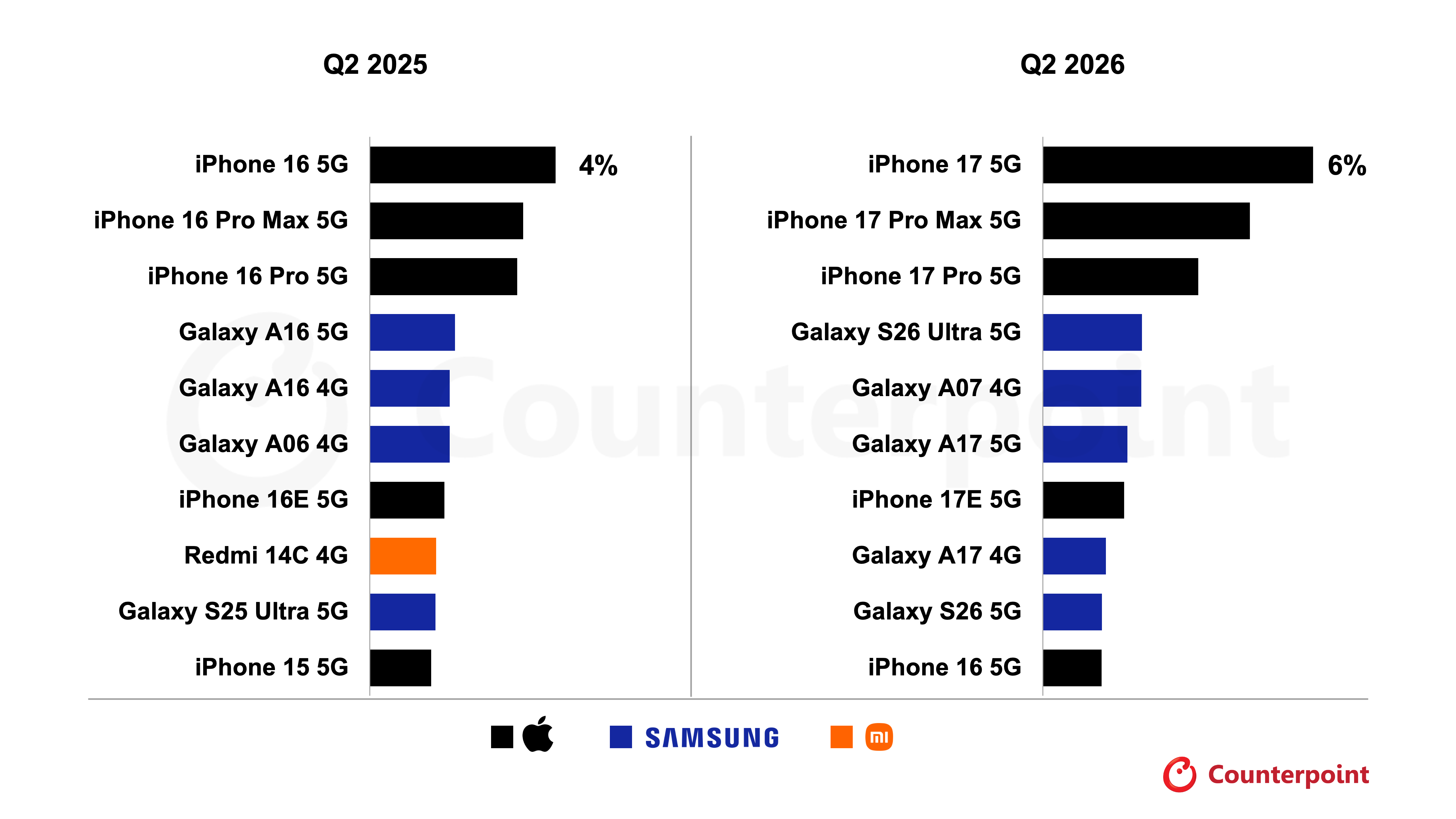
Samsung’s biggest success in the quarter came from the Galaxy S26 Ultra. It was the best-selling Android smartphone globally and moved five positions higher compared with the ranking of its predecessor. The result is significant because the Galaxy S26 Ultra became the first ultra-premium Android smartphone to lead Android sales in the June quarter. It also accounted for more than half of the sales of the Galaxy S26 series.
The timing of Samsung’s launch helped. The Galaxy S26 series launched later than the Galaxy S25 series, shifting more of its sales into Q2. This gave the S26 Ultra a stronger presence during the quarter and helped it outperform the previous-generation model.
Samsung has also focused heavily on differentiating the Ultra model. Its privacy display and enhanced AI features are among the features that Counterpoint identifies as helping the phone stand out. Samsung has increased promotions around its flagship models while allocating resources more carefully as component costs rise.
Samsung’s success was not limited to its flagship phones. Galaxy A series models also made it to the top 10. Galaxy A17 5G, Galaxy A07 4G, and Galaxy A17 4G did well. It shows that affordable and mid-range smartphones continue to be important sources of volume. The A series benefits from Samsung’s wide availability and established brand presence. Its pricing also makes it attractive in markets where consumers are more sensitive to rising smartphone prices.
Software support is another advantage. Counterpoint notes that the Galaxy A models in the top 10 offer at least six years of software support. Longer support periods are becoming more relevant as consumers keep their phones for longer and delay upgrades.
The most interesting part of the report is the increasing concentration of sales. The top 10 smartphones accounted for 26% of global unit sales in Q2 2026, compared with 24% in the same quarter last year. This happened even though the overall smartphone market declined 11%. It suggests that consumers who are still buying new smartphones are increasingly choosing established models that offer a strong combination of features, brand value and financing or promotional support.
The Q2 ranking also shows the continued strength of the premium smartphone segment. Apple’s three top positions and Samsung’s Galaxy S26 Ultra performance show that expensive smartphones are not losing their appeal even as overall unit sales decline. Counterpoint recently reported that premium smartphones priced at $600 or more accounted for a record 29% of the global smartphone market in the first half of 2026. Apple and Samsung together held 84% of this premium segment.
The shift is important for manufacturers because premium phones provide more room to absorb higher component costs. Trade-ins, financing, and promotions can also reduce the immediate impact of higher prices for consumers.
Overall, the Q2 2026 ranking shows a smartphone market that is becoming more concentrated around fewer successful models. Apple and Samsung together occupy the entire top 10, while the iPhone 17 continues to lead global sales. At the same time, the rise of the Galaxy S26 Ultra shows that Android buyers are also showing stronger demand for ultra-premium devices. With memory costs remaining a challenge, this focus on proven models is likely to remain an important part of smartphone makers’ strategy through the rest of 2026.