
QOO has launched its latest flagship smartphone, the iQOO 16, in China. The new model brings a major focus on display and gaming performance, while also upgrading the camera system, battery, and software experience.
The iQOO 16 features a 6.85-inch 2K Samsung Everest LTPO AMOLED display with a 165Hz refresh rate. It is the world’s first smartphone to combine 2K resolution with a 165Hz refresh rate, making the display one of the biggest highlights of the new flagship. The panel uses Samsung’s M16 luminescent material and 2K LEAD 2.0 technology. iQOO claims this combination can reduce power consumption by 31% compared with a similarly sized 1.5K display. The 165Hz refresh rate is supported across more than 100 everyday applications and over 50 games.
The display also supports up to 2,800 nits of global peak brightness and up to 10,000 nits of local peak brightness. It comes with DC dimming and up to 3,300Hz PWM dimming for eye comfort. For gaming, the panel also supports up to 5,000Hz instantaneous touch sampling. With 2K resolution, a 165Hz refresh rate and high touch responsiveness in the same panel, iQOO is clearly pushing the display as more than just a high-end screen for gaming.
The performance hardware is equally ambitious. The iQOO 16 is among the first smartphones to use the Snapdragon 8 Elite Extreme Gen 6, built on a 2nm process, and iQOO is pairing it with its own Q4 gaming chip. This is an important part of the new phone because iQOO is using its in-house chip to take more control over gaming performance instead of depending entirely on the Snapdragon platform.
The Q4 chip supports full-scene ray tracing and iQOO’s QNSS super-rendering technology. It can also enable 2K resolution with 165fps frame interpolation in supported games. The company says native QNSS rendering is supported in 11 games, 2K super-resolution works in 13 games, and 165fps modes are available across hundreds of titles.
It is available with up to 16GB of LPDDR5X Ultra Pro RAM and 1TB of UFS 4.1 storage. The base model comes with 12GB RAM and 256GB storage, while other configurations include 12GB + 512GB, 16GB + 512GB and 16GB + 1TB.
The phone also gets a substantial cooling system to keep this hardware running under sustained loads. It uses an 8,500mm² 3D vapor chamber along with a three-layer graphite structure covering 29,453mm². iQOO has also updated its Monster Hyper-Core Engine and added a Hyper-Core scheduler for dynamic workload management. These upgrades should matter more during long gaming sessions than during normal daily use, where the flagship chipset itself should already have plenty of performance.
The iQOO 16 runs OriginOS 7 based on Android 17. The software introduces the new Origin Smooth Engine for a more responsive interface and brings productivity features such as Atomic Workbench, which allows up to five applications to run on the same screen. It also includes Little V Dynamic Components for automated tasks and personalised desktop utilities. AI features, cross-device connectivity and additional customisation options further expand the software experience.
The iQOO 16 has a 50-megapixel main camera with a large 1/1.3-inch sensor and optical image stabilisation. iQOO says the sensor captures 79% more light than the previous generation’s high-end benchmark. The camera system uses the NICE 3.0 optical reconstruction engine and Super Light and Shadow HDR processing.
The main camera is joined by a 50-megapixel ultra-wide camera and a 50-megapixel Sony periscope telephoto camera with 3x optical zoom and OIS. The phone also supports 4K live photos and offers multiple colour profiles. On paper, this is a more complete camera setup than the performance-focused image many iQOO flagships have traditionally carried.
It also has a 32-megapixel front-facing camera for selfies and video calls.
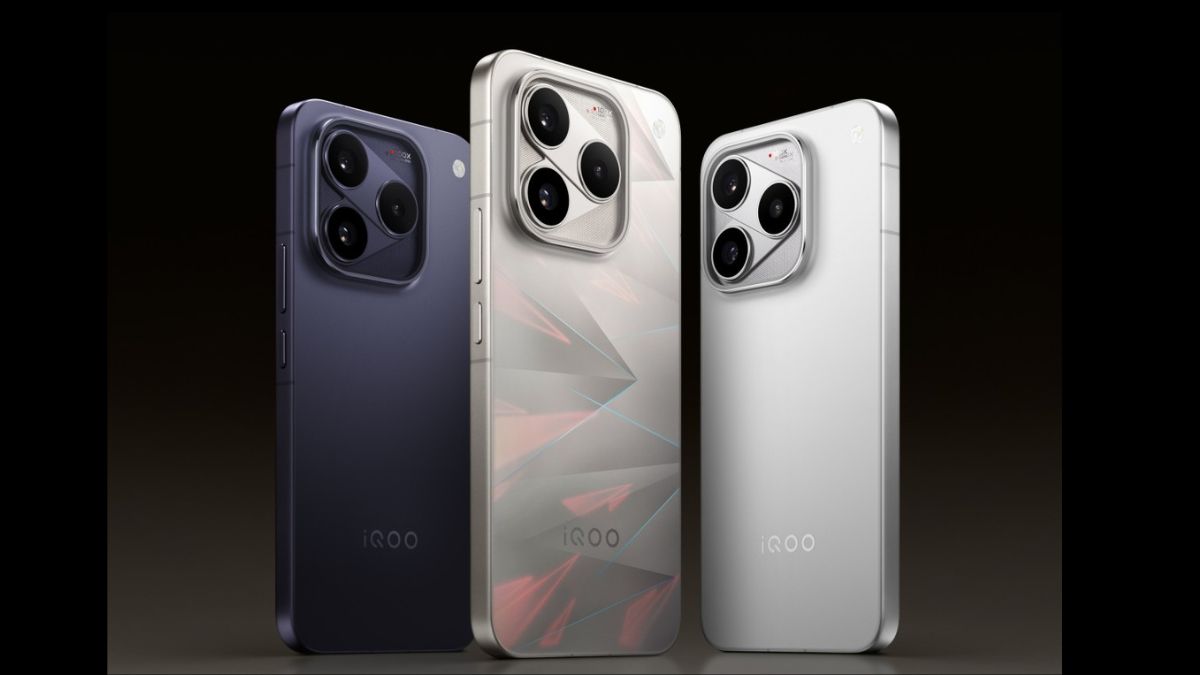
The iQOO 16 has a floating rear camera design under a glass cover, with the three cameras arranged in an interconnected triangular layout. The phone has rounded corners and a curved frame that blends into the rear panel. It is available in Light Chaser, Racing Track and Legend colour options.
Connectivity options include 5G, Wi-Fi 7, Bluetooth 5.4, NFC and USB Type-C 3.2 Gen 1. The phone also supports dual SIM connectivity and includes a range of satellite navigation systems. There is no 3.5mm headphone jack, with audio handled through USB Type-C and the stereo speakers.
The iQOO 16 packs an 8,400mAh Blue Ocean battery with support for 100W wired fast charging and 40W wireless charging. It also supports direct power supply during intensive gaming, which allows the phone to bypass the battery while connected to a charger. This could help reduce battery stress and keep performance stable during long gaming sessions.
The device measures up to 8.55mm thick depending on the variant and weighs between 222.5g and 229.8g. It also has IP68 and IP69 ratings for dust and water resistance, along with an in-display 3D ultrasonic fingerprint sensor, stereo speakers and an infrared sensor.
iQOO 16 Price in China
The iQOO 16 starts at 5,999 yuan for the 12GB RAM and 256GB storage variant. The 12GB + 512GB model costs 6,799 yuan, while the 16GB + 512GB version is priced at 7,499 yuan. The top-end 16GB + 1TB model costs 8,499 yuan. The phone is now available for sale in China.
iQOO has not yet announced India pricing or availability.