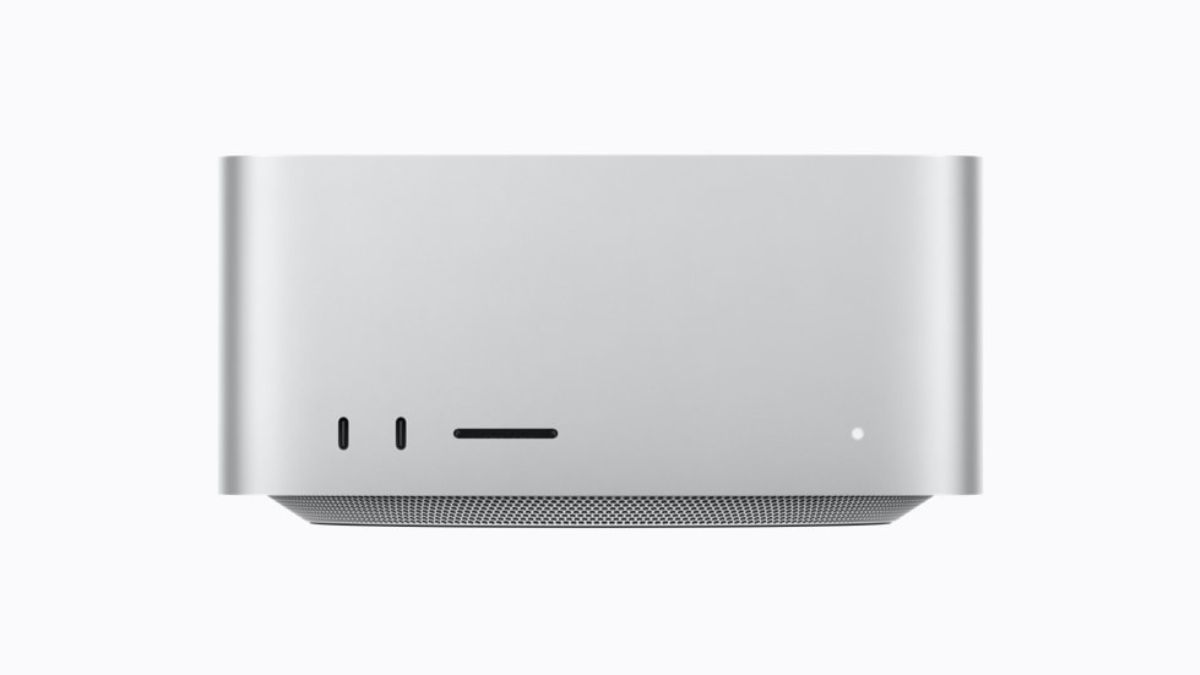

Apple has launched its new Mac Studio lineup with the M5 Max and all-new M5 Ultra chips. The new desktop is aimed at professionals working on demanding creative workloads, software development, scientific computing and increasingly large local AI models.
The new Mac Studio keeps Apple’s compact desktop design but brings major upgrades inside. Apple claims up to 4.3x faster AI performance, 1.8x faster graphics, 1.3x faster CPU performance and 2x faster storage compared with the previous generation, depending on the configuration and workload.
The biggest change is the move to Apple’s latest high-end silicon. The M5 Max configuration comes with an 18-core CPU and can be configured with up to a 40-core GPU. The GPU includes Neural Accelerators in every core, which is a major part of Apple’s push toward local AI processing.
The M5 Ultra takes the hardware much further. It supports up to a 36-core CPU, 80-core GPU, and 512GB of unified memory. Apple says the M5 Ultra is designed to run extremely large AI models directly on the Mac without sending data to the cloud.
This is where the new Mac Studio becomes more than just a faster workstation. Apple is clearly positioning it as a local AI machine for developers, researchers, and businesses that need to run large models while keeping data on the device.
The M5 Max has an 18-core CPU with six super cores and 12 performance cores. Apple says the chip delivers faster compilation and other CPU-heavy workloads while maintaining the power efficiency that Apple silicon is known for.
The GPU can have up to 40 cores and includes a Neural Accelerator in every core. Apple claims the M5 Max provides up to 50% faster graphics performance than the previous generation. The chip also supports up to 614GB/s of unified memory bandwidth, which gives the GPU and CPU faster access to large datasets and AI workloads.
The M5 Max also gets third-generation hardware-accelerated ray tracing and improved shader cores. This should help with professional 3D applications, visual effects, game development and real-time graphics. Apple says these improvements can provide faster lighting, reflections and shadows while also improving real-time viewport performance.
The Media Engine has also been upgraded. It supports hardware acceleration for H.264, HEVC, ProRes and AV1 decoding, allowing the Mac Studio to handle demanding video workflows. Apple says professionals can work with uncompressed 8K footage and multiple video streams without needing to rely entirely on CPU or GPU processing.
Apple says the M5 Max can deliver up to 3.9x faster AI performance than the previous generation. The company claims up to 10.7x faster LLM prompt processing in LM Studio compared with a Mac Studio with M1 Max and up to 3.9x faster performance compared with M4 Max.
Apple also claims up to 7.4x faster text-to-image generation compared with M1 Max and up to 3.5x faster than M4 Max.
Other claimed improvements include up to 5.3x faster Magic Mask performance in Blackmagic Design DaVinci Resolve Studio compared with M1 Max and up to 3x faster than M4 Max. Apple also claims up to 3.5x faster DNA sequencing basecalling in Oxford Nanopore MinKNOW compared with M1 Max.
These are Apple’s own benchmark figures, so actual performance will depend on the software and workload.
The M5 Ultra is the more interesting chip for AI researchers and developers. It can be configured with a 36-core CPU and 80-core GPU, with up to 512GB of unified memory. The GPU also includes Neural Accelerators in every core, bringing the Ultra chip into Apple’s newer AI-focused GPU architecture.
Apple claims up to 4.3x higher peak AI compute performance compared with M3 Ultra. It also claims up to 1.8x faster graphics performance than the previous generation and up to 1.3x higher multithreaded CPU performance.
The combination of GPU compute and massive unified memory is important because large AI models can require hundreds of gigabytes of memory. Instead of constantly moving data between system memory and storage, the model can remain in the unified memory pool.
Apple says the M5 Ultra can run frontier-class AI models locally, including models with hundreds of billions of parameters.
The Mac Studio with M5 Ultra can be configured with up to 512GB of unified memory. It also offers up to 1.2TB/s of memory bandwidth, which Apple says is 50% higher than the previous generation. This combination is arguably more important for AI than the raw CPU core count. Large language models need both memory capacity and bandwidth, and the M5 Ultra provides a very large memory pool that is directly accessible to the CPU and GPU.
For developers, this means they can experiment with much larger models locally. It can also reduce dependence on cloud inference for certain workloads, which can be useful for companies dealing with sensitive data or large recurring AI workloads.
Apple is also using the Mac Studio for local image generation, AI coding agents and scientific workloads.
Apple is taking local AI even further by allowing multiple Mac Studio systems to be clustered. The new Mac Studio supports Thunderbolt 5 and RDMA, or remote direct memory access. This allows multiple systems to share AI workloads and create a larger distributed memory environment. Apple says a cluster of four Mac Studio systems can deliver up to 3x faster AI inference than a single system.
This is an interesting approach because users can scale AI performance by adding additional Mac Studio systems rather than replacing an existing machine with an even more expensive workstation.
It could be particularly useful for AI development teams that need more compute but do not want to move their workloads entirely to cloud infrastructure.
Apple has also upgraded storage performance. The new Mac Studio uses a PCIe Gen 6-based SSD architecture, with Apple claiming up to twice the storage performance of the previous generation.
The faster storage should help with large project files, high-resolution video, application loading and AI models that need to be loaded from SSD storage.
Connectivity has also received a major upgrade. The Mac Studio includes Thunderbolt 5, which provides up to 120Gbps of bandwidth. This allows users to connect high-speed external storage, PCIe expansion chassis, professional displays and other high-performance peripherals.
The new model also supports Wi-Fi 7 and Bluetooth 6 through Apple’s N1 wireless chip. This is the first time these wireless standards have been available on the Mac Studio.
Apple has also added Genlock over USB-C, allowing precise synchronization between a display and professional camera capture systems such as the iPhone 17 Pro.
The new Mac Studio can support up to eight displays, giving professional users a large workspace for video editing, 3D applications, code, data visualization and other workflows. Users can connect up to four Studio Display XDR monitors at full 5K resolution and 120Hz, depending on the configuration. This makes the Mac Studio a capable workstation for users who need several displays and high-speed external storage at the same time.
The new Mac Studio will run macOS 27, which brings Apple’s latest Apple Intelligence features and the new Siri AI experience.
Siri AI can use personal context to help users find information across messages, emails and photos. It can also answer questions, interact with applications and provide information about what is currently displayed on the screen.
Apple is also integrating Siri AI into Spotlight and system-wide context menus. Users can use Visual Intelligence to ask questions about content displayed on their Mac.
For professionals, Apple is also focusing on AI-powered development tools. Its new Core AI framework is designed for building and running AI models on Apple silicon, while the open-source MLX framework allows developers to run, train and fine-tune machine learning models locally.
Xcode is also being updated to take advantage of these capabilities, including on-device coding agents.
Mac Studio price and availability in India
The new Mac Studio is available in two main configurations:
- Mac Studio with M5 Max: Starts at Rs. 2,79,900
- Mac Studio with M5 Ultra: Starts at Rs. 6,29,900
Education pricing starts at Rs. 2,56,900 for the M5 Max model and Rs. 5,84,900 for the M5 Ultra model.
Pre-orders are now open in India, and the new Mac Studio will be available from September 22 through Apple Store locations and authorised resellers. Configurations with 512GB of unified memory are expected to arrive in late October.