

Apple’s new Vision Pro headset runs visionOS, Apple’s new operating system. The company has designed this OS from the ground for spatial computing. This OS lets users interact with digital content using the immersive mixed-reality 3D interface. VisionOS overlays digital elements in the real world and lets users interact with digital elements.
VisionOS is the backbone of the Vision Pro headset. We first got to know about VisionOS when a few reports talked about xrOS, the code name for VisionOS. In this detailed article, I will explain some of the key features of VisionOS.
The VisionOS features a new three-dimensional interface. So apps have no boundaries of the display. They can appear at any scale and also side by side. This will make users even more productive and get new ways to multitask.
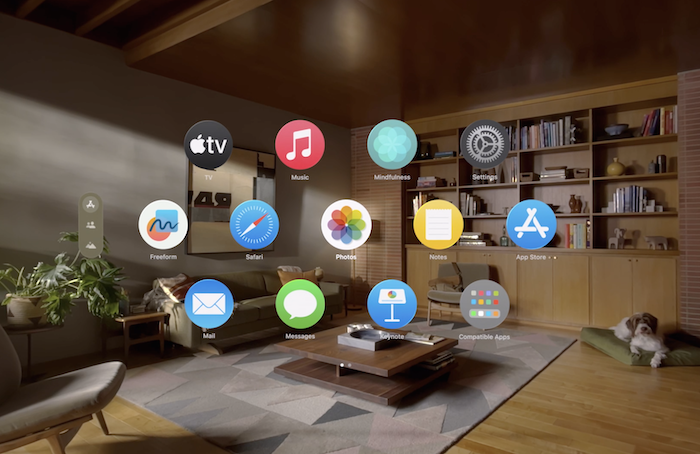
It has a controller-less input system that doesn’t require any extra hardware components. You can interact with UI and apps simply by using your vision, voice, and fingers. The headset responds to hand gestures without any lag. You can pinch your fingers to select an option or flick them up to scroll through a window.

VisionOS also supports Magic Keyboard and Magic Trackpad. It allows users to use the VisionPro headset with their Mac and get Mac’s display into Vision Pro wirelessly. They can now use Magic Keyboard and Magic Trackpad to work while seeing everything using the headset.

You can also make FaceTime calls using the headset. It will offer life-size videos ad Spatial Audio. Apple will display the digital Persona of the person wearing Vision Pro during a FaceTime call. Apple will use advanced machine learning techniques to reflect face and hand movements in real-time.
Apple has also introduced a newly designed App Store for discovering hundreds of new apps specially developed for the Vision Pro headset. VisionOS also provides native support for all iPad and iOS apps at launch.
VisionOS also supports gaming. You can connect your gaming controller and play over 100 Apple Arcade titles. It will surely provide an immersive gaming experience.
The most notable feature of VisionOS is Eyesight which makes users aware of their surroundings while wearing the headset. If someone approaches you, your headset will become transparent and the person will be visible in your headset visuals.

Apple has also introduced an all-new privacy and security feature dubbed Optic ID. It is an authentication system that uses your iris scan to provide access. Optical ID analyzes a user’s iris under various invisible LED light exposures and then compares the data with the enrolled Optic ID for authentication.
VisionOS also comes with Siri. You just need to say ‘Siri’ while wearing the headset and Siri will instantly respond.
VisionOS will be available with Apple Vision Pro headset that is sculled to be available in early 2024.