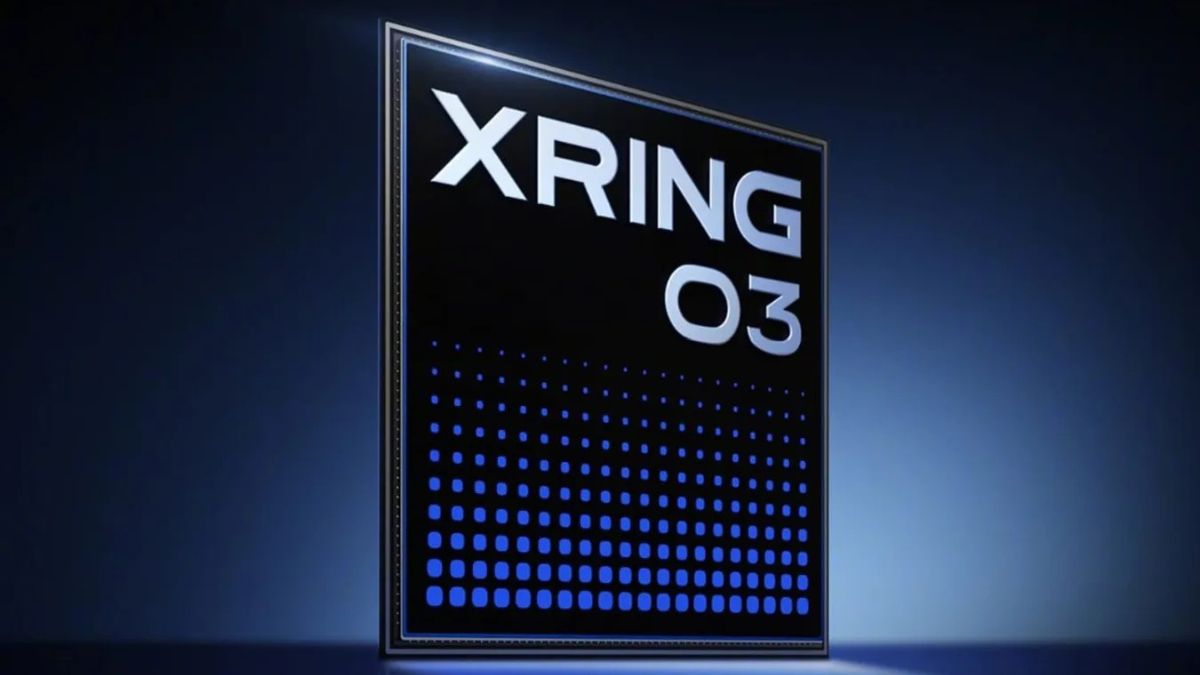

Xiaomi has unveiled the Xring O3, its second-generation flagship smartphone chip, as it continues to reduce its dependence on Qualcomm and MediaTek. The new processor brings a 10-core CPU, a new 16-core GPU, LPDDR6 memory support, and a 200 TOPS AI engine.
Xiaomi is also making a big performance claim. The company says the Xring O3 scored 5,228,014 points in AnTuTu V11, making it the first smartphone SoC to cross five million points. The result was produced in Xiaomi’s testing environment, so independent tests will be needed to determine how the chip performs in commercial devices.
The Xring O3 uses an all-big-core CPU instead of the usual mix of performance and efficiency cores found in most smartphone processors. It has two C1-Ultra cores running at up to 4.35GHz, four C1-Premium cores at up to 3.68GHz, and four C1-Pro cores reaching 3.15GHz.
Xiaomi claims Geekbench 6.5 scores of 3,945 in single-core and 15,221 in multi-core testing. That represents gains of 31% and 61% respectively over the Xring O1.
The chip is manufactured using TSMC’s 3nm process and contains more than 24 billion transistors on a 133mm² die.
The Xring O3 is also the first mobile SoC to support LPDDR6 memory. It can reach memory speeds of up to 10,667Mbps and offers up to 113.8GB/s of bandwidth. That matters because modern phones are moving more workloads onto the device itself. AI models, high-resolution graphics and advanced image processing all depend heavily on fast access to memory.
Xiaomi has also redesigned the AI hardware. The chip offers up to 200 TOPS of tensor performance and 3.13 TFLOPS of vector performance. Instead of putting all the AI workload on the NPU, Xiaomi says acceleration is spread across the CPU, GPU, ISP, DPU and ADSP.
The Xring O3 uses a 16-core G2-Ultra NX GPU. Xiaomi claims an 85% increase in graphics performance over the previous generation, along with a 64% improvement in power efficiency.
The GPU also includes dedicated hardware for AI-powered upscaling and frame generation. Xiaomi says a game can render internally at 540p and upscale the result to 1080p while using less power than native 1080p rendering. It can also generate additional frames to increase a 60fps output to 120fps.
These are useful features for mobile gaming, but their real impact will depend on how developers implement them and how well the chip maintains performance under sustained loads.
The Xring O3 is only one part of Xiaomi’s semiconductor push. The company has also introduced the Xring O100 for AI workloads and the Xring D100 for intelligent driving. Reuters reports that Xiaomi has invested more than 20 billion yuan, or about $3 billion, in chip development and has expanded its semiconductor team to more than 3,000 people.
This gives Xiaomi more control over how its hardware and software work together. It also reduces the company’s reliance on external chip suppliers and gives it more freedom to build features specifically for its own devices.
The O3 will debut in the Xiaomi 18 Fold and Xiaomi Pad 9 Pro Max, which are scheduled to launch in China in September.