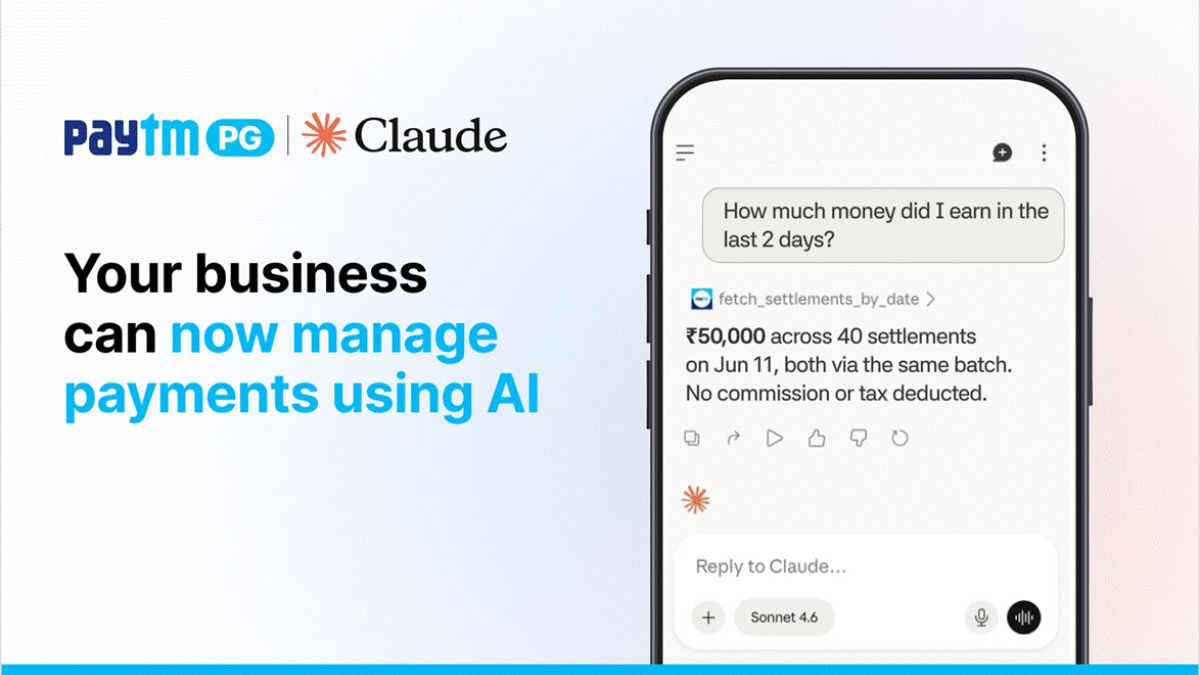

Paytm Payment Gateway has integrated with Anthropic’s Claude through the Model Context Protocol (MCP). This allows businesses to access payment information using natural-language prompts. The integration can be used to look up transactions, check refunds, review settlements and access reconciliation details without manually navigating through multiple payment dashboard pages.
The integration connects a merchant’s Paytm Payment Gateway account with Claude through an authorised MCP connector. Once connected, businesses can ask Claude for information related to their payment activity, such as the status of a transaction or refund, instead of searching for the same information through the payment dashboard.
Paytm says the connector can access information covering transactions, payment links, refunds, settlements, subscriptions, order status and reconciliation. This could be useful for different teams within a business. For example, a support team could check whether a customer’s payment or refund has been processed, while a finance team could use prompts to review settlement information or reconcile payments.
The bigger change is how businesses interact with payment data. Payment gateways have traditionally exposed this information through dashboards, downloadable reports and APIs. An MCP connection adds another layer on top of those systems, allowing an AI assistant such as Claude to retrieve relevant information based on what the user asks.
For developers, the integration could also make it easier to build AI-powered workflows around payment information without creating a separate interface for every use case. Instead of building a custom system to retrieve and present specific payment data, businesses can use Claude as the conversational layer while the underlying Paytm APIs continue to provide the information.
However, the integration is focused on accessing and understanding payment information rather than allowing Claude to freely control a merchant’s payment operations. Paytm says merchants retain control over access through authentication and permissions. Payment execution, refunds and settlement processes continue to be handled through Paytm’s existing infrastructure and merchant-controlled processes.
This distinction is important as businesses start connecting AI assistants to systems containing financial information. Giving an AI model access to business data is different from giving it unrestricted permission to perform financial actions. The MCP-based approach provides a standard way for Claude to communicate with Paytm’s APIs while keeping access authorised by the merchant.
The integration is being introduced for entrepreneurs, developers, business operations and finance teams, particularly those already using AI in their workflows. For smaller businesses, the immediate benefit could simply be faster access to payment information. Larger organisations could potentially use the connection as part of broader AI-based finance, customer support and reconciliation workflows.
Paytm Payment Gateway says the Claude integration is now available for businesses using its payment gateway, although the company has not provided details on any additional charges or limitations associated with using the MCP connector.
The move also shows a broader change in payment infrastructure and businesses. AI assistants are increasingly becoming an interface for business software, and payment systems are among the areas where conversational access can be useful because teams regularly need specific pieces of transactional information rather than a complete dashboard view.