

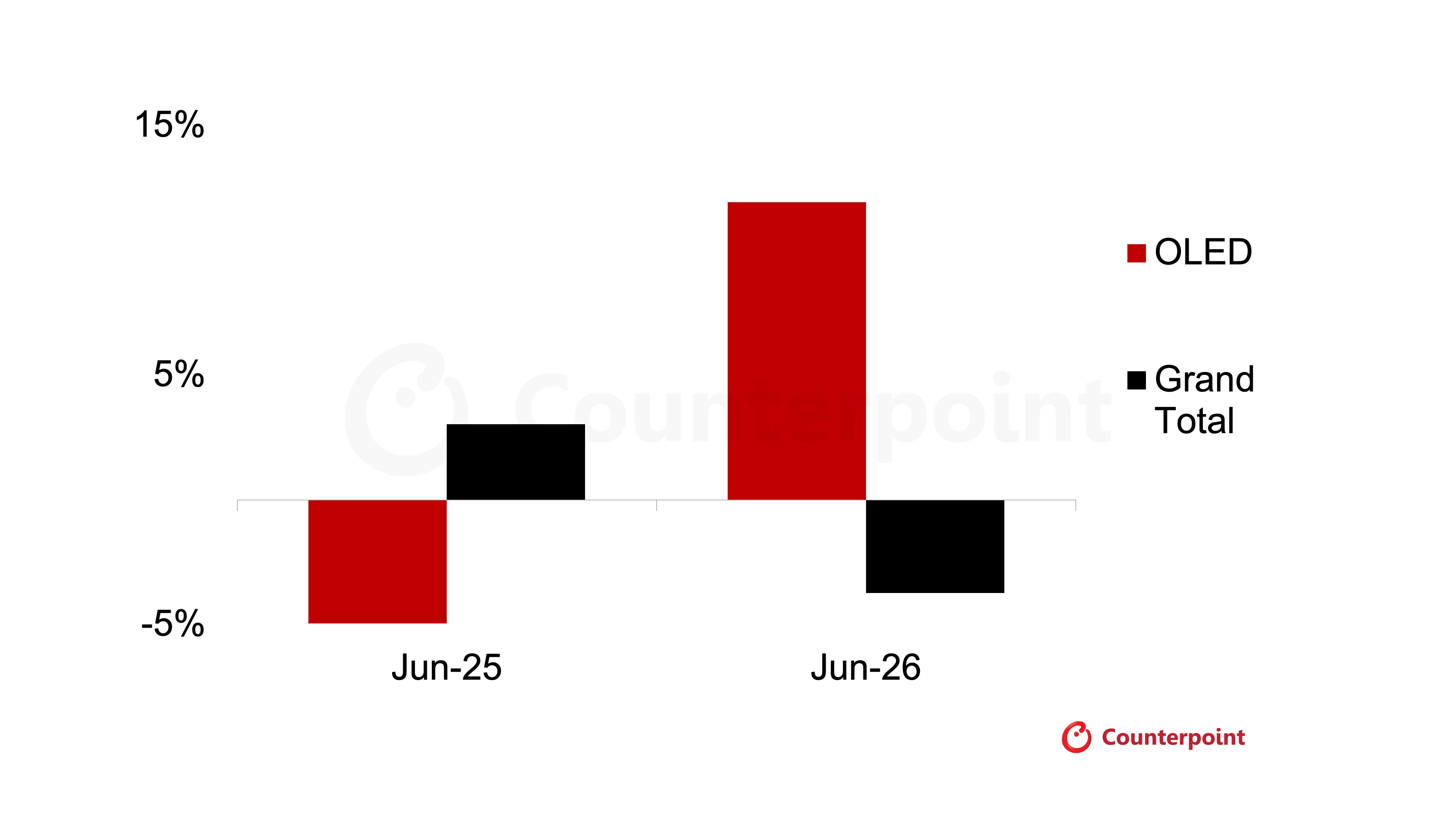
The global TV market had a weak second quarter of 2026, but OLED TVs continued to move in the opposite direction. Global TV shipments declined slightly in Q2, while OLED shipments grew 20% year over year, showing that consumers are still willing to spend on newer display technology even as the overall TV market struggles to grow.
According to Counterpoint Research’s latest Monthly Global TV Tracker, global TV shipments fell 4% year over year in June 2026. That brought the full second quarter to a 0.4% decline compared with the same period last year. The decline is small enough to describe the market as broadly flat, but it also shows how difficult it has become for TV makers to generate growth in a mature market.
The June decline may not be a sign of falling demand. Counterpoint says the 2026 World Cup pushed some TV purchases forward into April, as brands and retailers started promotions early to attract buyers ahead of the tournament. That likely reduced the number of TVs shipped later in the quarter. So, while June looked weak, the quarterly numbers suggest the market was more stable than the monthly decline might indicate.
The bigger story is what happened inside the market. While total TV shipments were almost unchanged, OLED TV shipments grew 20% during Q2. OLED shipments also increased 12% year over year in June. LG Electronics remained the clear leader, holding more than half of the global OLED TV market in both June and the full quarter.
That growth is important because OLED is facing stronger competition than it did a few years ago. MiniLED TVs have become much better and are now available across a wide range of prices. They can offer very high brightness, strong contrast and large screen sizes without reaching the price of many OLED models. For consumers who want a 75-inch or larger TV, a MiniLED model can sometimes offer better value than buying a smaller OLED TV at a similar price.
This has become one of the biggest challenges for OLED. The technology still has an advantage in areas such as perfect blacks and contrast, but consumers do not buy televisions based on picture quality alone. Screen size, brightness and price are equally important for many buyers. If a MiniLED TV gives someone a much larger screen for the same amount of money, OLED’s picture quality advantage may not be enough to win the sale.
This is why LG Display’s efforts to reduce the cost of WOLED panels could become more important than another improvement in OLED picture quality. LG Display is working on ways to make WOLED panels cheaper to produce. It has already introduced WOLED SE, which removes the polarizer from the panel design, and it is also developing a two-stack tandem structure that could simplify the panel while maintaining or improving its performance.
The goal is fairly simple. If LG Display can reduce panel production costs, TV manufacturers could eventually sell OLED TVs at lower prices. That would give OLED a better chance of moving beyond the premium segment and competing more directly with MiniLED TVs in the larger and more affordable parts of the market.
This could be a more important development for OLED than simply making existing premium TVs brighter. OLED already has a strong reputation among buyers who want high-end picture quality. The bigger opportunity is to make the technology affordable enough that consumers who normally consider a high-end LCD or MiniLED TV also start looking at OLED.
At the same time, Samsung and TCL are making the LCD market more competitive. The two companies are now almost tied in global LCD TV shipments. Samsung had a 13.7% share in June, while TCL reached 13.8%, leaving just a 0.1 percentage point difference between them.
Both companies are taking different approaches to premium LCD technology. Samsung is expanding its RGB backlight technology beyond its flagship models and is also pushing its newer MiniLED TVs into more price segments. TCL is using its SQD MiniLED technology at the top of its range while keeping RGB MiniLED focused on large premium TVs.
The close competition between Samsung and TCL shows how quickly the premium LCD market is changing. MiniLED is no longer just a cheaper alternative to OLED. TV makers are using better backlighting, improved local dimming and new color technologies to offer picture quality that can compete with OLED in several areas, while still keeping the advantage of larger screen sizes and, in many cases, lower prices.
For OLED, therefore, the next big battle may not be about becoming the best display technology. It already has a strong position at the high end. The bigger question is whether manufacturers can reduce its cost enough to make it a better value for mainstream buyers.
Counterpoint Research Research Director Bob O’Brien also points to this shift, noting that OLED has lost some ground in the super-premium segment to less expensive MiniLED TVs. The problem becomes even more obvious when consumers compare a larger MiniLED TV with a smaller OLED TV at a similar price.
If WOLED becomes significantly cheaper, that calculation could change. A buyer who previously chose a large MiniLED TV because OLED was too expensive may have a reason to consider OLED again. That could help OLED capture some of the customers it has lost to premium LCD TVs.
The overall TV market still has a long way to go before returning to strong growth. The Q2 numbers show that consumers are not suddenly buying more televisions just because newer display technologies are available. But the growth of OLED shows that there is still demand for premium display technology when the product offers a clear reason to upgrade.
The interesting part will be what happens when that technology becomes cheaper. OLED has spent years building its reputation as a premium display technology. If LG Display can successfully reduce WOLED production costs, the next stage could be about making OLED less premium in terms of price while keeping its advantages in picture quality.
That could make the competition between OLED and MiniLED much closer. And for consumers, that may be the most important change of all. Instead of choosing between a smaller OLED and a larger MiniLED at the same price, buyers could eventually get much larger OLED TVs without paying a huge premium.