

Perplexity has expanded its Comet browser to iOS and brought its AI-powered browsing experience to iPhone users. This shows that the company is no longer just building a search product. It is trying to change how people interact with the web. Comet is already available for desktop and Android. Initially, it was launched as a paid software, but the company later made it free for everyone.
The iOS version of Comet includes most of the features already available on desktop. Users get a mix of traditional search results and AI-generated answers through the Comet Assistant. There is also a voice mode, so users can ask questions instead of typing them. However, the mobile version does not support extensions yet, which may limit power users for now.
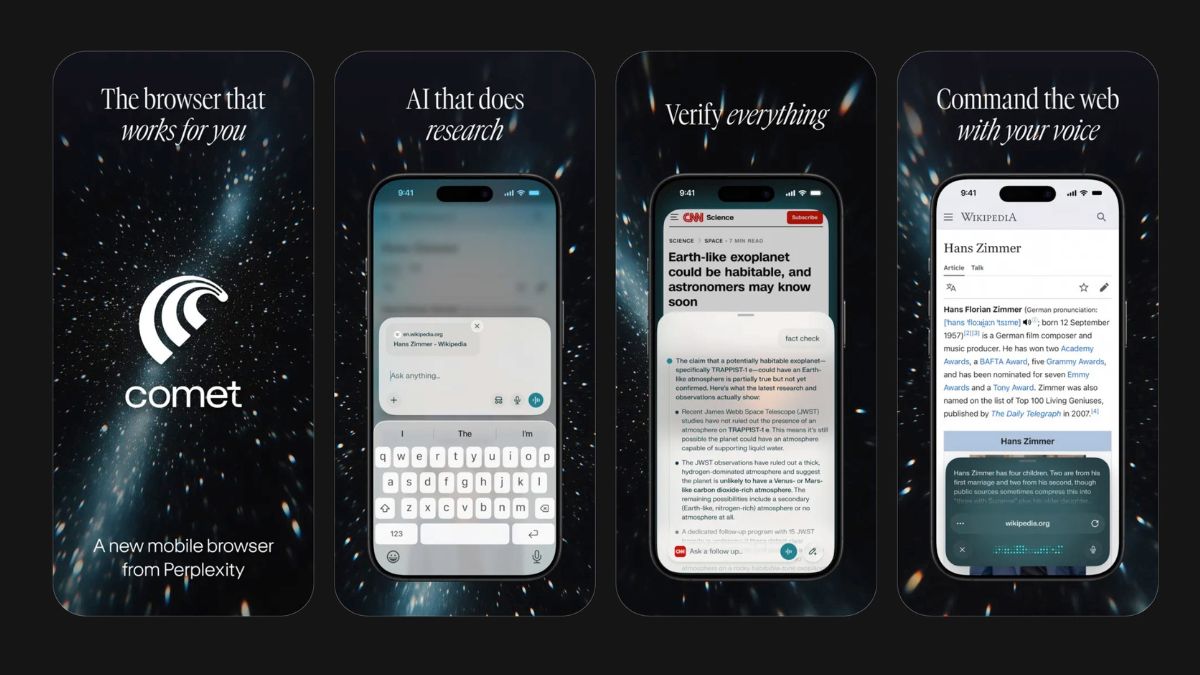
One of the key features is Deep Research. This feature pulls information from multiple sources and delivers quick summaries. It feels like a step beyond simple search. This is what most people expect from AI assistants today. Comet can also perform tasks like summarising emails, comparing product prices, and helping users navigate across websites without doing everything manually.
Perplexity has also made Comet more connected across devices. A search started on a desktop can continue on mobile. This kind of continuity is now a basic expectation from a browser.
This is also important for Perplexity in terms of business. Comet collects browsing and search data to build ad profiles. While the app is free on iOS, Perplexity offers paid plans starting at $20 per month. The hybrid model, where users can either pay or become part of the ad ecosystem.
People who don’t know about Comet, it is a web browser, but different from traditional browsers. It is an attempt to merge search, assistant, and task execution into one layer. Traditionally, browsers like Google Chrome or Safari act as gateways. You search, open links, and do things manually. Comet tries to remove those steps. Instead of giving you ten links, it tries to give you one structured answer. Instead of asking you to visit five sites to compare prices, it does the comparison itself. This saves time and effort.
When you look closely, Perplexity is not moving fast like some AI companies. It is very focused on what it wants to do. First, it built a strong AI search engine to compete with Google. Then it added Deep Research to improve answer quality. Now it is building its own browser to control the full experience. This is important. Companies like Google and Microsoft dominate the web because they control both search and the platform around it. Google has Chrome. Microsoft has Edge and Windows integration.
Perplexity seems to be following the same playbook, but from a smaller starting point. Instead of trying to beat them everywhere, it is building a tightly integrated experience where search, AI, and browsing work together.
I think the strategy makes sense. Perplexity is targeting a real problem of users. Web search today is cluttered, and giving direct answers would be helpful.
At the same time, Perplexity has a big problem to solve. Convincing users to switch browsers is very hard. People are deeply tied to Chrome or Safari, depending on what devices they use. Even if Comet is better, habits do not change easily.
Data also confirm how difficult this is. Browsers remain one of the most concentrated markets in tech. Google Chrome alone controls close to 69% of global usage, while Safari holds around 16%, and Microsoft Edge stays in the low single digits. Even on mobile, Chrome and Safari together dominate the majority of traffic. This leaves very little room for new entrants. Edge was the first to integrate AI features in the browser, but Chrome followed the same. And market share is still almost the same.
Accuracy is another big problem to solve. We have seen many times how AI hallucinates. Many times, AI-generated answers are not correct. If users rely too much on summaries, they may miss important details or context.
As a web publisher, we also feature such AI tools that are trying to pull readers away from our websites to their AI chatbots. These AI tools scrape our content and summarise it for their users. Our content is still being accessed, but we aren’t getting anything in return. We are losing traffic and revenue. It has become very hard to survive.
Read: AI Is Killing Publisher Traffic — And It Could Kill Content Itself
That’s the reason I try to request all readers to keep supporting publishers who try their best to provide quality content. Without them, even AI tools won’t have helpful content to summarise.