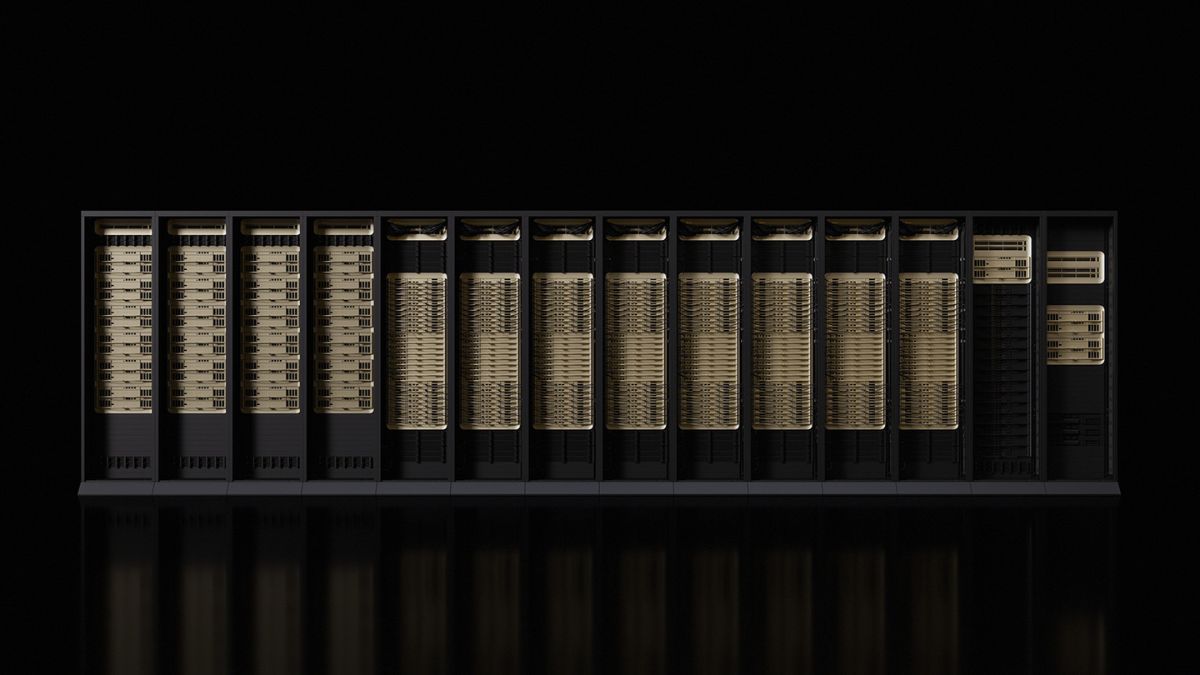

Nvidia has introduced its new Rubin architecture at CES 2026. This is the company’s next major platform for AI computing and is now in full production. Nvidia CEO Jensen Huang described Rubin as a system built for the growing demand of modern AI, where models need more power, more memory, and faster data access than ever before.
Huang said the need for compute power has increased at a rapid pace. He explained that Rubin was created to handle this shift and to keep up with the scale required for new AI models. This new platform will start reaching partners and cloud services in the second half of the year.
Rubin was first confirmed in 2024 and is named after astronomer Vera Rubin. It now follows Nvidia’s long line of architectures, replacing Blackwell, which replaced Hopper and Lovelace before it. With this launch, Nvidia continues its cycle of upgrading hardware every year and strengthening its position as the most valuable tech company.
Nvidia has already secured wide industry support. Almost all major cloud companies will use Rubin chips, including AWS, OpenAI, and Anthropic. Rubin-powered systems will also appear in the HPE Blue Lion supercomputer and the Doudna system planned for Lawrence Berkeley National Laboratory.
It includes six chips that work together to manage GPU performance, storage, and data movement. The Rubin GPU is the core, but Nvidia has also updated NVLink for faster interconnects and BlueField for improved data handling. A new Vera CPU is part of the setup and is designed to support advanced agent-style reasoning tasks, which are becoming common in new AI models.
Nvidia says one of the biggest challenges today is handling the memory load of large AI systems. The company has added a new external storage tier that connects smoothly with compute units. This approach helps manage the key-value cache needed for long tasks, multi-step reasoning, and other advanced AI workflows.
Nvidia claims Rubin is around three and a half times faster than Blackwell for training and up to five times faster for inference. It can reach around 50 petaflops, and it is more power efficient, offering up to eight times more inference compute per watt.
The launch comes at a time when the entire industry is racing to secure AI hardware. Demand for GPUs continues to exceed supply, and companies across the world are investing in new data centers and power infrastructure. Huang has previously said that trillions will be spent on AI facilities over the next few years.
With Rubin, Nvidia is preparing for that future and offering partners a platform built for the next generation of AI.