


DeepSeek R1 is trending all over the internet and it is being called a strong challenger to established models like OpenAI’s GPT-4o. DeepSeekWith an advanced mixture-of-experts (MoE) architecture, DeepSeek R1 claims to deliver top-tier performance in reasoning, coding, mathematics, and multilingual understanding. So, I decided to write a detailed article about it, so you know all the information at once place. Here’s an in-depth look at why DeepSeek R1 is trending, its benchmarks, and why it’s seen as a potential threat to OpenAI.
What is DeepSeek R1
DeeoSeek R1 is an AL model, developed by DeepSeek, a Chinese AI company. It is open-source in nature and has exceptional reasoning capabilities. It uses a Mixture-of-Experts (MoE) architecture with 671 billion parameters, but only 37 billion stay active at once. This selection helps it cut down computing needs. It selectively activates a subset of experts for each query to ensure high efficiency and accuracy without excessive computational costs.
DeepSeek R1 has demonstrated superior performance in tasks requiring complex logical reasoning. Its reasoning capabilities surpass many existing models, including GPT-4o. This makes it particularly valuable for scientific research, data analysis, and problem-solving in critical domains like healthcare, finance, and academia.
DeepSeek R1 embraces an open-source philosophy. So, it becomes even more valuable for developers, researchers, and organizations. DeepSeek R1 focuses on explainability. It offers insights into how it arrives at its conclusions. So, you get a clear idea of the details it provides.
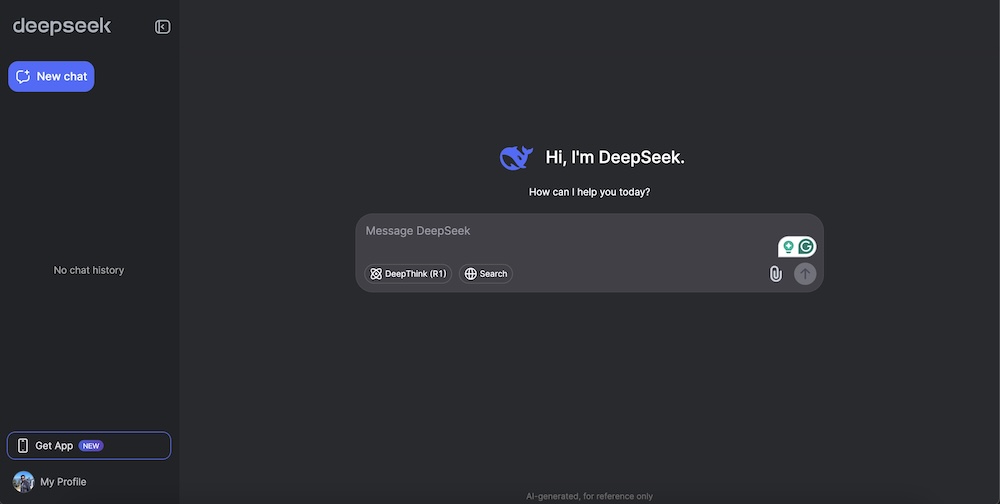
It also released a free AI-powered chatbot that looks similar to ChatGPT. You can use it for most of the same tasks you use ChatGPT.
Who is behind DeepSeek?
DeepSeek is a Chinese AI company founded by Liang Wenfeng in December 2023. Liang graduated from Zhejiang University and has degrees in electronic information engineering and computer science.
Benchmark results
DeepSeek R1 has achieved remarkable results across various benchmarks. Here are the key benchmark results for DeepSeek-V3 compared to other AI models like DeepSeek V2.5, Qwen2-72B, Llama3-405B, Claude-3 Sonnet, and GPT-4o:
English Language Tasks:
- MMLU: 88.5, outperforming DeepSeek V2.5 (80.6) and Qwen2-72B (85.3), but slightly behind GPT-4o (87.2).
- DROP (3-shot F1): 91.6, the highest score compared to all models, including GPT-4o (83.7).
- HumanEval-Pass@1 (code tasks): 82.6, leading all other open-source models, though GPT-4o scores 80.5.
- Frames (Accuracy): 73.3, behind GPT-4o (80.5).
Coding Tasks:
- Codeforces (Percentile): 51.6, significantly ahead of DeepSeek V2.5 (35.6) and GPT-4o (23.6).
- LiveCodeBench-Pass@1: 37.6, leading over DeepSeek V2.5 (28.4) but below GPT-4o (34.2).
- Aider-Edit (Accuracy): 79.7, outperforming GPT-4o (72.9) and DeepSeek V2.5 (71.6).
Mathematical Reasoning:
- MATH-500 (EM): 90.2, outperforming GPT-4o (74.6) and Llama3 (78.3).
- AIME 2024 (Pass@1): 39.2, highest among open-source models but behind GPT-4o (9.3).
- CNMO 2024 (Pass@1): 43.2, significantly ahead of GPT-4o (10.8).
Pricing
DeepSeek R1 is generally more affordable than GPT-4o. It is an open-source model. So, DeepSeek R1 can be run locally or on cloud platforms.
If you want to use commercial API for DeepSeek R1, the costs per query are typically lower than GPT-4o. OpenAI’s o1 charges $15 per million input tokens and $60 per million output tokens. DeepSeek R1 offers lower prices at $0.55 per million input tokens and $2.19 per million output tokens
How to Access DeepSeek R1
Web Interface
If you want to access the web interface, you can visit the official DeepSeek website: https://chat.deepseek.com/
You need to register with your email, Google account, or phone number. Then you can interact with the model directly through the web interface in the same way you do with Chat GPT.
You Local Installation with Ollama
You can download and install Ollama, a platform for running large language models locally Use Ollama to download and run specific DeepSeek R1 models on your system.
Mobile App:
DeepSeek R1 apps are also available on the Apple App Store or Google Play Store. Download these apps to access it directly on your mobile device.
How DeepSeek R1 Lowers Server Costs
DeepSeek R1 has been developed with a focus on efficiency. It requires fewer resources and computing power compared to many other large language models (LLMs). The model uses reinforcement learning techniques that allow it to learn from interactions and improve its performance over time. This approach has made it more data-efficient than traditional supervised learning methods. DeepSeek has optimized its training process to minimize resource consumption. The process includes techniques like efficient data parallelism and careful selection of hyperparameters.
As I already aid, it selectively activates only 37 billion parameters out of its total 671 billion. It lowers GPU/TPU usage and takes less processing time per request. It also has lower RAM and storage demands.
Businesses and developers, who run AI models on cloud servers, can find it really cost-effective. Running a dense model with hundreds of billions of parameters requires expensive GPU clusters, but DeepSeek R1 delivers comparable performance while consuming far fewer resources
Wrap Up
DeepSeek R1 has shown us that open-source AI can also compete with, and even surpass, proprietary models in key areas. Its open-source nature and efficiency have made it an excellent choice for developers, researchers, and businesses.
DeepSeek R1 is now challenging OpenAI’s dominance. It has better reasoning capabilities. offers explainability, and is open-source in nature. So, it is an attractive alternative for developers and organizations. So, it will be interesting to see how OpenAI manages to retain its dominance.