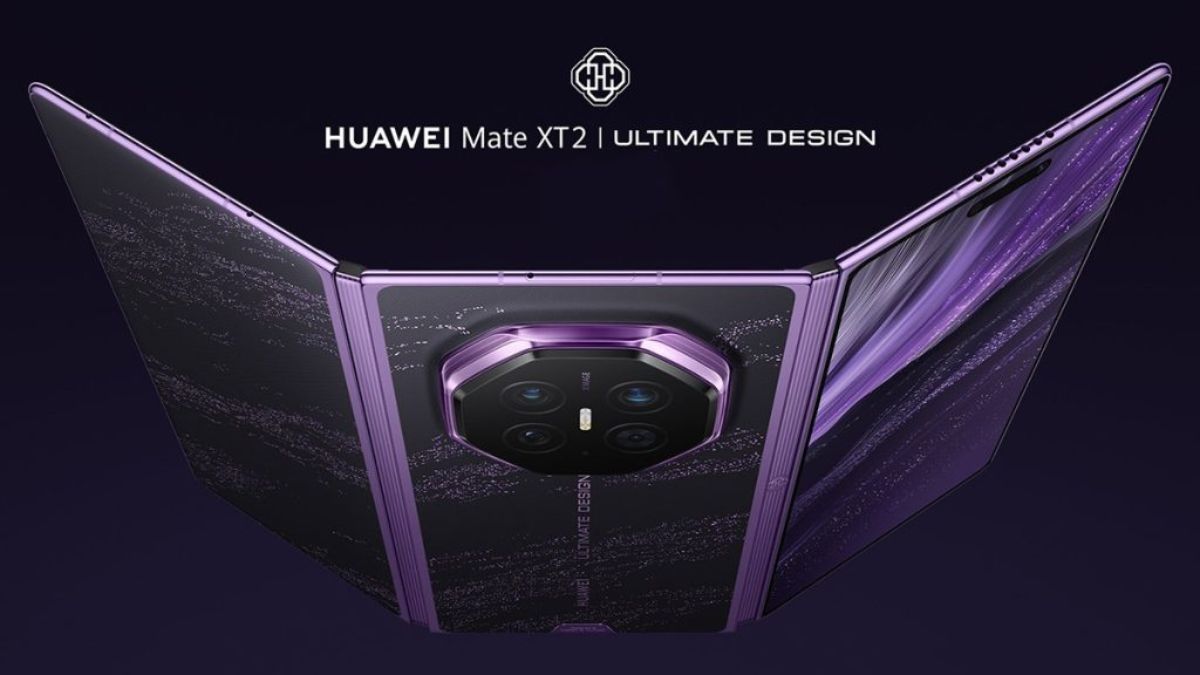

Huawei has launched the Mate XT 2 Ultimate Design in China, its latest tri-fold smartphone and the successor to the Mate XT. The new model keeps the unusual three-panel design but adds a faster processor, improved cameras, satellite communication, stronger protection and software designed to make better use of its large unfolded display.
The Mate XT 2 is built around a new G-shaped hinge system. It measures 12.3mm when folded and can become as thin as 3.5mm when fully unfolded. Users can open it in different configurations to use one, two or all three screen sections. Huawei has also added hardware-level privacy features that can limit screen visibility from the sides, which could be useful when using the large display in public places.
When fully opened, the phone offers a 10.2-inch OLED display with a 2232 × 3184 resolution and a 1-90Hz refresh rate. The external screen is a 6.5-inch OLED panel with a 2442 × 1140 resolution and a 1-120Hz refresh rate. The outer display can reach up to 6,500 nits of peak brightness. Both displays also support 1440Hz high-frequency PWM dimming.
Huawei has focused heavily on durability this time. The Mate XT 2 comes with IP58 and IP59 ratings for dust and water resistance. The outer screen uses basalt glass, which Huawei says offers 30 times greater drop resistance and 16 times greater scratch resistance compared with its previous solution. The inner display also uses a multi-layer impact-resistant structure.
The Mate XT 2 is powered by Huawei’s new Kirin 9050 Pro processor. The company claims that CPU performance is up 42% compared with the previous Mate XTs, with single-core performance improving by 24% and multi-core performance by 52%.
Graphics performance also gets a significant upgrade. The new Ma Liang GPU supports real-time ray tracing, and Huawei claims a 142% improvement in rendering performance. The phone uses a cross-axis graphene VC cooling system along with multiple thermal interface materials. Huawei says the setup can reduce peak gaming temperatures by 2.5°C.
The device comes with 16GB of RAM and up to 2TB of storage, giving the top-end version more storage than many laptops. Huawei is also using a new Da Vinci-based NPU for on-device AI tasks, including a 30-billion-parameter multimodal Mixture-of-Experts model with 2 billion active parameters.
The Mate XT 2 gets a quad-camera system on the rear. Its main camera uses a 50-megapixel RYYB sensor with a 1/1.28-inch size, optical image stabilisation and a variable aperture that can move between f/1.49 and f/4.0. Huawei claims the camera can deliver up to 18 stops of dynamic range.
The main camera is joined by a 50-megapixel RYYB periscope telephoto camera with 3.5x optical zoom, OIS and telephoto macro support. There is also a 40-megapixel RYYB ultra-wide camera and a 1.5-megapixel multispectral colour sensor. Huawei says its third-generation Red Maple colour technology improves colour reproduction by 95%.
The phone also has an 8-megapixel front camera on both the external and internal sides. Huawei has added several AI-based camera features, including pose recommendations, real-time previews and a dedicated calendar shooting mode.
The large foldable display is not just for watching videos or browsing the web. Huawei has optimised HarmonyOS 7 for multitasking, allowing users to run up to three apps side by side. The software also supports split-screen charting and a desktop-class PC application environment.
The phone supports the M-Pen 3 stylus, which makes the 10.2-inch display more useful for writing, drawing and other productivity tasks. Huawei is essentially trying to make the tri-fold form factor work as a portable tablet while keeping the device usable as a regular smartphone when folded.
The privacy version takes this further with Huawei’s Lingdun hardware-level privacy technology. The system uses dual-pixel masking to direct visible light forward and reduce what people viewing the screen from an angle can see.
Connectivity includes 5G, Wi-Fi 6, Bluetooth 6.0, NFC and USB 3.1 Gen 1 through the USB Type-C port. The phone also supports Tiantong satellite communication, satellite paging and two-way BeiDou satellite messaging. It supports dual SIM connectivity and a wide range of satellite and navigation systems, including NavIC.
Huawei has also included ECG analysis, which it says has been certified as a Class II medical device by China’s National Medical Products Administration.
Huawei has also packed the Mate XT 2 with a 5,600mAh battery, which supports 66W wired charging and 50W wireless charging. Despite the large battery and three-panel design, the phone weighs 299 grams.
Huawei Mate XT 2 price
The Huawei Mate XT 2 Ultimate Design is now available to order in China and will go on sale on September 7. The base 16GB RAM and 256GB storage model costs 19,999 yuan, which is around ₹2.81 lakh based on the provided conversion.
The 16GB + 512GB version costs 21,999 yuan, while the 1TB version is priced at 23,999 yuan. The 1TB model with the privacy screen costs 24,999 yuan. The top-end 16GB + 2TB Special Edition with the M-Pen 3 stylus costs 29,999 yuan, or around ₹4.22 lakh.
Huawei is also selling the M-Pen 3 Mini Stylus Set for 1,199 yuan and a Mobile Imaging Kit for 1,499 yuan.
At these prices, the Mate XT 2 is clearly not aimed at mainstream smartphone buyers. Huawei is targeting users who are willing to pay a premium for a device that can move between smartphone and tablet formats without carrying two separate devices.