
Google’s Pixel 11 series has plenty of visible upgrades. There are new camera features, more Gemini capabilities and features such as Magic Capture and HiLight on the Pro models.
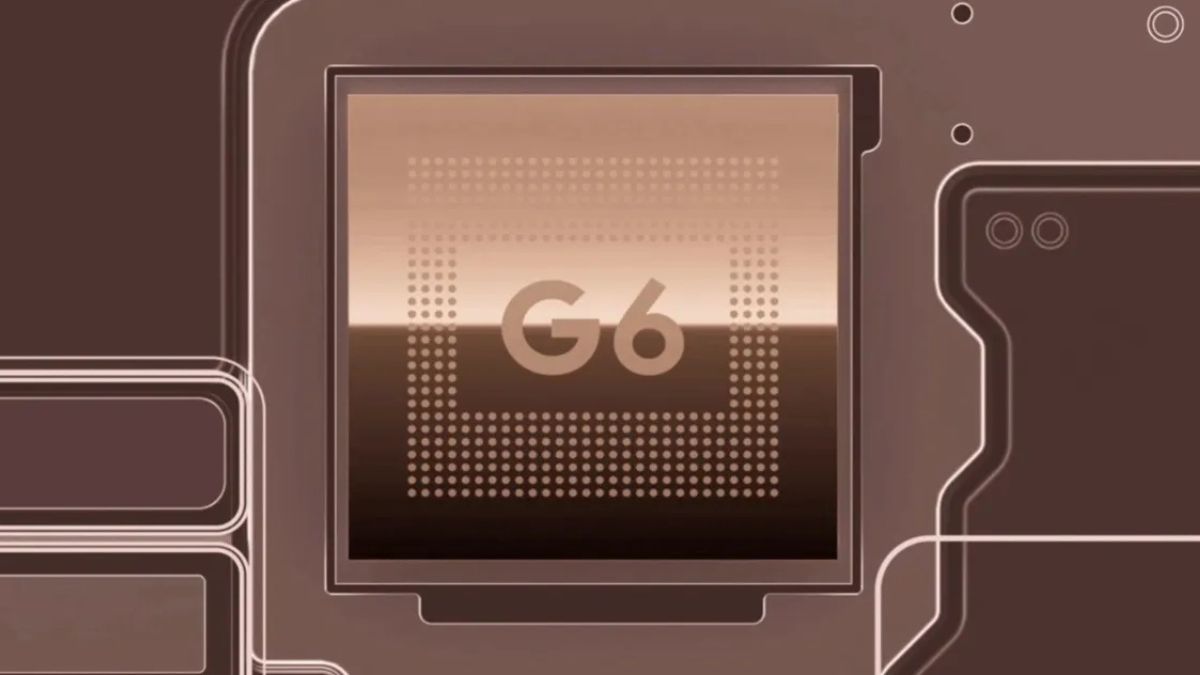
But one of the most important changes is something most users will never see. All four Pixel 11 models are powered by Google’s new Tensor G6 chip.
Google has never treated Tensor as just another smartphone processor. Since its introduction with the Pixel 6, the chip has been designed around Google’s own priorities, particularly AI, photography, security and the way its hardware and software work together.
Tensor G6 continues that approach. It brings a more powerful AI processor, better CPU power efficiency and new security hardware. More importantly, several of the Pixel 11’s new features depend on it.
CPU
The chip uses a new seven-core CPU architecture based on Arm’s C1 family. It features a single Arm C1-Ultra core clocked at 4.11GHz, four C1-Pro cores at 3.38GHz and two more C1-Pro cores at 2.65GHz. Now, the Tensor G6 has the same CPU cores as MediaTek’s top-of-the-line Dimensity 9500 chip and Samsung’s Exynos 2600 processor.
These are the same Arm C1 CPU families used by some of the biggest competing chips of this generation. MediaTek’s Dimensity 9500, for example, also uses a C1-Ultra core, but combines it with three C1-Premium cores and four C1-Pro cores. Samsung’s Exynos 2600 also uses Arm’s new C1 architecture.
Google’s choice is therefore quite deliberate. It is not simply using the same CPU design as everyone else. It is configuring the new Arm architecture differently.
The move to TSMC’s 2nm process is important because the manufacturing process affects both performance and efficiency. Google says Tensor G6 delivers up to 20% better CPU power efficiency than Tensor G5. The company also claims that Pixel 11 can deliver up to 25% faster web browsing and up to 15% faster app launches.
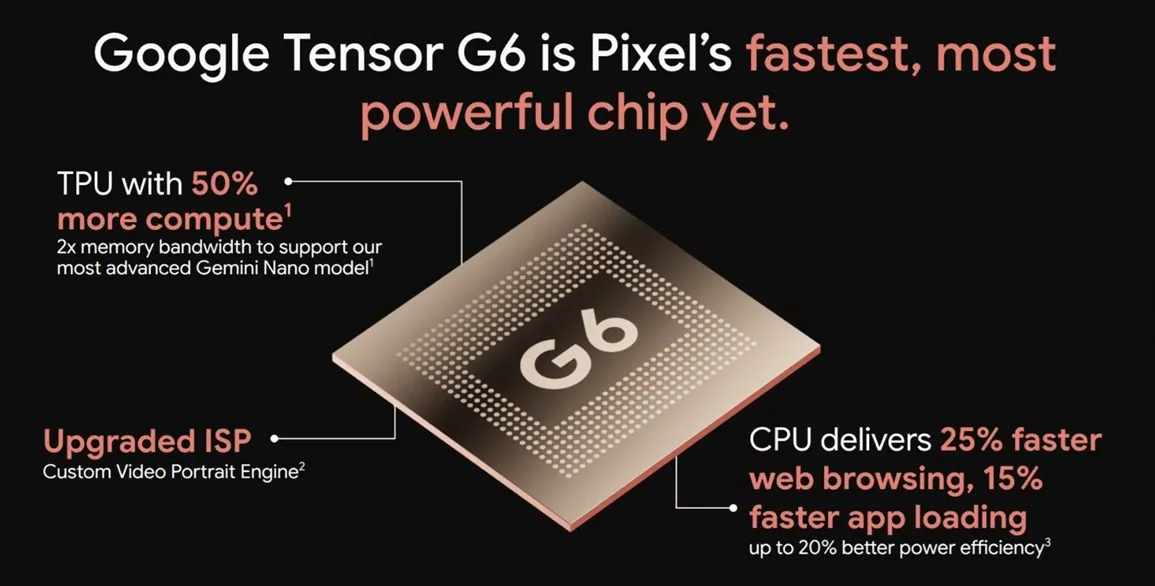
These are Google’s own performance claims, so they should not be treated as independent benchmark results. But they show that Google is not using the 2nm process simply to increase peak clock speeds.
TPU
Google also says the Tensor G6 TPU has 50% more computing power than the TPU in Tensor G5. That matters because Pixel’s newest features are increasingly dependent on AI processing.
Gemini can perform more work directly on the phone. Live Translate for Media uses on-device processing. The camera uses AI for more than traditional image enhancement. Magic Capture can record video and then identify the moments that are worth turning into photos.
These are not workloads where having another CPU core necessarily solves the problem.
Google wants dedicated hardware that can process AI models efficiently, and that is where Tensor’s TPU becomes important.
Google says some local AI workloads on Tensor G6 can run up to 3.5 times faster while using up to 3.5 times less energy than the previous generation.
GPU
Google is using an Imagination PowerVR C-Series CXTP-48-1536 GPU. The specification is unusual because Tensor G5 already used a PowerVR DXT-48-1536 GPU. The new GPU does, however, bring an important capability that Tensor G5 lacked: hardware ray tracing support.
The CXT-48-1536 configuration includes three ray acceleration clusters and supports hardware ray tracing.
That does not automatically make Tensor G6 a powerful gaming chip.
In fact, the GPU remains the biggest concern with the processor. Tensor G5 was already far behind competing flagship chips in graphics performance, and the new GPU does not appear designed to challenge the best gaming-focused mobile GPUs.
This matters because the Pixel 11 is still a flagship phone. Users will expect it to handle demanding games and graphics-heavy applications.
Tensor G6 should handle normal gaming without a problem, but demanding games remain an area where competing flagship phones are likely to have an advantage.
Modem
Tensor G6 uses MediaTek’s M90 5G modem instead of the Samsung modem used with previous Tensor generations. The M90 supports peak download speeds of up to 12Gbps. MediaTek also claims up to 18% lower power consumption compared with its previous modem generation.
The modem has a direct effect on cellular performance and power consumption, particularly when the phone is using 5G heavily. A more efficient modem could therefore help Google improve battery life during mobile data use.
ISP
The processor’s image signal processor has also been upgraded. Tensor G6 includes a new custom Video Portrait Engine that enables new camera processing capabilities, including 4K Portrait Video.
This fits Google’s wider strategy with Tensor. The company does not treat the processor as something that simply runs Android. It uses dedicated hardware to determine what the camera can do. The Pixel 11’s camera features rely heavily on this approach.
Night Sight processing is faster, while the Pro models use Tensor G6 for more advanced zoom and computational photography features.
Magic Capture is an even better example. The feature can record a video and then use AI to identify the best moments and save them as photos.
That kind of feature depends on the phone being able to analyse a continuous stream of images and run AI models without making the process excessively slow or power hungry.
Security and memory
Tensor G6 is paired with Google’s Titan M3 security chip and supports LPDDR5X memory and UFS 4.0 storage. These are not headline-grabbing changes, but they keep the Pixel 11 platform in line with other current flagship phones.
Titan M3 provides the dedicated hardware layer Google uses for device security, while the faster memory and storage standards help with general system performance and application loading.
Google is also introducing new security capabilities with the Pixel 11 generation, including post-quantum cryptography.
Tensor G6 is built around the Pixel experience
Tensor G6 is more interesting when you look at the whole chip rather than just the CPU. Google wants Gemini to perform more work on the device. It wants the camera to analyse more information in real time. It wants AI features to work without constantly relying on the cloud. It wants these features to run without destroying battery life.
Those goals require a different kind of processor. Tensor G6 is therefore less interesting as a traditional flagship SoC and more interesting as Google’s attempt to build a processor around its own definition of a modern smartphone.
The biggest improvement in Tensor G6 is not one particular specification.
It is the fact that almost every major part of the chip has moved in the same direction. The CPU is newer and more efficient. The manufacturing process is smaller. The TPU is considerably more powerful. The ISP is built for more advanced camera processing. The modem has changed. The GPU gains ray tracing. Security has its own new hardware.
Google isn’t chasing benchmark numbers, but wants to make the Pixel better at the things Google thinks matter most.