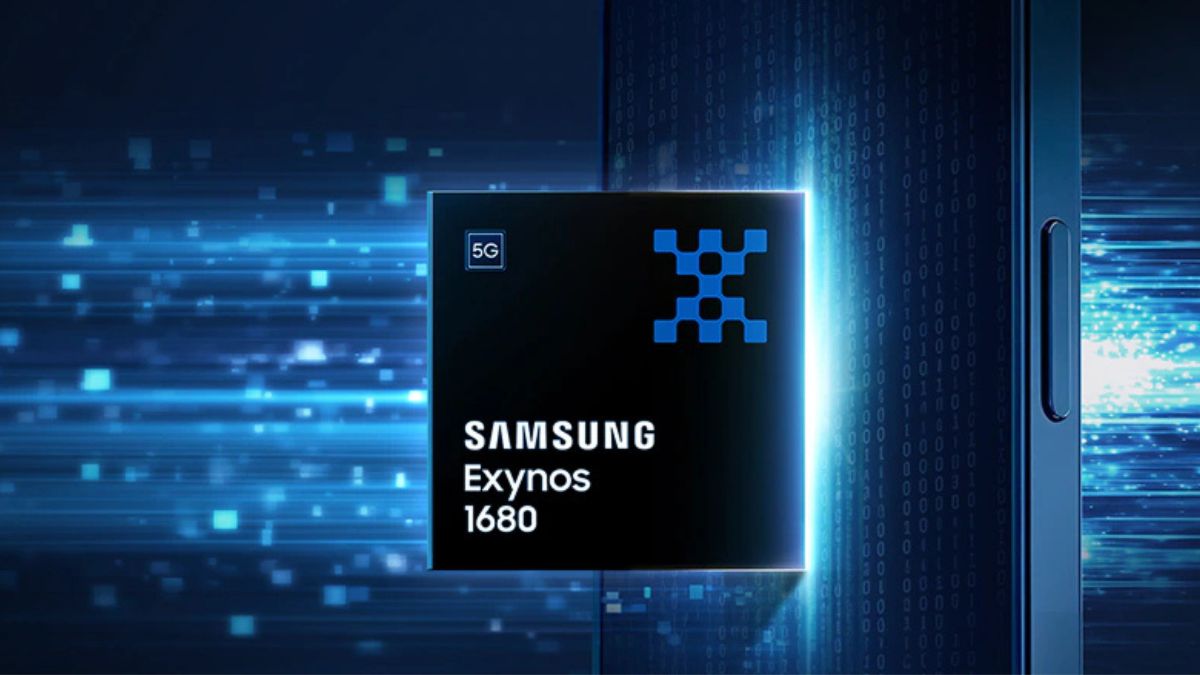

Samsung has officially announced the Exynos 1680. This new processor is expected to power upcoming mid-range phones like the Galaxy A57 5G.
The chipset is built on a 4nm process and brings improvements in performance, graphics, and AI capabilities. Samsung has also confirmed that the chip is already in mass production.
The Exynos 1680 comes with a tri-cluster octa-core CPU design. It includes one Cortex-A720 core clocked at 2.9GHz, four Cortex-A720 cores at 2.6GHz, and three Cortex-A520 cores at 1.95GHz. Samsung has made a small but important change here by replacing one efficiency core with a mid-core. This should help improve overall performance without a big impact on power consumption.
The chipset uses the Xclipse 550 GPU based on AMD RDNA 3 architecture. Samsung claims up to 16 percent better GPU performance compared to the previous generation. This should result in smoother gaming and better visuals.
The chipset supports LPDDR5X RAM and UFS 4.1 storage. It can also handle Full HD+ displays with up to 144Hz refresh rate, which means smoother scrolling and a better gaming experience.
AI is another area where Samsung has made improvements. The Exynos 1680 comes with an upgraded NPU that can deliver up to 19.6 TOPS. This allows the device to handle tasks like image processing, live translation, and other AI features directly on the phone.
Camera support is also quite strong. The chipset can handle up to a 200-megapixel camera sensor. It also supports a 64-megapixel sensor at 30fps and dual 32-megapixel camera setups. For video, it supports 4K recording and playback at 60fps along with common codecs like HEVC and H.264. Samsung has also included AI-based image processing and better noise reduction for improved low-light photography.
Exynos 1680 supports Wi-Fi 6E, Bluetooth 6.1, and GNSS. It also supports both sub-6GHz and mmWave 5G networks, with peak download speeds going above 5Gbps. LTE support is also present with decent speeds.
Exynos 1680 Specifications
| Feature | Details |
|---|---|
| Process | 4nm |
| CPU | Octa-core (1x Cortex-A720 @ 2.9GHz + 4x Cortex-A720 @ 2.6GHz + 3x Cortex-A520 @ 1.95GHz) |
| Architecture | Tri-cluster design |
| GPU | Xclipse 550 (AMD RDNA 3) |
| GPU Improvement | Up to 16% better performance |
| AI / NPU | Up to 19.6 TOPS |
| RAM Support | LPDDR5X |
| Storage Support | UFS 4.1 |
| Display Support | Full HD+ up to 144Hz |
| Camera Support | Up to 200MP single camera |
| Other Camera Support | 64MP @ 30fps, Dual 32MP |
| Video | 4K recording and playback at 60fps |
| Codecs | HEVC, H.264, VP9, VP8 |
| Connectivity | Wi-Fi 6E, Bluetooth 6.1, GNSS |
| 5G | Sub-6GHz and mmWave |
| 5G Speed | Up to 5.1Gbps (sub-6), 4.84Gbps (mmWave) |
| LTE | Cat.18 (Up to 1.2Gbps download) |
The Exynos 1680 looks like a solid upgrade for mid-range phones. With better CPU performance, improved graphics, and stronger AI, it should deliver a smoother overall experience.