
NVIDIA has revealed the next version of its Deep Learning Super Sampling technology during the keynote at NVIDIA GTC 2026. The company is calling the new version DLSS 5 and claims it could represent a major change in how graphics are rendered in modern games.
DLSS has already become an important technology in PC gaming. It uses AI models to upscale frames and improve performance without heavily impacting visual quality. With DLSS 5, Nvidia now wants to move beyond simple upscaling and introduce what it calls neural rendering.
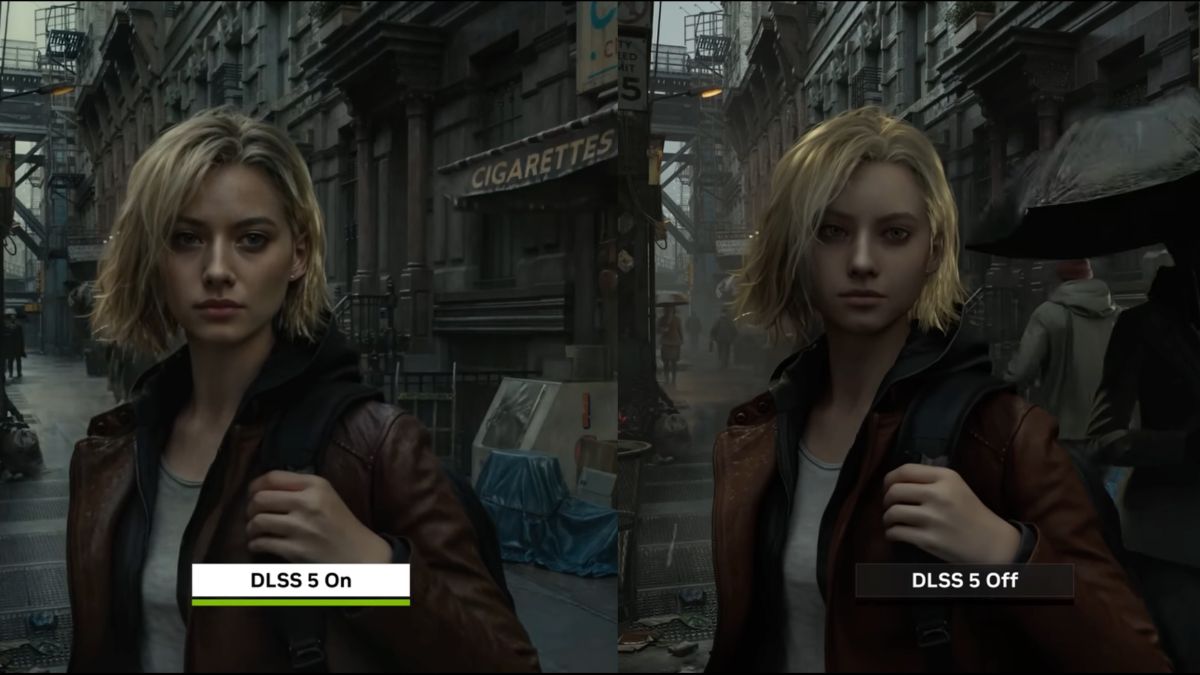
According to the company, the new model can generate photorealistic lighting and material details in real time. Instead of relying only on traditional rendering techniques, the system analyzes color and motion data from each frame and then reconstructs visual details using AI.
During the presentation, Nvidia CEO Jensen Huang described this shift as the “GPT moment for graphics.” The comparison highlights how generative AI could start playing a larger role in building the final image seen on screen.
The company says the model is trained to understand complex scene elements such as characters, hair, fabric, and skin. It also studies environmental lighting conditions like front lighting, back lighting, and cloudy environments. Using this understanding, the AI can recreate subtle details such as how light interacts with skin, cloth textures, or reflective surfaces.
Nvidia says DLSS 5 will support gameplay at up to 4K resolution. However, the company did not reveal performance benchmarks or frame rate gains yet. Those numbers will likely be shared closer to the final release.
Several large game publishers have already announced support for the technology. These include Bethesda Softworks, Capcom, NetEase, Ubisoft, Tencent, and Warner Bros. Games. Upcoming or existing titles such as Assassin’s Creed Shadows, Hogwarts Legacy, Delta Force, Resident Evil Requiem, and Starfield are expected to support DLSS 5.
One interesting detail from the demo is the hardware used to run it. NVIDIA confirmed that the demonstration required two GeForce RTX 5090 graphics cards. One GPU rendered the game while the second GPU handled the DLSS 5 AI model. NVIDIA says the final consumer version will run on a single GPU, though it has not confirmed which graphics cards will support it.