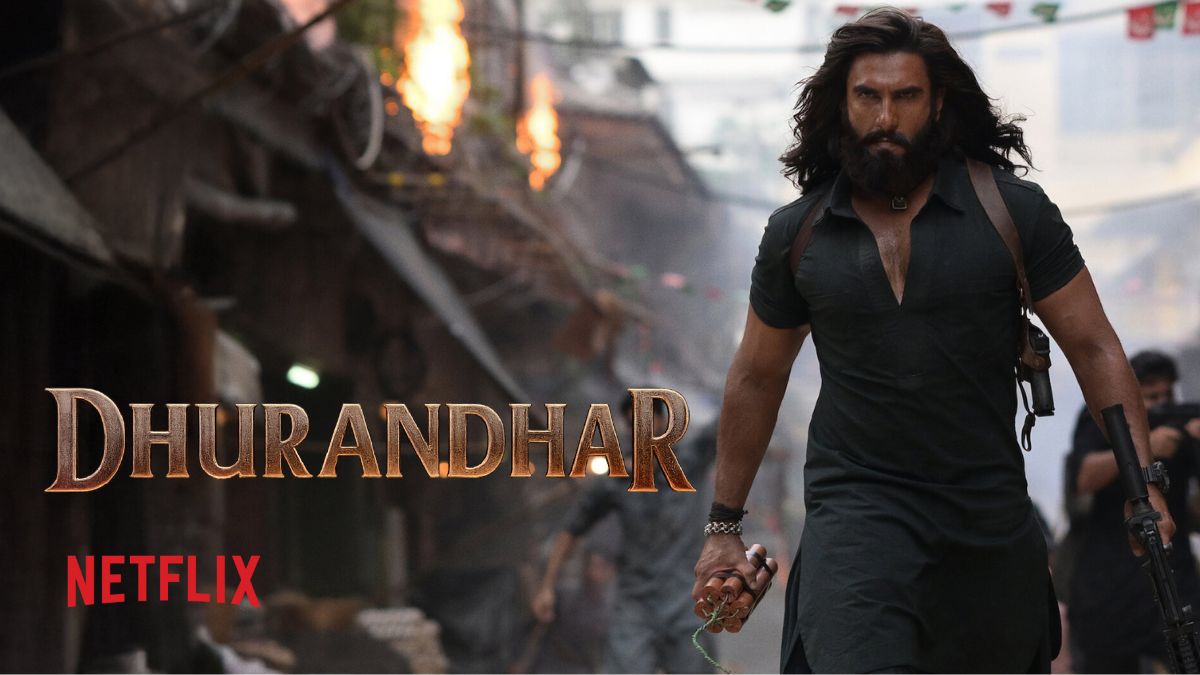

When Dhurandhar released in theatres, it looked stunning with rich colors. Action scenes felt sharp, and the overall image had depth. When the same movie arrived on Netflix, many viewers felt something was wrong. The movie looked faded, flat, and lifeless. This is not just a feeling. There are real technical and business reasons behind it.
Before I explain all technical things, you should understand that Netflix did not really “ruin” Dhurandhar. The primary responsibility sits with the makers. But you need to read the complete article to understand it.
The biggest reason is the bitrate. In cinemas, movies are played using something called a Digital Cinema Package. These files are massive. The bitrate can go up to 250 Mbps or even higher. This means a lot of data is sent every second, so the image keeps fine details, strong colors, and clean motion.
Netflix works very differently. It has to stream movies to millions of people over the internet. To make this possible, it compresses the video heavily. For 4K movies, Netflix usually streams between 8 to 12 Mbps. In the early release of Dhurandhar, the bitrate dropped as low as 1.79 Mbps in some versions. That is extremely low for a high-action movie. When the bitrate is low, the video encoder starts cutting corners. Colors get merged together. Shadows lose detail. Fast action scenes look muddy. This is why many people described the Netflix version as washed out.
Netflix later updated the file with a higher bitrate. That fixed the sharpness to some extent, but the original cinema look could not fully come back. This also comes down to the codec. Netflix uses advanced codecs like HEVC and AV1. These codecs are very efficient. They try to give better quality at lower bitrates. But even the best codec has limits. When bitrate is too low, the codec still has to remove detail. In action-heavy films like Dhurandhar, this becomes very noticeable, especially in dark scenes and color-rich shots.
Cinemas use the DCI-P3 color space. This color space is wider than what most TVs normally use. It allows deeper reds, richer greens, and better contrast. The movie was graded specifically for this environment.
Most TVs use Rec.709 for SDR content and HDR standards like HDR10 or Dolby Vision for HDR content. These standards need proper metadata. Metadata tells the TV how bright a scene should be and how colors should behave. The problem with Dhurandhar on Netflix is that it appears to have been delivered either as an SDR master or a poorly optimised HDR master. In simple words, it was not properly regraded for home HDR viewing. When an SDR file plays on an HDR TV, the TV tries to stretch brightness and colors on its own. Without Dolby Vision or HDR10+ metadata, this stretching often makes colors look pale instead of vibrant.
This is why even good HDR TVs could not fix the issue.
Another important factor is re-editing and post-processing for Netflix release. The Netflix version of Dhurandhar has cuts and muted dialogues. Every time a movie is edited and re-exported, it goes through another compression cycle. During this process, platforms often apply noise reduction to make the image look clean for streaming. Noise reduction removes film grain. Film grain is not noise in a bad sense. It gives the image depth and texture. When grain is removed, the image looks smooth but flat. This makes the movie feel more like a digital video than a cinematic film.
But when you watch Netflix Originals, you don’t experience the same. The reason is control. For Netflix Originals, Netflix controls the entire pipeline. From camera requirements to color grading to final encoding, everything is done to Netflix standards. These movies are mastered in native Dolby Vision with correct metadata. They are optimized specifically for streaming and home TVs.
For licensed films like Dhurandhar, Netflix is just a distributor. The studio provides a file. Netflix cannot magically improve it. If the studio sends a broadcast-safe or SDR master, Netflix has to stream that version. Even if Netflix was involved in production, the theatrical master and OTT master can still be different. Many films are graded mainly for cinemas first. The OTT version becomes a secondary priority.
Their top priority was always the theatrical release of the second part. By the time the first film reached Netflix, the creative and technical teams were already focused on finishing the sequel for cinemas. Spending additional time and effort on re-grading, re-mastering, and fine-tuning the first part specifically for Netflix was simply not a priority.
Creating a proper OTT master is not a small task. It requires a separate color grade for home screens, HDR metadata work, multiple test passes on different TVs, and strict quality checks. All of this takes time, money, and attention from the same people who are needed to deliver the theatrical version of Part 2 on schedule.
From the maker’s point of view, the first part had already done its job in theatres. The real business value now depended on building anticipation for the sequel. As long as the Netflix version was watchable and met platform requirements, pushing it to cinematic perfection on OTT did not add much return.
This approach also fits a cinema-first mindset. The makers wanted the best version of the story to be experienced in theatres, not on a streaming screen.
There is also a business side to this.
Higher bitrate streaming costs more money. It uses more server space and more bandwidth. Netflix serves millions of users at the same time. Streaming everything at cinema-level quality is simply not practical at scale. Netflix focuses on efficiency so that playback works smoothly on different internet speeds and devices. This is also why Netflix often looks softer compared to physical media like 4K Blu-ray.
There is another reason why movies in theaters feel different than the same movie on TV. A cinema projector throws light onto a large screen. The light is reflected, which creates a softer and more natural image. A TV emits light directly into your eyes. This makes contrast feel harsher and colors feel less natural, especially in bright rooms. Because of this physical difference alone, home viewing can never perfectly match a cinema experience.
And at the end, it could also be a part of a strategy. Dhurandhar is a franchise film where the 2nd part is coming in March. The success of the 2nd part depends on the number of people returning to theatres. If the first film’s OTT version feels visually underwhelming, viewers may feel that Netflix is not enough for the experience, and that the movie works better in theatres. But I don’t think this was the reason.
If we see all scenarios, I think the reason is Cost and effort.
When you combine low bitrate, heavy compression, poor HDR grading, re-encoding, noise reduction, limited studio control, business decisions, and display physics, you can understand why Dhurandhar doesn’t feel the same on Netflix.
So yes, protecting the cinema experience is possible. But in this case, the issue appears to be driven mainly by technical and production priorities, not intention.