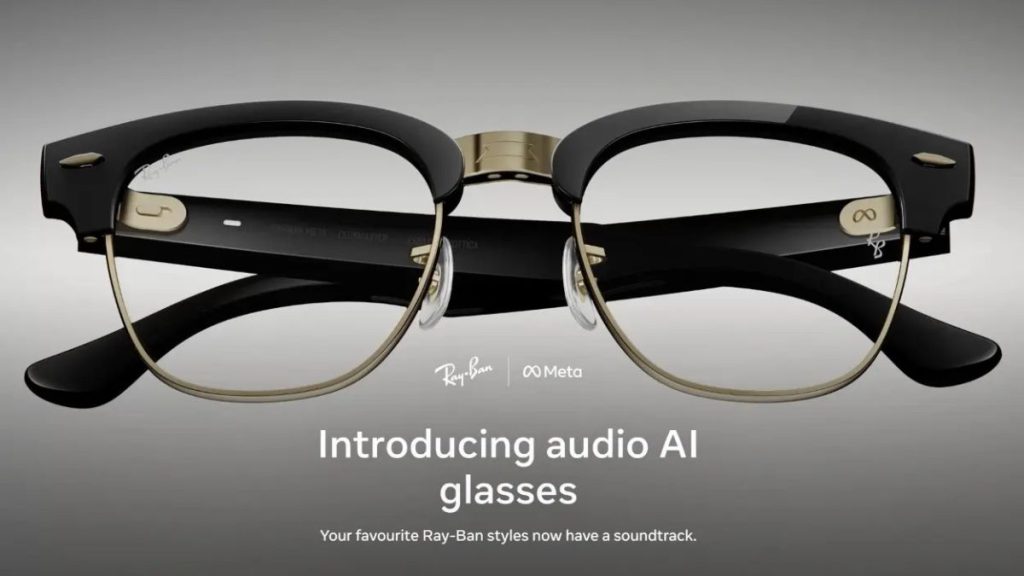
Meta has introduced a new version of its Ray-Ban smart glasses that takes a very different approach from the company’s existing models. The new Ray-Ban Meta Audio glasses do not have a camera. Instead, Meta is focusing on audio, calls and AI, creating a simpler version of its smart glasses that could appeal to people who are interested in the technology but are not comfortable wearing a camera on their face.
The lack of a camera is also what makes these glasses interesting. Meta’s existing Ray-Ban Meta glasses can capture photos and videos and use the camera for AI features, but that capability also creates privacy concerns. A camera-free design removes that problem and makes the glasses less intrusive in situations where recording devices may be uncomfortable or inappropriate.
The glasses weigh 43 grams and offer up to 12 hours of battery life, with the charging case providing another 48 hours. Meta has also made the fit more adjustable, with adjustable temple tips, nose pads, and hinges. They will be available in Clubmaster and Burbank designs, with 23 combinations and prescription options.
Meta is positioning the glasses around audio and AI rather than photography. They can be used for listening to audio, making calls, and interacting with Meta’s AI features without requiring a phone to be constantly pulled out. This makes them closer to a pair of connected audio glasses, while still offering some of the benefits of an AI wearable.
The approach could help Meta reach a different audience. Not everyone interested in AI glasses necessarily wants a camera, and removing it also gives Meta a way to make the product feel more socially acceptable in everyday situations. It could also be an important distinction as smart glasses become more common, since privacy is likely to remain one of the biggest concerns around camera-equipped wearables.
There is also a clear difference in pricing. Ray-Ban Meta Audio starts at $349, while the new camera-equipped Gen 3 Ray-Ban Meta costs $449. That gives Meta two distinct options: a cheaper camera-free model for people who primarily want audio and AI, and a more capable model for users who also want photography and video features.
The bigger question is whether AI alone is enough to make people wear smart glasses throughout the day. Without a camera, Meta cannot rely on visual AI features to make the glasses more useful, so the quality and usefulness of its voice and audio-based AI experience will become even more important.
Ray-Ban Meta Audio will be available from October 13.
Related Posts