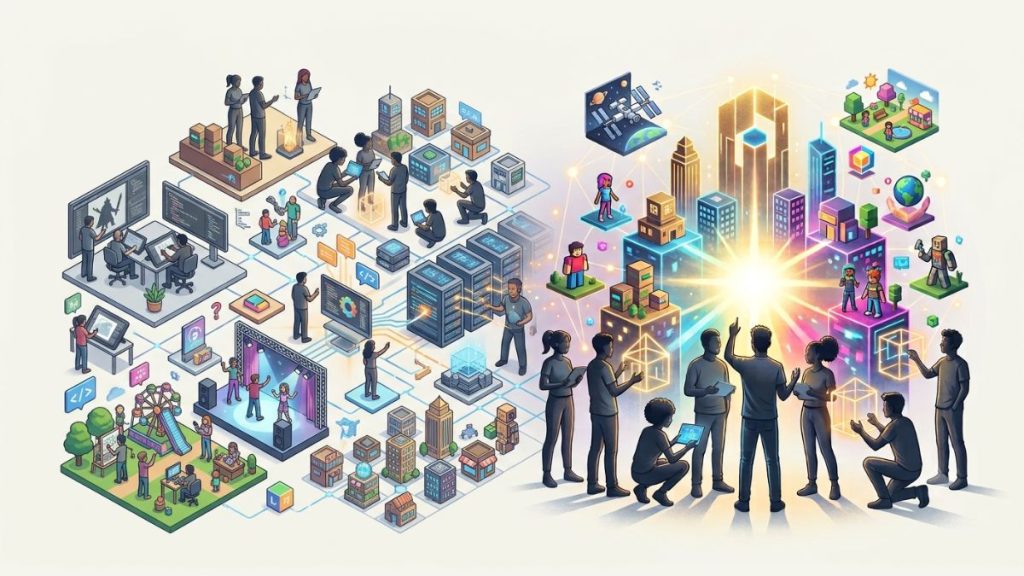
For decades, the gaming industry had a simple relationship between companies and players. Developers created games, publishers distributed them, and players consumed them. It was a model that not only worked but also built one of the world’s largest entertainment industries.
But the next phase of gaming may not be defined by the studios that build the biggest games. It may be defined by the companies that build the infrastructure where millions of creators can build games, communities, and even businesses of their own. That distinction could fundamentally change how the gaming industry creates value over the next decade.
Roblox, Fortnite, and Minecraft are quietly moving toward this future. They are no longer just games. They are becoming digital ecosystems where users create experiences, build communities, run businesses, and participate in economies. The companies behind them are no longer competing only for gaming time. They are competing to become the foundation of the next creator economy.
Gaming is shifting from products to platforms
The traditional gaming business has always resembled Hollywood. A studio spends years developing a game, invests heavily in marketing, launches it globally, and hopes it becomes a commercial success. Even after launch, publishers continue supporting the title with downloadable content and updates, but the product itself remains largely created by professionals.
That approach has produced some of the biggest entertainment franchises in history. However, it has also become increasingly expensive and risky.
Modern AAA games often require development teams spread across multiple studios, production cycles lasting several years, and budgets that rival blockbuster films. A single unsuccessful release can significantly impact a publisher’s financial performance. At the same time, player expectations continue to rise while competition for attention grows stronger every year.
This pressure is forcing the industry to rethink a question that would have sounded unusual a decade ago.
What if the most valuable gaming company is not the one that creates the most successful games, but the one that enables millions of other people to create them? That is the philosophy behind Roblox, Fortnite, and Minecraft.
In all three cases, the game itself is no longer the only product. The real product is the platform. It provides development tools, distribution, payments, infrastructure, social features, and increasingly, monetization opportunities. Creators contribute the experiences, while players continuously generate engagement.
The same transformation has already happened across several technology industries.
YouTube became the world’s largest video platform not because Google produced videos, but because it built an ecosystem where anyone could publish content and reach an audience.
Apple’s App Store became one of the most valuable software marketplaces because millions of developers built applications and businesses on top of Apple’s platform, while Apple focused on providing infrastructure, distribution, payments, and trust.
Amazon’s Marketplace grew by enabling third-party sellers to reach customers at global scale. Uber connects drivers with passengers without owning a fleet of vehicles, while Airbnb built a hospitality platform without building hotels.
The pattern is remarkably similar in many successful companies. The companies that create the most value are often the ones that build the ecosystem rather than produce every product within it.
Gaming is beginning to follow the same path.
Roblox has turned game development into a creator economy
Among today’s gaming platforms, Roblox represents the clearest example of this transformation.
Although it is commonly described as a gaming platform, that description no longer captures its full role. Roblox increasingly resembles a creation platform where users build interactive experiences instead of simply consuming them.
At the center of this ecosystem is Roblox Studio, the company’s game development environment. Unlike traditional game engines, creators do not need to worry about building backend infrastructure, payment systems, multiplayer networking, hosting, or distribution. Roblox provides the underlying platform while creators focus on developing experiences.
This fundamentally changes the economics of game development. Independent developers no longer need publishing deals or large marketing budgets before launching a project. Instead, they get immediate access to an existing ecosystem with millions of users already looking for new experiences.
Roblox recently surpassed 100 million daily active users. This number is enough to show the scale of its platform. More importantly, the company has built a creator economy where developers can monetize their experiences through virtual goods, premium purchases, and engagement-based revenue. According to Roblox, creators earned $923 million on the platform in 2024. Creator payouts officially crossed the $1 billion milestone in 2025, with average annual earnings for the top 1,000 developers reaching $1.3 million. Those numbers would have been difficult to imagine for independent game creators just a few years ago.
Roblox is also investing heavily in artificial intelligence to reduce the barriers to creation even further. AI-powered assistants, code generation, texture creation, and 3D asset generation are gradually becoming part of Roblox Studio. The long-term objective appears straightforward: allow more people to build games without requiring years of technical expertise.
The company’s biggest competitive advantage, however, is not AI. It is the network effect.
Every new creator adds more content to the platform. More content attracts more players. More players create larger opportunities for creators, encouraging even more people to build on Roblox. Once that flywheel reaches sufficient scale, it becomes increasingly difficult for competitors to replicate.
Epic Games is taking a different route with Fortnite
Epic Games shares a similar vision, but its strategy is significantly different. Fortnite began as a battle royale phenomenon, yet Epic’s long-term ambition extends well beyond a single game. The company wants Fortnite to become a platform where creators publish experiences built using professional-grade development tools.
That ambition became much clearer with the launch of Unreal Editor for Fortnite (UEFN). Rather than simplifying game development, Epic is bringing Unreal Engine’s capabilities into the Fortnite ecosystem. UEFN allows creators to design complex worlds, build custom gameplay systems, and create experiences that go far beyond traditional Fortnite matches.
Epic reinforced this strategy through Creator Economy 2.0, which rewards eligible creators based on player engagement instead of simply selling user-generated content. The model encourages developers to keep players engaged rather than focusing solely on in-game purchases.
This approach is noticeably different from Roblox. Roblox prioritizes accessibility, which makes game creation easier for anyone willing to learn its tools.
Epic is attempting to lower the barrier for professional-quality development while preserving the power of Unreal Engine. In other words, Roblox wants to expand the number of creators, while Epic appears focused on raising the quality of creator-built experiences.
However, both strategies lead toward the same destination.
They transform the platform into a marketplace where creativity, rather than first-party content, becomes the primary growth engine.
Minecraft proved creativity can outlast content
Long before the creator economy became a popular business term, Minecraft had already demonstrated its potential.
When Microsoft acquired Mojang in 2014, Minecraft was already much more than a sandbox game. Players were building adventure maps, custom servers, modifications, educational experiences, and entire online communities. The community continuously expanded the game far beyond what its original developers could have produced alone.
That is one of the main reasons Minecraft continues attracting players after more than a decade.
Traditional games depend on developers to release new content. Minecraft depends on its community. Every custom world, multiplayer server, educational project, or Marketplace creation gives players another reason to return. Creativity itself becomes the content pipeline. In many ways, Minecraft proved that unlimited creativity generates far longer engagement than unlimited developer-produced content.
AI could accelerate this shift much faster than expected
Artificial intelligence is also making this transition even more significant. The obvious impact is that AI lowers the barriers to creating games. Tasks that previously required programming knowledge, artistic skills, animation expertise, or scripting experience are gradually becoming easier with AI-assisted development tools.
However, the larger impact may be economic rather than technical. As AI reduces the cost and time required to create assets, dialogue, environments, animations, and even gameplay systems, content becomes increasingly abundant. When content becomes abundant, creating it is no longer the primary competitive advantage, but distribution is.
If thousands, or eventually millions, of people can build interactive experiences with AI assistance, then the companies controlling discovery, recommendation systems, and creator ecosystems become even more valuable. In other words, AI could increase the importance of platforms rather than reduce it.
That is a subtle but important shift.
The biggest beneficiaries of AI may not necessarily be individual creators. They could be the companies that own the platforms where AI-generated content is discovered and monetized.
Discovery is becoming the next battleground
This creates another challenge that extends well beyond gaming. Every major creator platform eventually reaches a point where creation becomes easier than discovery.
YouTube has millions of creators competing for attention. The same goes for app stores, which contain millions of applications. Streaming platforms host enormous libraries of content. Gaming platforms are heading in the same direction.
As creator ecosystems expand and AI accelerates content production, discovering quality experiences will become increasingly difficult. Recommendation systems will therefore become much more than convenience features.
They will become economic infrastructure.
Algorithms will increasingly determine which creators receive visibility, which experiences attract players, and ultimately where revenue flows across the ecosystem.
The next competitive battle may not be over who builds the best creation tools. It may be over who builds the smartest discovery engine.
Platform businesses also create new risks
The rise of creator platforms also introduces an important trade-off. Creators gain access to powerful infrastructure, built-in audiences, payment systems, and monetization opportunities. But in return, they become dependent on platforms they do not control.
- Revenue-sharing models can change.
- Platform policies can change.
- Recommendation algorithms can change.
History has already shown this pattern across YouTube, Facebook, TikTok, and Apple’s App Store. Platform owners create enormous opportunities for independent businesses, but they also control the rules that govern those businesses.
Gaming creator platforms are unlikely to be any different. As more developers choose to build entirely within Roblox, Fortnite, or future creator ecosystems, the relationship between platform owners and creators will become one of the industry’s most important debates.
The future of gaming may belong to platform builders
Looking at today’s gaming industry purely through the lens of traditional game publishing misses the larger transformation already taking place. Roblox, Fortnite, and Minecraft are not simply competing to release better games. They are competing to become the operating systems of the creator economy.
Each platform is pursuing that vision differently. Roblox is building an accessible creator-first ecosystem. Epic Games is combining professional development tools with a massive consumer platform. Minecraft continues proving that community creativity can sustain engagement for years.
The next decade of gaming may therefore be less about blockbuster titles and more about platforms that enable millions of creators to continuously build new experiences.
The biggest gaming companies of the future may not be remembered for making the best games. They may be remembered for building the platforms where everyone else made them.
Related Posts