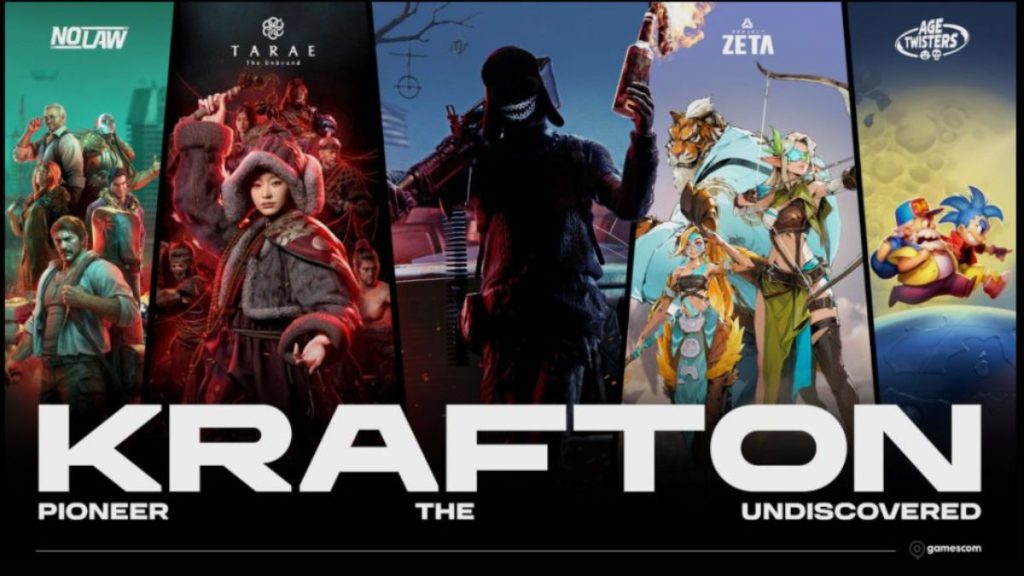
KRAFTON is making it clear that its future is not going to depend on PUBG alone. At Gamescom 2026, the company used its third consecutive KRAFTON Media Day to show five upcoming games that cover very different genres, from an open-world shooter RPG to a two-player adventure and a roguelite take on the PUBG formula.
The lineup includes NO LAW, Project ZETA, Age Twisters, TARAE: The Unbound, and PUBG: DED.NET. More importantly, KRAFTON is not simply building more games around the same formula. The five projects come from different studios and are aimed at different audiences, which gives a clearer picture of how the publisher wants to grow beyond its biggest franchise.
This is part of a strategy KRAFTON has been building for some time. The company previously said it had 13 games in development across several areas, with a focus on finding new franchise opportunities and even creating new genres. It has also been investing in external development teams and acquiring publishing rights to promising games.
The gamescom lineup shows what that strategy looks like in practice.
NO LAW
Developed by Neon Giant, the studio behind The Ascent, NO LAW is probably the most traditional-looking game in the new lineup, but its approach to the open world is what makes it interesting. The game is set in Port Desire, a dense cyber-noir city where players can approach situations in different ways. It is an open-world first-person shooter RPG, but KRAFTON is putting a strong emphasis on player choice rather than simply giving players a large map filled with activities.
The official game site describes Port Desire as a city of vice and violence where players can use stealth, direct combat or tactical approaches. Choices are intended to affect how situations unfold instead of simply producing different dialogue options.
Neon Giant is also taking a different approach to open-world design. Rather than chasing the biggest possible map, the studio is focusing on density and verticality. Buildings, rooftops and the spaces between them are designed to give players multiple ways to move through the city. The game is being developed with Unreal Engine 5 and is currently planned for PC, PlayStation 5 and Xbox Series X|S in 2027.
That makes NO LAW feel less like another giant open-world checklist and more like an attempt to build a city where the environment itself is part of the gameplay.
Project ZETA
Project ZETA takes a different route. Developed by Nirvanana, it is a third-person multiplayer game that KRAFTON calls a “Multi-team Tactical Arena” rather than a MOBA or hero shooter.
The biggest difference is the match structure. Four teams of three players compete on the same map, rather than two large teams fighting across traditional lanes. Matches are built around objectives and direct encounters between squads.
The game has already gone through community testing, and KRAFTON has been using player feedback as part of its development process. Its Steam listing currently describes it as a four-team tactical hero arena, while KRAFTON has said that global Early Access is targeted for late 2026.
That open-development approach is important because competitive multiplayer games are difficult to get right. KRAFTON is not simply launching another hero-based multiplayer title and hoping it finds an audience. The company is testing the core structure with players before committing to the final version.
Age Twisters
Age Twisters is perhaps the biggest departure from what people normally associate with KRAFTON.
Developed by Barcelona-based Piccolo Studio, the game follows a grandfather and his granddaughter as they investigate the disappearance of her mother. The central gameplay mechanic comes from two bracelets that allow both characters to change their age between childhood, adolescence, adulthood and old age.
The age system is not just a story device. Each age gives the characters different abilities, meaning players have to switch between ages to solve puzzles and progress through the world. The game also changes its dialogue depending on the ages of the two characters at a given moment.
It is designed specifically for two-player cooperation and supports both local and online play. Piccolo Studio is also using a Friend’s Pass system, meaning one player can invite another person to play without that second player purchasing the game.
That gives KRAFTON a game that has little in common with PUBG, Project ZETA or NO LAW. It is a narrative-focused cooperative adventure built around relationships, puzzles and a rather unusual gameplay mechanic.
TARAE: The Unbound
KRAFTON is also betting on a different kind of fantasy with TARAE: The Unbound.
Developed by Boundary, the studio behind Project: ARC Raiders? No, this is a separate project from the Korean developer Boundary, TARAE is an action RPG built around East Asian dark fantasy, mythology, reincarnation and karma.
The game takes place in Taegwido, an island born from the shattered boundaries of the Six Realms. Players can choose from six classes and develop different combat builds.
What stands out is the decision to make the narrative a central part of the experience rather than using story mainly as a reason to push players toward an endgame grind. KRAFTON says the campaign is designed around the cycle of karma and should provide a complete experience before players move into the build-focused endgame.
It is another example of KRAFTON looking for opportunities outside the familiar medieval European fantasy setting that dominates much of the RPG market.
PUBG: DED.NET
PUBG: DED.NET takes the most recognizable KRAFTON formula and changes almost everything around it. Instead of another conventional battle royale, PUBG Studios is turning the idea of dropping into a map, scavenging and surviving into a roguelite structure. The game is set in a fictional version of the Pacific Northwest called Cascadia and is built around repeated runs rather than isolated matches.
Players can collect items, build up their character and unlock new abilities, while injuries can accumulate during the run. Eventually, those injuries can become too much to manage and end the run.
The game also introduces “ROMs”, which can be used to unlock gameplay abilities. This means every match becomes part of a larger progression system rather than simply ending when a player dies or extracts.
KRAFTON’s official site sums up the philosophy with the idea that death is only the beginning. The company has already opened registration for the closed beta, giving players a chance to test the new formula.
For KRAFTON, this may be the most important experiment of the five. PUBG remains one of the company’s biggest assets, but DED.NET shows that the publisher is willing to take its core survival mechanics somewhere completely different instead of simply making another battle royale.
KRAFTON is building a portfolio, not another PUBG clone
The bigger story from gamescom is therefore not really the five games themselves, but what the lineup says about KRAFTON’s ambitions. PUBG has been the foundation of KRAFTON’s success for years. The company has previously described the franchise as a long-term global IP and has been expanding it across PC, console and mobile. KRAFTON said in its 2024 strategy that the PUBG franchise had generated more than $10 billion in gross revenue across its titles and that it wanted to continue expanding the IP with new games and products.
But the company has also been spending heavily on what comes next. Its publishing strategy has included investments in developers, new original IP and games such as inZOI, Subnautica 2 and Dinkum Together. KRAFTON has described this pipeline as a way to find future genre leaders rather than simply filling its portfolio with similar games.
The five games shown at gamescom fit that strategy unusually well. All five may not become major franchises. But KRAFTON is trying to create something it did not have to the same extent when PUBG was carrying much of the company’s identity.
Related Posts