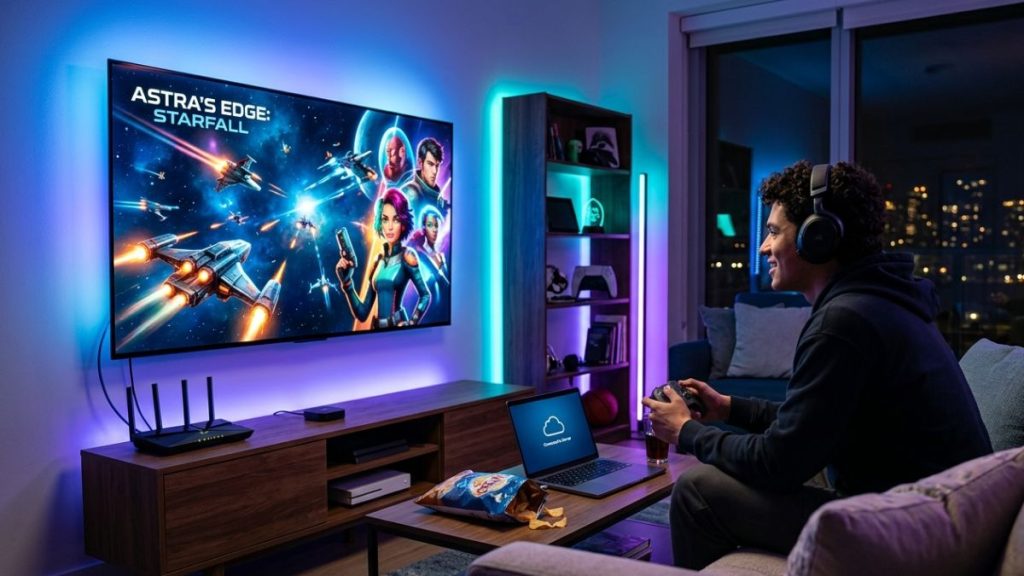
Cloud gaming is not a new idea. OnLive was already trying to stream console and PC games from remote servers back in 2010, long before most Indian consumers had access to the kind of broadband connections we have today. The technology has improved a lot since then, but cloud gaming took much longer to become a practical option in India.
I first properly tried cloud gaming after Microsoft launched Xbox Cloud Gaming in India in November 2025. India became the 29th country to get the service, and for me, this was more interesting than another gaming service launch. I already had a decent PC and had used game streaming in different forms before, but this was the first time I could officially use a major cloud gaming service in India without depending on a workaround or a server in another region. Microsoft also made the service available across phones, PCs, tablets, supported TVs and Fire TV devices.
My first reaction was not that cloud gaming had finally replaced a gaming PC. It was more practical than that.
It worked.
And that is important because cloud gaming in India has usually been discussed as a technology problem. We did not have enough high-speed internet. Servers were too far away. Latency was too high. Connections were not stable enough.
Those arguments made sense several years ago. But they are becoming less convincing now.
India’s internet infrastructure has changed considerably. Government data shows that median mobile broadband download speed increased from 10.71 Mbps in 2019 to 131.47 Mbps in October 2025. Median fixed broadband speed also increased from 29.25 Mbps to 60.34 Mbps during the same period.
That does not mean everyone in India has a perfect connection. Far from it. But a large number of users now have enough bandwidth for cloud gaming.
Xbox itself recommends 10 Mbps for mobile devices and 20 Mbps for PCs, consoles and tablets, along with 5 GHz Wi-Fi for better performance.
So, if your home has a reasonably good fibre connection, internet speed is probably not the reason you should reject cloud gaming anymore. I have already written a detailed guide on the internet speed you need for cloud gaming.
Latency is a different matter, and it is important as well. I noticed this pretty quickly while using Xbox Cloud Gaming. A connection can be fast enough to download a large game in a reasonable amount of time and still not feel great when you are playing it through the cloud. The game is not simply sending a video to your device. Your controller input has to travel to Microsoft’s servers, the game has to respond, and the new frame has to come back to you.
That is why cloud gaming can feel very different from Netflix or YouTube even when both services are running on the same internet connection.
A normal speed test also does not tell the whole story. You can have a 200 Mbps or 500 Mbps connection and still get an inconsistent cloud gaming experience because of latency spikes, packet loss, Wi-Fi interference or the route your ISP uses to reach the gaming server.
This is one reason I would not judge cloud gaming in India by Mbps alone.
My Xbox Cloud Gaming experience changed my view
When I first tried Xbox Cloud Gaming, I was mainly interested in one thing: could I actually play a proper console game on a device that was not a console?
The answer was yes.
There was still streaming compression, and the experience was not identical to running the game locally. But once the connection was stable, the fact that the game was running somewhere else became less important than I expected.
That is where cloud gaming starts making sense. You do not need to install a huge game. You do not need a gaming GPU. You do not need to wait for a large download or keep hundreds of gigabytes free on your SSD. You connect a controller, open the service and start playing. That convenience is difficult to appreciate until you actually use it.
At the same time, my experience also made the limitations obvious. Cloud gaming is very sensitive to network conditions. A small change in connection quality can be much more noticeable in a game than it would be while watching a video.
This is why I still would not tell someone to sell their gaming PC and move completely to the cloud. Cloud gaming makes much more sense when I don’t have a powerful enough PC to run the game in the first place.
Gaming hardware is expensive in India, especially if you want to play modern AAA games at high settings. You can buy a reasonably capable gaming PC for less, but a genuinely powerful machine can easily cost ₹1 lakh or more once you include the GPU, CPU, motherboard, RAM, storage, power supply and other components. Most people buying a normal laptop do not have that kind of hardware.
With increasing memory and GPU prices, PC gaming has already become an expensive hobby. Cloud gaming gives gamers another option.
If you already have a ₹40,000 or ₹50,000 laptop that is perfectly good for work, browsing and entertainment, you don’t necessarily need to replace it with a gaming machine just because you want to play a few demanding games.
This is also where services such as GeForce NOW become interesting.
NVIDIA’s service is different from Xbox Cloud Gaming because it can connect to supported PC game stores such as Steam, Epic Games Store and Ubisoft Connect. You can stream supported games you already own instead of buying the same game again just to play it in the cloud.
For someone who already has a sizeable PC game library but a weak GPU, that is a much more convincing proposition than simply paying another subscription for access to games.
NVIDIA’s arrival in India has also made the market more interesting. The company started offering GeForce NOW in India in 2026. It gave Indian users another major option besides Xbox Cloud Gaming.
The difference between the services is important.
Xbox is attractive if you want a large library through Game Pass. GeForce NOW makes more sense if you already own games on supported PC stores and simply need the hardware to run them.
Neither approach is automatically better. It depends on how you already play games.
But I would not call cloud gaming cheaper for everyone. A monthly subscription will obviously look cheap when compared with a ₹1 lakh gaming PC. But a gaming PC can be used for several years.
If you spend ₹1 lakh on a PC and keep it for four years, the hardware cost works out to about ₹2,083 per month. That does not include electricity, upgrades or maintenance, but it gives a rough idea of the long-term cost.
Cloud gaming can be cheaper if you play occasionally. If I only want to play a few games every month, there is little reason to spend a huge amount on hardware that will sit idle most of the time.
But if I am playing several hours every day, the calculation changes. The gaming PC is also more flexible. I can install mods, play offline, change graphics settings, use games that are not supported by my cloud provider and keep using the machine even if a particular cloud service changes its catalogue.
With cloud gaming, I am paying for access to someone else’s hardware. That is convenient, but it also means I am dependent on the service.
I have also compared cloud gaming and console gaming in terms of cost. If you were planning to buy the expensive gaming console, you can read that article to understand if buying an Xbox or PS5 makes sense or you should get a subscription to cloud gaming.
Data usage is another problem for many Indian users. Cloud gaming is essentially interactive video streaming, so it can consume a surprising amount of data. At 25 Mbps, a continuous stream works out to roughly 11.25 GB per hour if we calculate directly from the bitrate. At 15 Mbps, it is around 6.75 GB per hour.
Actual usage will vary because cloud gaming services adjust bitrate and resolution depending on network conditions, but the calculation gives an idea of what can happen.
Two hours of gaming every day at around 25 Mbps could theoretically work out to roughly 675 GB of data in a month.
This is not a big concern if you have an unlimited fibre connection. However, it is a very different situation if you are using mobile data.
India’s 5G networks are fast enough for cloud gaming in many locations, but I would still prefer fibre for regular cloud gaming. Speed is not the only issue. A mobile connection can change considerably depending on signal strength, congestion, and your location.
For occasional gaming, 5G can be useful. But I would still choose a stable wired broadband connection if cloud gaming is the main gaming platform.
Competitive gaming is where I still prefer local hardware. I would not use my cloud gaming experience to argue that everyone should move away from a gaming PC.
For competitive shooters and other games where response time matters heavily, local hardware still has an obvious advantage. Even with a good connection, cloud gaming adds network delay between your input and the game. The stream is also compressed, and image quality can drop when the connection cannot maintain the required bitrate.
For a single-player game, this is usually easier to accept. If I am playing an RPG or an open-world game, a little extra latency is not going to ruin the experience.
However, if I am playing a competitive shooter such as Valorant where a fraction of a second can decide a fight, I would rather have the game running directly on my PC.
Understanding this difference is important because cloud gaming does not need to beat local gaming at everything. It only needs to be good enough for the people who value convenience more than absolute performance.
So, is cloud gaming worth it in India?
After trying it myself and looking at where India’s internet infrastructure is today, I think the answer is finally yes for a particular type of user.
If you already have a powerful gaming PC, I don’t see much reason to move your main gaming experience to the cloud. However, I would recommend sticking with local hardware if you are a competitive gamer
But if you have a normal laptop, a good broadband connection and want to play demanding games without spending ₹70,000, ₹1 lakh or more on a dedicated gaming machine, cloud gaming is now a genuinely useful option.
That is the part I find most interesting about cloud gaming in India. It does not necessarily need to replace gaming PCs or consoles. It can simply make them unnecessary for some people.
Someone who would never spend ₹1 lakh on a gaming PC can still buy a controller, subscribe to a cloud gaming service and play games that their existing laptop could never run.
That is a much more realistic future for cloud gaming in India than the old idea of everyone abandoning their consoles and PCs.
The technology is not perfect. Latency, compression, data usage, server availability and game support are still real limitations. But the basic infrastructure is no longer the deal-breaker it once was.
I started with Xbox Cloud Gaming because it was finally officially available in India. After using it, my view is not that cloud gaming has killed the gaming PC.
It has made expensive gaming hardware optional for a much larger group of Indian gamers.
And for someone who only wants to play a few big games without spending a fortune on a gaming machine, that may be enough to make cloud gaming worth it.
Related Posts