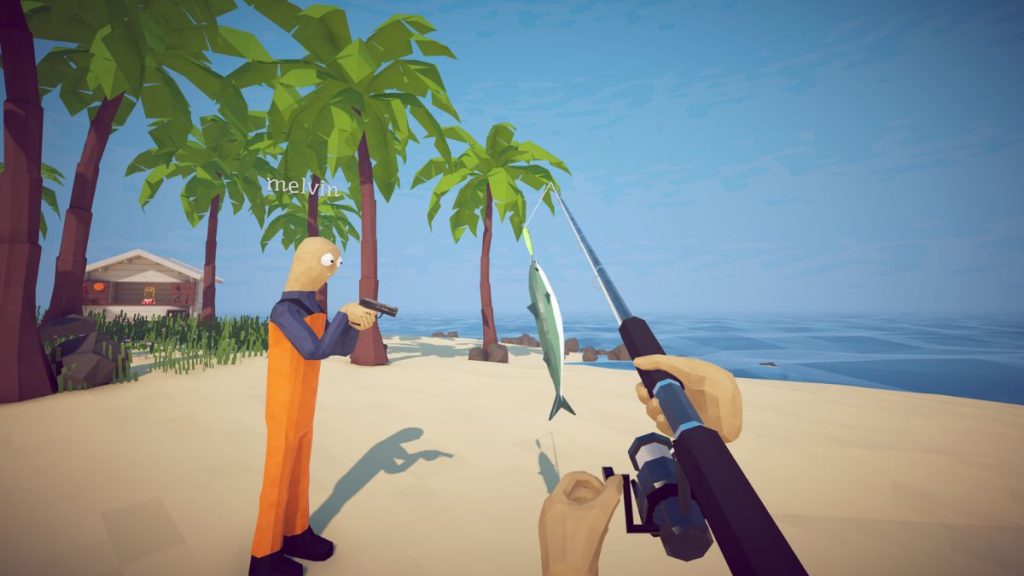
A $5 indie game about fishing, guns and ridiculous physics has become one of the biggest surprise hits of August. How to Fish, developed by Swedish indie studio Dazed Games, sold 1 million copies within two days of its August 20 launch.
The game has also produced unusually strong player numbers for such a small release. It reached 268,101 concurrent players according to Techlomedia Gaming’s Steam Charts, while the latest figures show its 24-hour peak climbing to more than 340,000 players. Its Steam page has also accumulated more than 11,000 reviews, with the overall rating sitting at “Very Positive.”
That makes the launch worth looking at beyond the headline sales number. How to Fish is not backed by a major franchise, does not require a $60 or $70 purchase, and is built around a deliberately silly concept. It launched at $7.99, with a 38% introductory discount bringing the price down to $4.95 until August 27.
How to Fish is a one-to-four-player co-op game where players are stranded on an island after a boating accident. The objective is to catch creatures, sell them, upgrade equipment and progress through increasingly difficult islands.
The fishing itself is where the game becomes unusual. Players can use weapons and explosives to kill their catches, while trick shots can increase their value. The game also includes gambling and boss encounters, turning what could have been a straightforward fishing simulator into a physics-heavy multiplayer game built around unpredictable moments.
That design gives How to Fish an advantage that many conventional games do not have. Its mechanics can produce situations that are difficult to predict or reproduce. In a multiplayer setting, that can quickly turn into clips, streams and stories that players share with others.
The sales numbers suggest that this approach is working. The price is probably a major part of the equation. The $4.95 launch price should not be ignored when looking at the game’s performance. A player may hesitate before spending $60 on an unfamiliar indie game. Spending $5 to try a strange co-op game with friends is a much easier decision. The same applies to multiplayer groups, where one person discovering the game can quickly turn into several purchases.
This does not mean the low price alone created the hit. The game has also received strong reviews and generated a large active player base. But the pricing clearly reduces the barrier to entry, which gives the game a much better chance of turning curiosity into an actual purchase.
That is useful for a game whose biggest selling point is playing with friends. The most interesting statistic is not even the 1 million sales. It is the relationship between sales and concurrent players.
Reaching more than 268,000 simultaneous players shortly after launch means a substantial portion of the audience was actively playing at the same time. The latest reported 24-hour peak of more than 340,000 suggests the game was still gaining momentum after its initial sales announcement.
The game’s momentum is also visible on Twitch. How to Fish currently has around 80,959 viewers watching across 480 live channels, while its 24-hour peak has reached 86,046 viewers. The current all-time peak is also 86,046 viewers.
That is significant for an indie game that only launched days ago. The Twitch audience is still much smaller than the game’s reported 300,000-plus concurrent player peak, but nearly 81,000 people watching the game at the same time shows that its appeal is extending beyond players who have already bought it.
Together, these numbers suggest that How to Fish is not simply benefiting from a cheap launch price. Players are actually engaging with it, at least during its first week.
The success also fits into the growing popularity of games often described as “friendslop”, where the main appeal is getting a group together and creating unpredictable moments rather than completing a huge campaign.
The formula is becoming easier to recognize: simple mechanics, short learning curves, multiplayer, a low price and enough chaos to make every session different.
How to Fish adds another useful ingredient. It offers a concept that is immediately understandable. You fish, make money, upgrade your equipment and move forward. The weapons, physics and bizarre encounters provide the entertainment around that basic loop.
That simplicity may be one of the biggest reasons the game has travelled so quickly.
There is still one important question: how long can this momentum last?
One million sales in two days is an extraordinary result, but it does not tell us how many players will still be playing weeks or months from now. Dazed Games has already said that it will add more content and fix bugs, which will be important if the studio wants to turn the viral launch into a longer-lasting game.
For now, though, the data is difficult to ignore. A small Swedish studio has sold 1 million copies of a game that launched for less than $8, reached more than 268,000 concurrent players and crossed 11,000 reviews within days.
The bigger lesson is not that every indie developer should make a fishing game. It is that a simple multiplayer idea, a low entry price, and mechanics that naturally create shareable moments can still cut through an extremely crowded games market.
How to Fish has managed to prove that with numbers, not just hype.
Related Posts