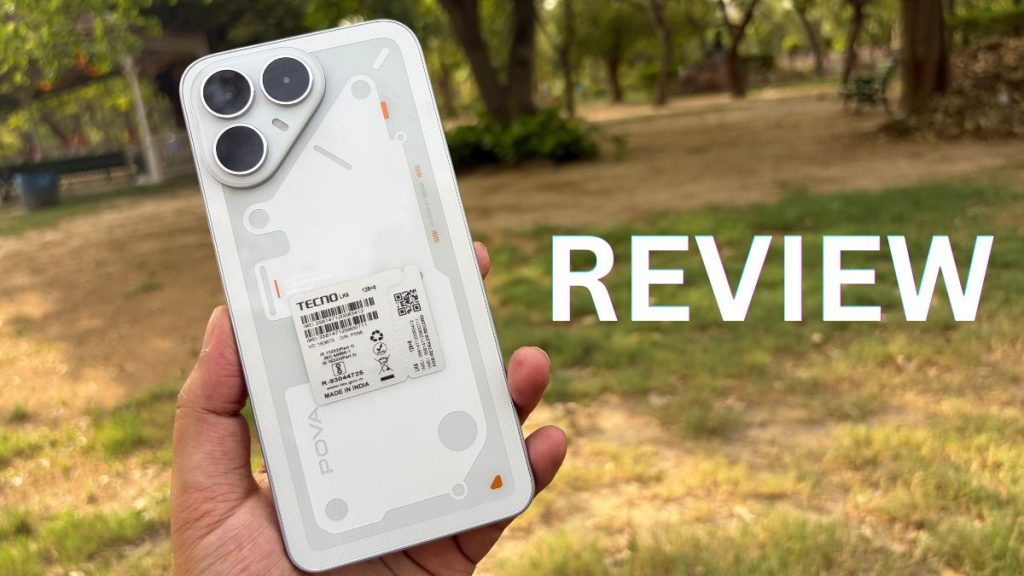
The Tecno Pova series has always focused on delivering big batteries, gaming-oriented hardware, and flashy designs at affordable prices. The Tecno Pova 8 continues the same strategy. On the specs sheet, Tecno Pova 8 seems like a good device. However, some compromises have also been made to keep the price competitive.
After spending time with the device, here is my detailed review of the Tecno Pova 8.

Unboxing
- Pova 8
- USB-A to USB-C Cable
- 45W Adapter
- Sim Ejector Pin
- Silicon Case
- Warranty Card
- Manual
Design
The Tecno Pova 8 immediately grabs attention with its unique design language. Unlike most smartphones in this segment that follow a generic design approach, the Pova 8 has a distinctive gaming-inspired appearance that helps it stand out.
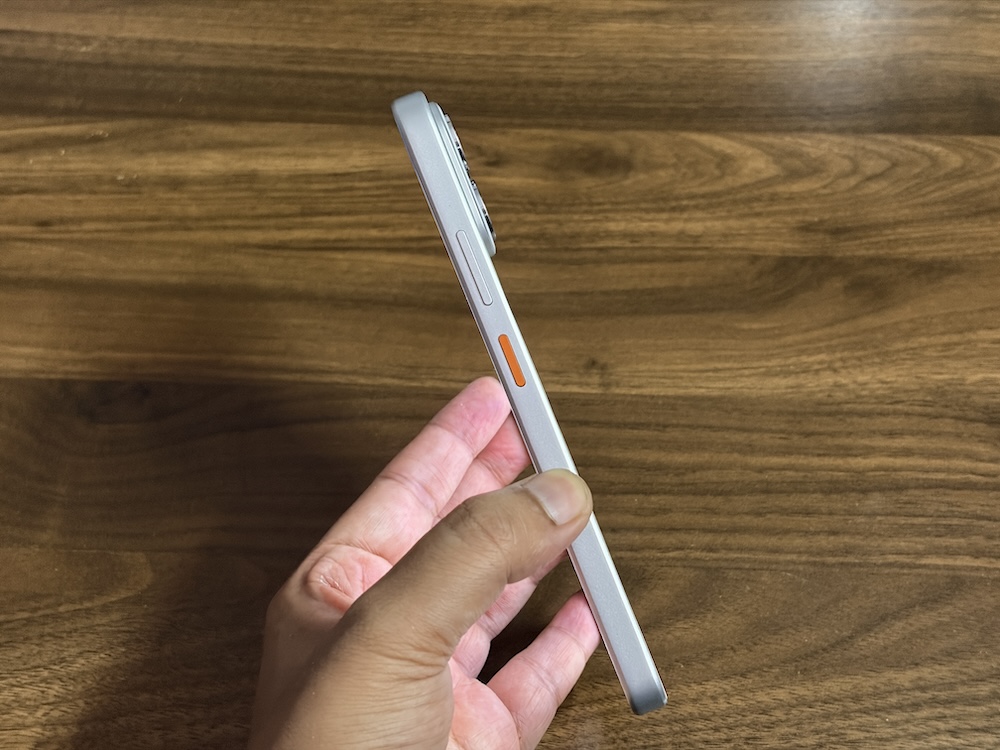
The device adopts a completely flat matte-finished silver frame with sharp corner radii. The flat-frame design not only looks modern but also helps maximize internal space for the massive battery. Despite packing an enormous 8,000mAh battery, the phone feels surprisingly sleek in hand. The silver frame gives the device a premium appearance, while the matte finish helps reduce fingerprint smudges during daily use.
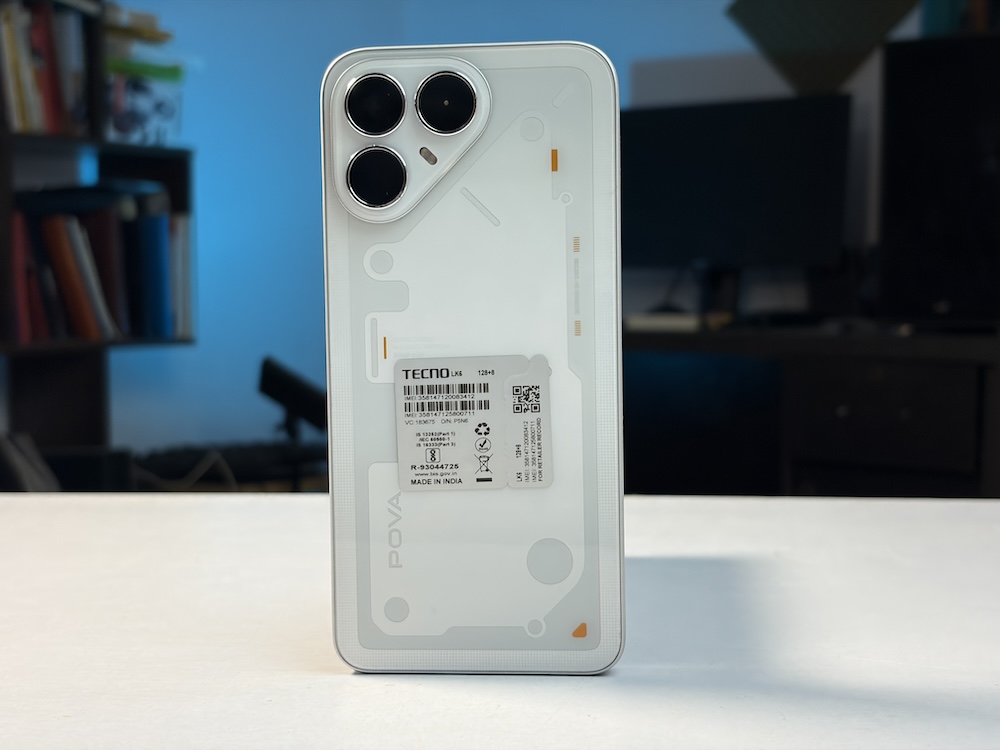
Photo: Techlomedia
The front is dominated by the display, but the bezels are difficult to ignore. While the side bezels are acceptable, the bottom chin is noticeably thick and reminds you that this is not a premium smartphone.
The left side houses the volume rocker. One of my favorite design elements is the bright orange accent on the power button, which also doubles as the fingerprint scanner. The orange color breaks the otherwise monochrome design and instantly makes the button easier to locate.
The bottom edge remains clean and practical. It houses the SIM tray, primary microphone, USB Type-C port, and a six-hole speaker grille.
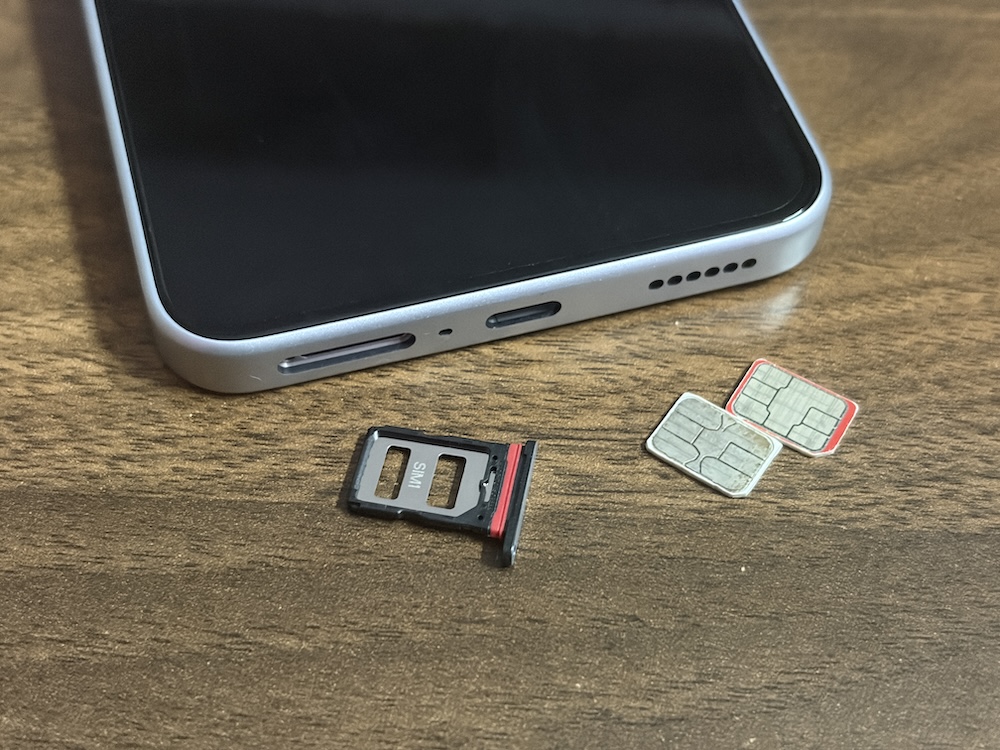
At the top, Tecno has included an IR blaster, which can be used to control compatible home appliances. It is a feature that many brands have abandoned, so its inclusion is welcome.
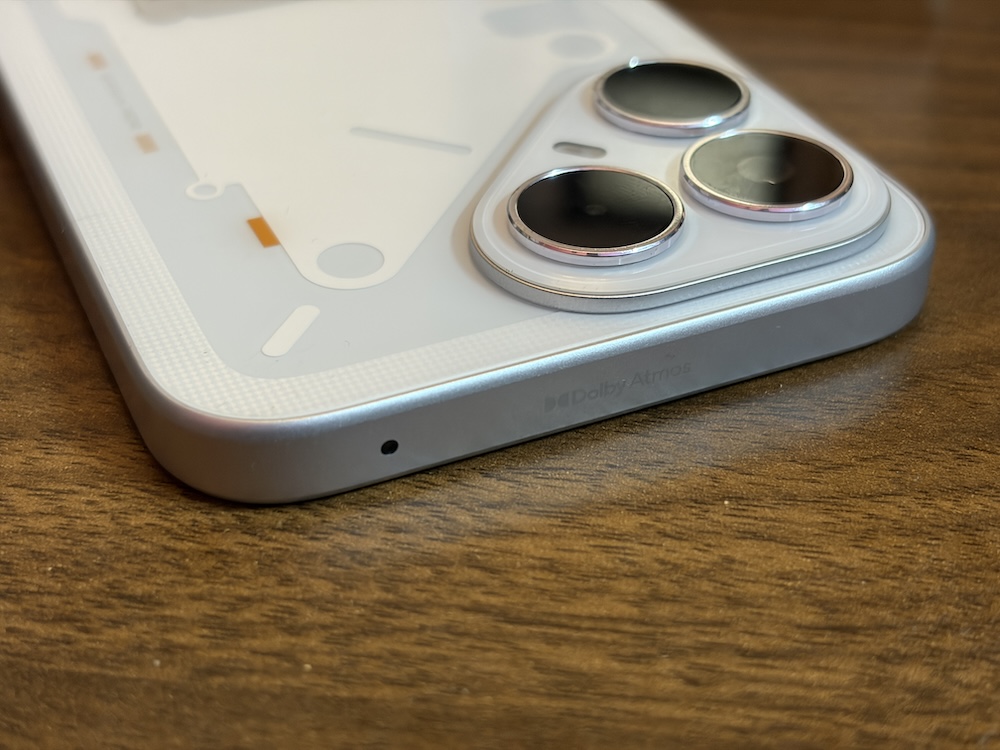
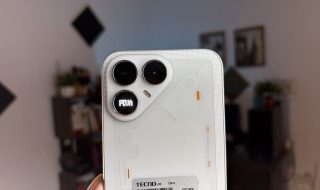
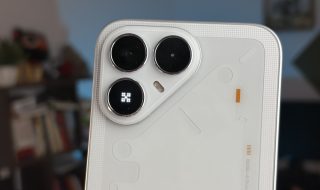
The rear panel is where Tecno has invested the most effort. It uses a dual-layer design with a transparent outer layer placed over a structured white-and-grey internal chassis plate. The design includes geometric cutouts, faux-conduit lines, and subtle orange accent elements that create a futuristic sci-fi mechanical look. The camera module is housed inside a teardrop-shaped island that flows naturally from the rear panel. The symmetrical triple-ring layout gives the phone a premium and aggressive appearance.
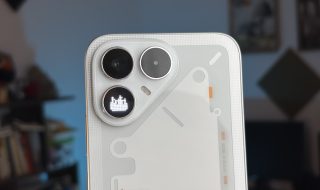
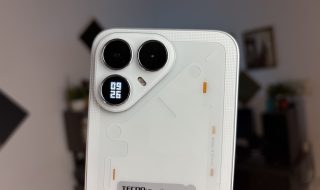
Interestingly, not all rings are camera sensors. One of them is dedicated to the micro-LED matrix system. The lower circular section houses a dot-matrix LED array that displays various notification and status animations. Tecno has integrated this feature tastefully. It complements the futuristic personality of the phone while remaining functional. You can also customize it by selecting available options to display here. Or, you can also create your own custom pattern.
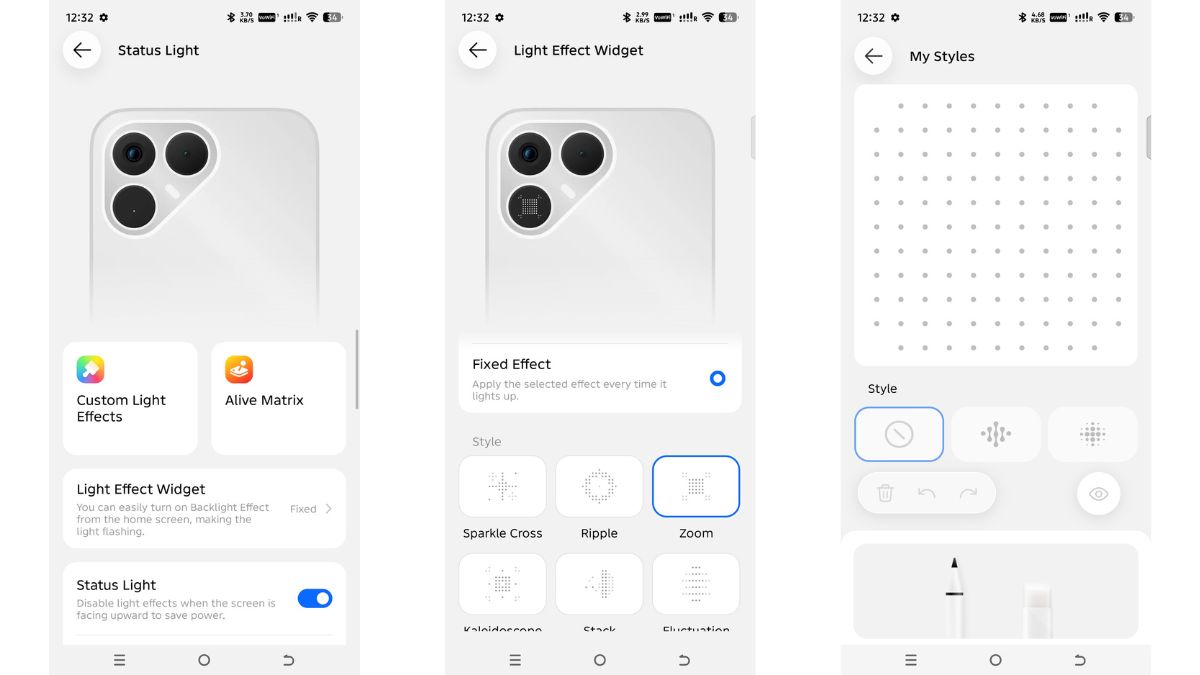
Photo: Techlomedia
You can also enable it for media and entertainment things like turning on while playing music, starting a game, notifications, charging, timer, video shooting, and other options. In many cases, this dot-matrix LED is really useful. For example, if you want to capture a photo using a timer, it keeps showing the timer.
The device also comes with an IP64 rating for dust and water resistance, adding some durability for daily usage.
Overall, the Tecno Pova 8 offers one of the most distinctive designs in its segment. If you want a phone that stands out from the crowd, this is definitely one of its strongest selling points.
Display
The Tecno Pova 8 features a 6.76-inch Full HD+ display with a resolution of 1080 × 2344 pixels. The display is sharp, the colors look decent, and the overall experience remains good. Tecno has used an IPS LCD panel instead of an AMOLED display. This means you miss out on the deep blacks, superior contrast, and richer viewing experience typically associated with AMOLED screens. At a starting price of ₹29,999, the choice of an IPS LCD panel feels difficult to justify, especially when several competing smartphones offer AMOLED displays.
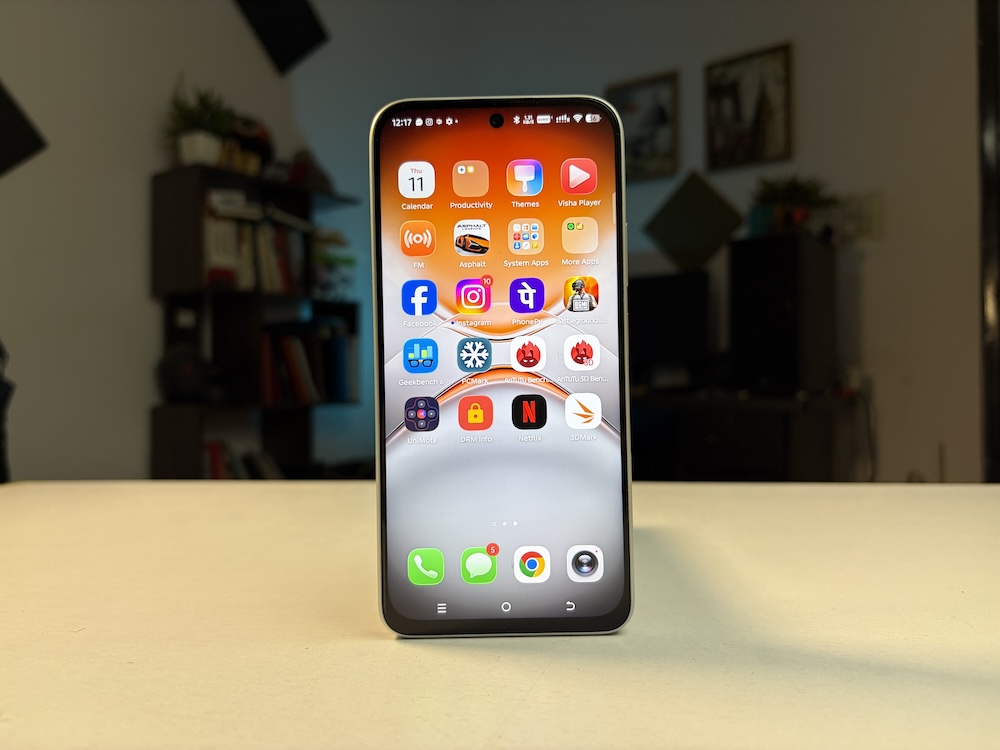
Photo: Techlomedia
The display still feels smooth in daily use with 120Hz. Scrolling through apps, navigating the interface, and switching between screens all feel fluid thanks to the higher refresh rate. Just do not buy this phone expecting a 144Hz experience because most users are unlikely to ever see it in action.
Outdoor visibility is decent, and the display remains usable under sunlight. For video streaming, social media browsing, and gaming, the screen performs adequately, but the IPS panel prevents it from delivering a truly premium viewing experience.
The device comes with Widevine L1 certification and supports HDR content playback. However, HDR compatibility is not consistent across all streaming services. During testing, YouTube was able to stream HDR videos with HDR content available up to 1440p60. But it doesn’t support HDR on Netflix. The app doesn’t recognize the device for HDR streaming and lists HDR capability as unavailable.
Software
The Tecno Pova 8 runs HiOS based on Android 16. Over the years, Tecno’s software experience has improved significantly. HiOS now feels much more polished than earlier generations and includes a variety of useful features. The interface offers extensive customization options, allowing users to personalize icons, themes, wallpapers, animations, and lock screen layouts.
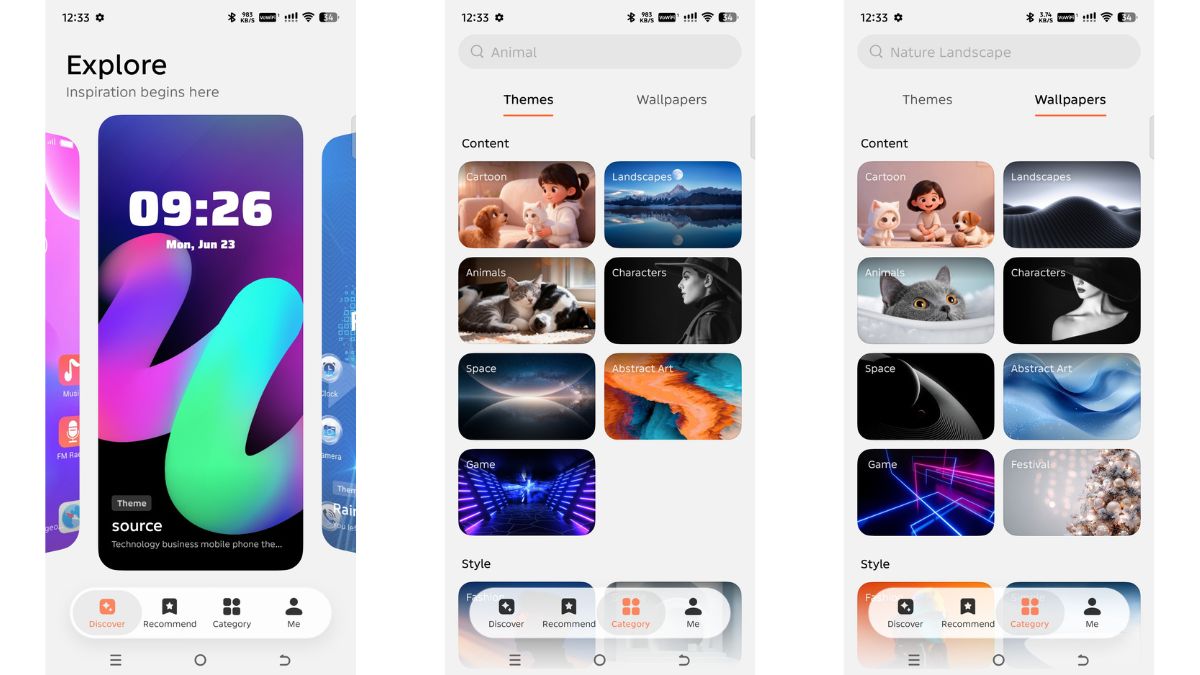
Photo: Techlomedia
Howver, the device also comes with several pre-installed apps. Some may be useful, but not all. The good thing is that you can uninstall some of this bloatware.
The software also includes various AI-powered features integrated throughout the system. Tecno has added several gaming enhancements, productivity tools, privacy options, and battery management features. Even the gallery app has one-tap access to the circle to search.
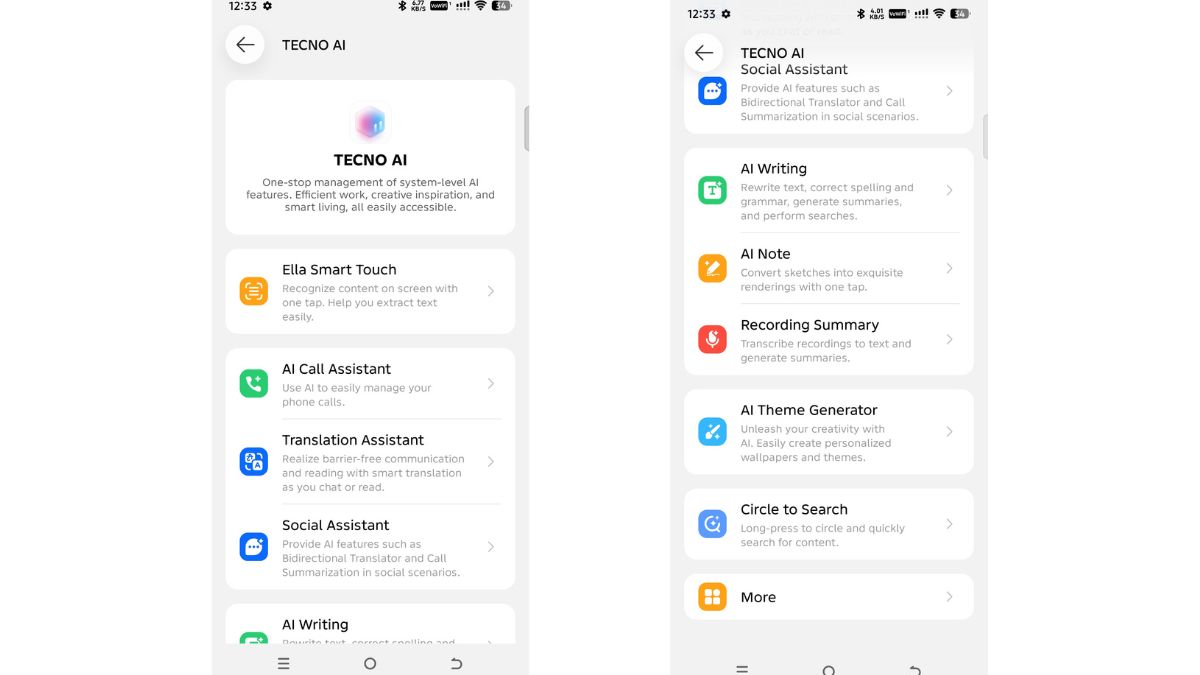
Photo: Techlomedia
The interface generally feels smooth during daily use. App opening speeds are acceptable, multitasking works well, and system animations remain fluid thanks to the high refresh rate display.
The battery management system is interesting. Tecno uses AI-based charging optimization that learns user habits and adjusts charging behavior accordingly. This helps reduce battery stress over time while maintaining convenience.
Overall, HiOS has matured into a capable software experience. It may not be as clean as stock Android, but it offers plenty of features and customization options.
Performance, Storage & Gaming
The Tecno Pova 8 is powered by MediaTek’s Dimensity 7100 chipset, which is built on TSMC’s efficient 6nm manufacturing process. It features an octa-core CPU with four Cortex-A78 performance cores clocked at up to 2.5GHz and four Cortex-A55 efficiency cores running at up to 2.0GHz.
The Dimensity 7100 is a capable mid-range chipset that handles everyday tasks without any major issues. Daily activities such as web browsing, social media scrolling, messaging, video streaming, navigation, and multitasking run smoothly. App launches are reasonably quick, and switching between applications does not create noticeable slowdowns.
However, the performance story does not feel as strong when you look at the price segment Tecno is targeting. The Dimensity 7100 is a reliable chip for daily use, but at a price point that can reach the upper mid-range category, it starts to feel less competitive compared to newer processors offering better efficiency and gaming performance.
The device is paired with up to 8GB RAM and also supports up to 8GB of virtual RAM expansion.
The phone achieves an AnTuTu score of around 750,000 points, which places it comfortably in the mid-range category. On Geekbench, it scores 968 for single-core and 2804 for multi-core.
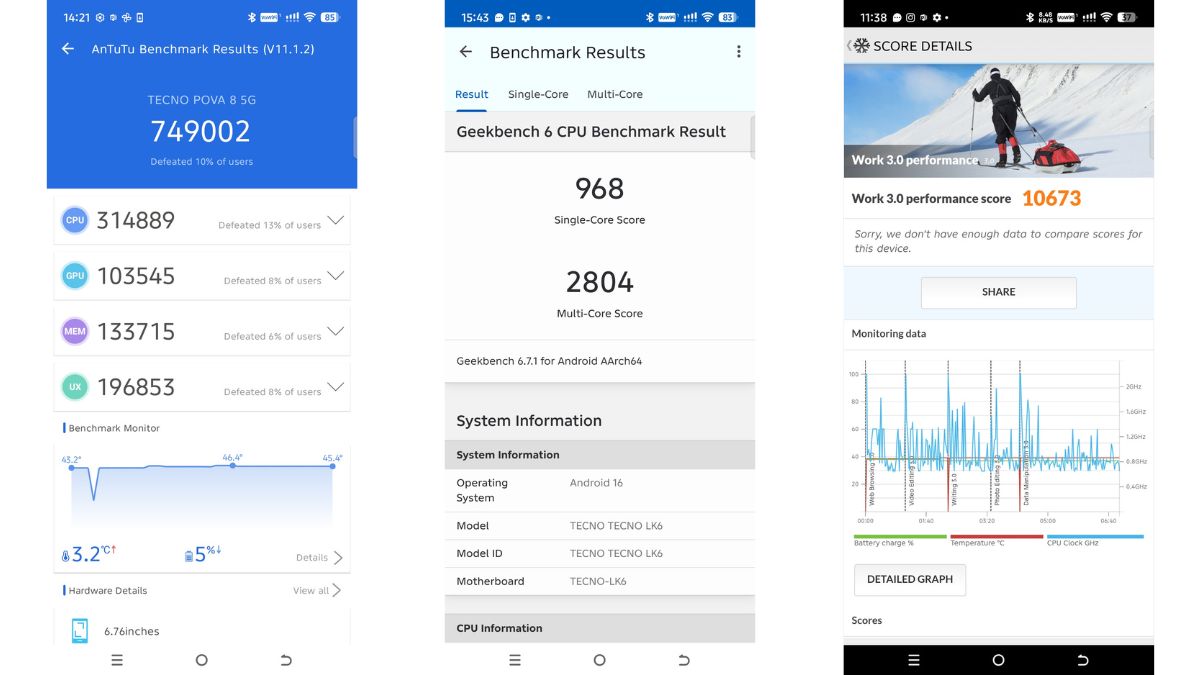
Photo: Techlomedia
For most users, performance will be more than sufficient.
Gaming performance is decent but not exceptional. The integrated Mali-G610 MC2 GPU is capable of handling popular games like BGMI Fire without major issues. These titles run smoothly at medium-to-high graphics settings while maintaining stable frame rates.
However, more demanding games require compromises. If you play graphics-intensive titles such as Genshin Impact or similar games, you will need to lower graphical settings to maintain smooth gameplay. The GPU simply does not have enough power to push high settings consistently.
While playing game, you can also get access to a floating panel that provides options to help you while gaming. Here you get quick shortcuts to boost performance, enhance network connectivity, enable by pass charing, touch optimization, capture screenshot, or record vides.
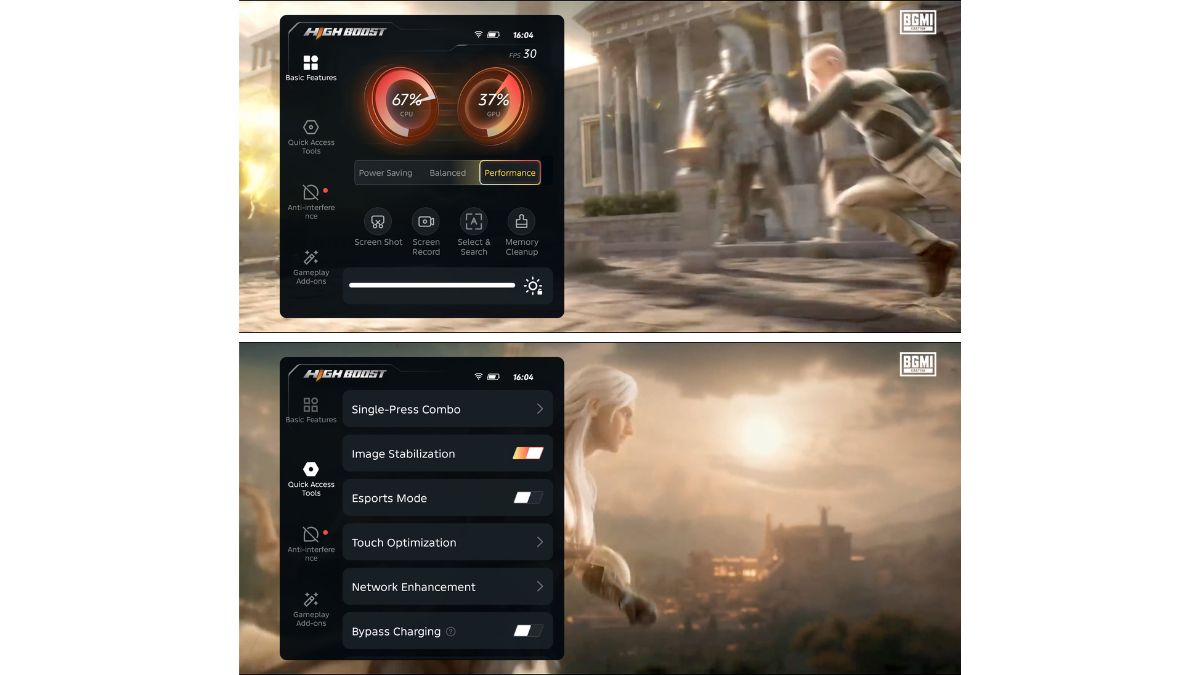
Photo: Techlomedia
The massive battery also works in favor of gamers. Long gaming sessions become much more practical since battery anxiety is almost eliminated. Thermal management remains acceptable during extended sessions, and the phone does not become uncomfortably hot under normal gaming conditions.
For casual and competitive gamers, the Pova 8 delivers a good experience. Hardcore gamers looking for flagship-level graphics performance will need to look elsewhere.
It has 128GB of internal storage. The device has UFS 2.2, which is acceptable for a device of this segment. Read-write speed is also good, and numbers clearly suggest UFS 2.2. Here’s the test result.
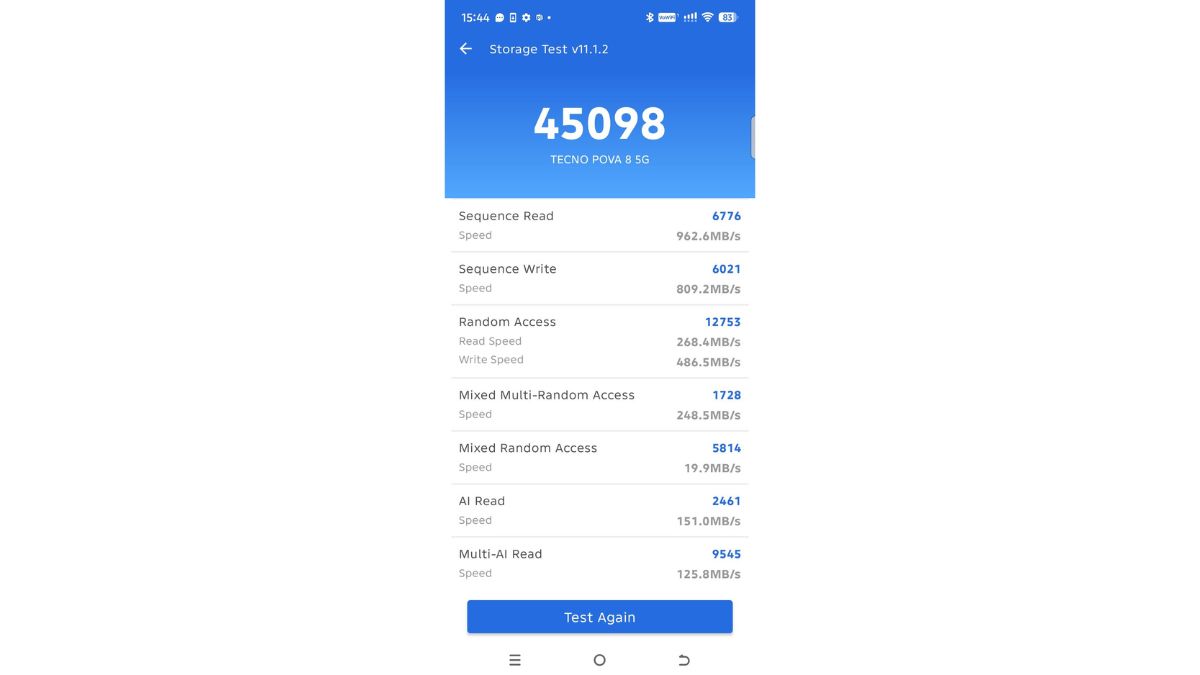
Photo: Techlomedia
Camera
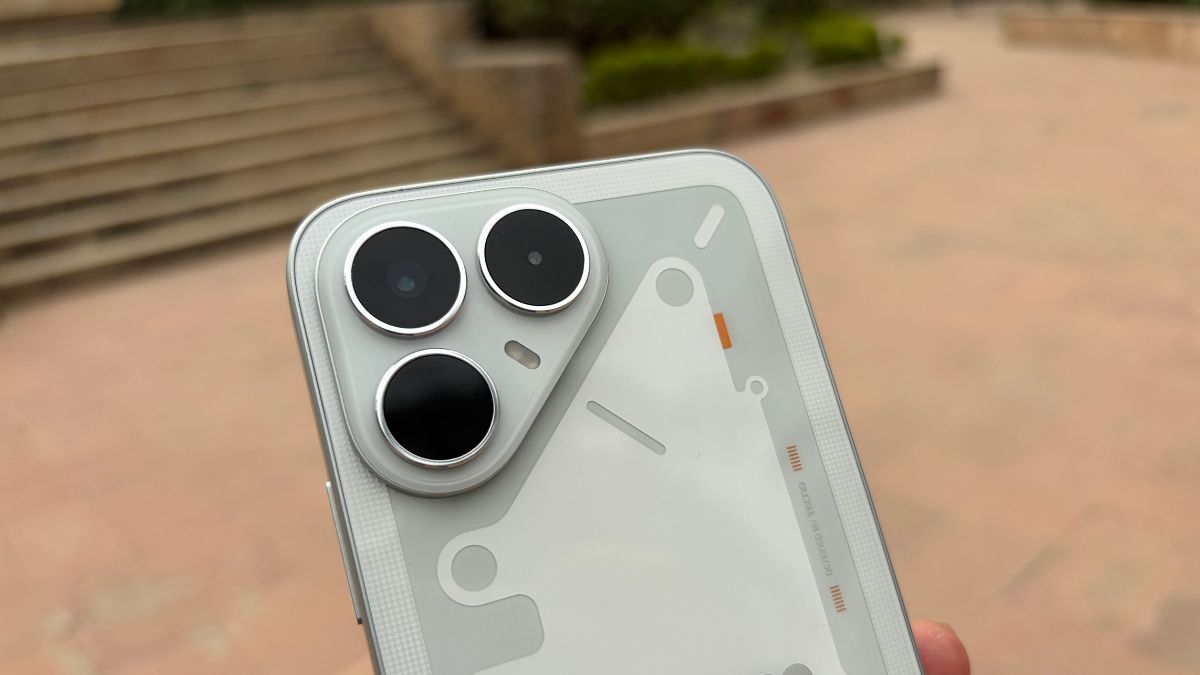
Photo: Techlomedia
The Tecno Pova 8 uses a 50MP Sony LYTIA 600 primary sensor. The Sony LYT-600 is actually a capable sensor and has been used successfully in several smartphones. On paper, it should be capable of producing strong results.
Daylight photos come out sharp with plenty of detail, while the image processing adds a noticeable boost to colors. Greens appear richer, flowers look vibrant, and buildings have a pleasing punch that makes photos look social-media-ready straight out of the camera. The camera also performs well when shooting close-up subjects. It captures fine textures nicely and creates a natural-looking background blur without making the image look artificial. Whether you are photographing flowers, small objects, or food, the camera does a good job of keeping the subject sharp while separating it from the background.
In scenes with strong backlighting or a bright sky, the HDR processing can struggle. The camera often prioritizes the main subject, which can result in overexposed skies with highlights getting completely blown out. This is especially noticeable when shooting against direct sunlight.






Low-light performance is decent but far from class-leading. In well-lit indoor environments and brightly lit streets, the camera manages to keep noise under control while maintaining good exposure levels. Buildings, signboards, and illuminated scenes generally turn out usable.
Once lighting conditions become more challenging, the limitations start to show. The camera relies heavily on software processing and noise reduction to clean up images. While this keeps grain under control, it also removes some finer details. Moving subjects can also appear blurry due to slower shutter speeds. Another issue is lens flare, which becomes quite noticeable when bright light sources such as street lamps or vehicle headlights are present in the frame.
Portrait mode delivers mixed results. In daylight, the camera captures good facial details and natural skin tones. Clothing textures and facial features are retained nicely. This makes portrait shots look pleasing overall. However, the edge detection is not always accurate. The same limitations become more noticeable in low light. While the camera does a decent job of brightening faces, the overall image loses some depth and detail. The artificial background blur can also look a bit aggressive at times.






For selfies, Tecno has included a 13MP front camera. In daylight, it produces detailed and natural-looking photos. Unlike many smartphones that apply excessive beauty filters, the Pova 8 preserves skin texture and facial details fairly well. Skin tones look natural, while the slightly warm color tuning helps selfies appear lively without looking unrealistic.
Low-light selfies are acceptable, but image quality takes a noticeable hit. The camera keeps subjects visible, especially with screen flash assistance, but fine details become softer as the software attempts to reduce noise. As a result, facial textures lose some sharpness and clarity.


Portrait selfies perform similarly to the rear camera. Subject separation is generally good in daylight, but the software can struggle with hair and other intricate edges. In low-light situations, the camera applies stronger background blur to hide image noise, which sometimes gives portraits an artificial cutout-like appearance. In many indoor situations, standard selfie mode actually delivers more natural-looking results than portrait mode.
Camera Features
Tecno includes several fun camera features. It offers AIGC portrait mode, where you can select different portrait effects, and then AI will recreate your photo in the selected portrait effect. Another interesting addition is Sky Shop, which uses AI to replace the sky with different styles and weather effects. The phone also offers Dual Video. It allows users to record using both front and rear cameras simultaneously.
There are numerous additional shooting modes available for users who enjoy experimenting with different photography styles.
Video Recording
When it comes to video recording, the Tecno Pova 8 can capture videos at up to 2K resolution at 30fps from both the rear and front cameras. While having 2K recording support sounds impressive on paper, I actually found the 1080p mode to deliver better overall results. The 1080p videos appear more balanced with better consistency, while 2K footage does not offer a significant improvement in detail to justify using it all the time. One area where the phone disappoints is video stabilization. Since there is no effective stabilization system in place, videos often come out shaky, especially when walking or recording handheld movements.
The same limitation applies to the front camera as well. Selfie videos can look noticeably shaky. If you plan to shoot videos regularly, I would recommend sticking to 1080p recording.
Connectivity
The Tecno Pova 8 offers a comprehensive set of connectivity options. Network reception remains stable, and mobile data performance is reliable during daily use. Wi-Fi connectivity works as expected, Bluetooth pairing remains stable, and GPS performance is accurate for navigation purposes.
One interesting feature is Tecno’s FreeLink technology. This feature allows nearby calling and communication capabilities under supported conditions, providing an additional layer of convenience when traditional connectivity options are unavailable.
The phone features a side-mounted fingerprint sensor, which is fast and accurate. It quickly unlocks the phone. The device also includes an IR blaster. So, you can use it as a remote to control other home appliances.
Face unlock is also available and works reasonably well in good lighting conditions, although it is naturally less secure than the fingerprint scanner.
Throughout testing, connectivity performance remained reliable with no major issues.
Audio and Calling
Tecno advertises Dolby Atmos support on the Pova 8. While the software tuning is present, the hardware setup is less impressive. The device uses a single bottom-firing speaker instead of a dual stereo speaker configuration. So, the media playback lacks balanced stereo separation.
Call quality is generally good. Voice clarity remains acceptable during regular phone calls, and microphone performance is adequate for conversations and voice recordings. The earpiece is sufficiently loud, and I did not face any issues hearing callers even in moderately noisy environments.
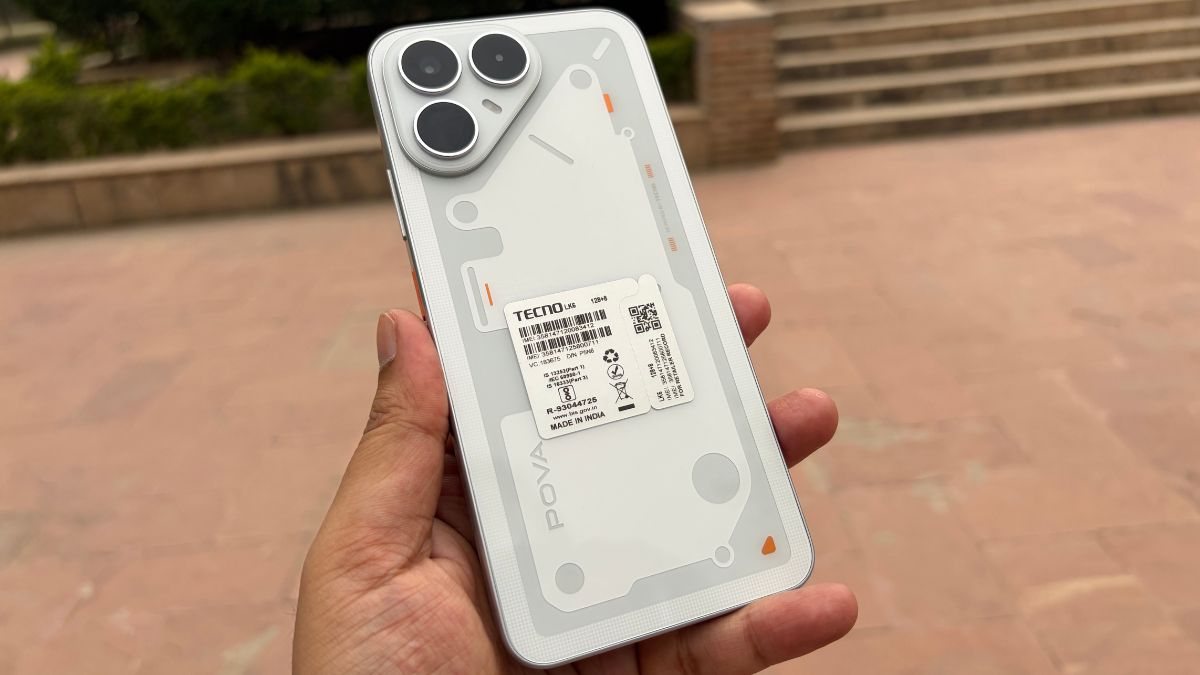
Photo: Techlomedia
Battery
The smartphone packs a massive 8,000mAh battery, which is significantly larger than what most competing smartphones offer. In real-world usage, the results are excellent. With normal usage involving social media, messaging, web browsing, video streaming, and occasional gaming, achieving two full days of battery life is easy. Heavy users will also appreciate it. Screen-on-time can comfortably exceed 10 hours, making this one of the most battery-efficient smartphones in its category.
Charging is handled by a 45W fast charger. Interestingly, Tecno uses AI-based charging management that dynamically adjusts charging speed based on battery condition and usage habits. While charging may not always operate at maximum speed, the system aims to improve long-term battery health.
The phone also supports reverse wired charging. So, you can use the phone as a power bank for charging other devices.
Another useful addition is bypass charging. During gaming sessions, bypass charging can supply power directly to the system without continuously charging the battery. This helps reduce heat generation and battery wear during extended gaming.
Wrap Up
The Tecno Pova 8 is a smartphone with a very clear identity. It may not have the best display or camera in its segment, but it gets the basics right. It offers dependable performance, strong battery life, and a design that stands out from most smartphones in this range.
The massive 8,000mAh battery is easily the biggest highlight of the phone. Add to that features like bypass charging, reverse charging, IP64 protection, an IR blaster, and a customizable mini LED matrix, and you get a device that clearly focuses on endurance and style.
However, the pricing makes things a bit complicated. Even older models like the Tecno Pova Curve 2 were seen around a similar price bracket and offered an AMOLED display. In comparison, the Pova 8 shifts to an IPS LCD panel, which feels like a step back, especially when users are being asked to pay a similar amount. At this level, the display downgrade feels noticeable and hard to ignore.
The performance side also does not fully settle the value question. The Dimensity 7100 is a capable chipset for daily use, but it is not as strong as what several competing phones now offer in this price range. This makes the overall package feel slightly uneven when compared to alternatives that deliver better display quality and stronger performance together.
If your priority is a phone that can comfortably last two days on a single charge while handling gaming, entertainment, and everyday tasks without major issues, the Tecno Pova 8 still works as a practical choice. But when you look at the full package against the price, it feels more situational than a clear value winner.
Related Posts