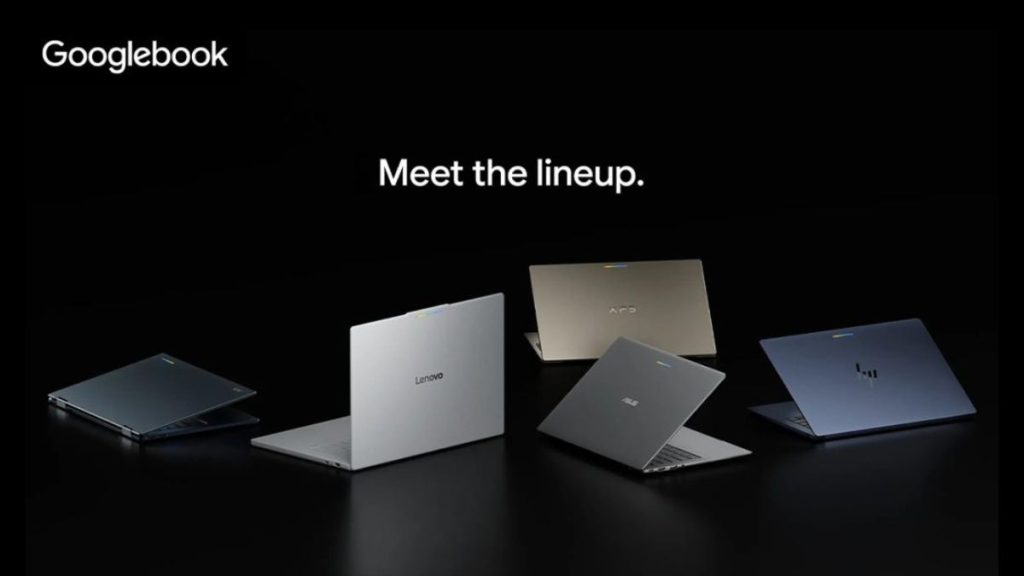
Googlebook is finally becoming a real product. Pre-orders opened this week, with the first laptops starting at $899 and coming from Acer, ASUS, Dell, HP and Lenovo. But this is not another attempt to make a better Chromebook. Google is creating a new category of premium laptops that combines Android technology with ChromeOS desktop foundations and builds Gemini into the experience.
The hardware also makes it clear that Google is not targeting the traditional budget Chromebook market. Every Googlebook starts with 16GB of RAM and 512GB storage, while the lineup uses Intel Core Ultra 5 or Snapdragon X Elite processors with dedicated NPUs capable of more than 45 TOPS of on-device AI performance. The lineup also includes 2.8K OLED touch displays on several models, along with premium materials and haptic trackpads.
At first, Googlebook looks like another competitor to Windows laptops. But I think that misses the bigger reason Google is building it. The more interesting competitor is Apple, or more specifically, the relationship Apple has built between the iPhone and Mac.
Apple’s advantage has never been just the MacBook itself. It is what happens when you already own an iPhone. Messages, calls, files, passwords and other information can move between devices, while features such as Handoff and Universal Clipboard make the two products feel like parts of the same system. Apple has spent years building this experience through its Continuity features.
Android has had pieces of this idea for years, but there has never been one laptop platform designed around making the Android phone and laptop feel like a single experience. Googlebook is Google’s attempt to close that gap.
Googlebook OS brings together Android technology and ChromeOS desktop capabilities, while Google has built several features specifically around the Android phone. Continue On can let users pick up supported activities from their phone, while Quick Access provides access to files stored on the phone. Cast My Apps goes a step further by letting users open phone apps in windows on the laptop without installing those apps on the computer.
That last feature is particularly interesting. The phone is no longer just a device that sends a file to the laptop. Parts of the phone experience can effectively move to the laptop when needed. If Google can make this work reliably, it could make the Android phone much more useful when paired with a Googlebook.
Google has also taken a very different approach from Apple when it comes to hardware. Apple controls the iPhone and Mac from top to bottom. Googlebook is being built by Acer, ASUS, Dell, HP and Lenovo, while the phone side can come from the much wider Android ecosystem. A Samsung, OnePlus or Xiaomi phone could potentially become part of the same experience as an Acer, Dell or Lenovo Googlebook.
That gives Google a much bigger opportunity, but it also creates a much harder engineering problem. Apple only needs to make its own hardware and software work together consistently. Google has to make a cross-device experience work across different laptop makers and a huge number of Android phones.
This is also not Google’s first attempt at making a premium laptop. Google introduced the Chromebook Pixel in 2013 and followed it with another model in 2015. The Pixelbook arrived in 2017 and showed that ChromeOS could work in a much more premium laptop. Google later released the Pixelbook Go in 2019.
That experiment did not turn into a long-running Google laptop business. Google eventually stopped developing its own Pixelbook hardware, while companies such as Acer, ASUS, Dell, HP and Lenovo continued making Chromebooks.
Googlebook is different in one important way. Google is not trying to build one Google laptop and compete with every PC maker. It is giving several major manufacturers a common platform and software experience. That makes Googlebook look less like another Pixelbook experiment and more like Google’s attempt to establish a new laptop platform.
Googlebook is clearly not being positioned as a cheap Chromebook. The hardware baseline is already much higher than what people traditionally associate with ChromeOS, and Google is using the premium hardware to support another major part of its strategy: AI.
Googlebook is designed around what Google calls Gemini Intelligence. Features such as Magic Pointer can understand text, images and context on the screen and bring Gemini into the workflow. The laptops also have dedicated NPUs with more than 45 TOPS of on-device AI performance, allowing some AI workloads to run locally.
Magic Pointer is particularly interesting because it changes how the user interacts with Gemini. Instead of opening a separate chatbot and explaining what is on the screen, users can bring Gemini into the task they are already doing. Google is also allowing users to create custom widgets through natural language.
This matters to the ecosystem argument because Google is not only trying to connect your phone and laptop at the file level. It is trying to connect them through software, apps and AI as well. The bigger idea seems to be that the laptop should understand more of what you are doing instead of simply giving you another collection of applications.
But there is a difficult question for Google. Why should someone spend $899 or more on a Googlebook instead of buying a Windows laptop, a MacBook or a cheaper Chromebook?
The answer cannot simply be better hardware. Windows already has plenty of premium laptops, while Apple has spent years building high-end MacBooks. Google needs the Android connection and its software experience to become a meaningful reason to choose Googlebook.
This is where I think Google’s biggest opportunity lies.
If Google can make an Android phone and Googlebook feel like two parts of the same system, it could eventually create an ecosystem-driven buying decision similar to the one Apple has built around the iPhone and Mac. An Android user might not choose Googlebook because it has the fastest processor or the best display. They might choose it because their phone is already part of the experience.
That would be a much bigger achievement than simply taking some Windows market share.
There is another challenge, though, and this one has nothing to do with Apple. Google needs developers to take Android seriously as a laptop platform.
Android has an enormous app ecosystem, but many Android apps were designed primarily for phones and touchscreens. Making an app available on a laptop is not the same as making it feel like a proper desktop application. Google says more than 20,000 Android games will work on Googlebook at launch, and it has highlighted apps such as Netflix, Photoshop Lightroom and CapCut as part of the experience.
The bigger test will be what happens beyond the launch lineup. Developers need to make their apps work properly with large screens, keyboards, mice, windows and multitasking. If they do, Googlebook could give Android apps a much larger role in the desktop world. If they don’t, Google will still have a premium laptop with a phone connection, but the platform will be harder to differentiate from existing laptops.
This is also where Google’s cross-vendor approach could become both its biggest strength and its biggest weakness. A platform that works across Acer, ASUS, Dell, HP and Lenovo can reach more users than a single Google-made laptop. But Google also has to maintain a consistent experience across hardware it does not control.
Googlebook therefore does not need to replace Windows to succeed. It needs to make an Android phone and a Googlebook feel more valuable together than they are separately.
That is what Apple has spent years doing with the iPhone and Mac.
The difference is that Google is attempting it without controlling the entire hardware stack. If Google can make a Samsung phone work naturally with an Acer Googlebook, or a OnePlus phone with a Dell Googlebook, it could build a much broader ecosystem than Apple. But making that experience consistent across manufacturers may also be Google’s biggest challenge.
Google has spent years building Android into one of the world’s biggest mobile platforms. It now has ChromeOS technology, Google services, Play Store apps, Gemini and a new premium laptop category. Googlebook brings these pieces together in a way that previous Pixelbook attempts never did.
That is why Apple’s ecosystem is a more interesting competitor than Windows. Windows competes with Googlebook as a laptop platform. Apple represents the much harder challenge of convincing users that their next device should naturally work with the one they already own.
If Googlebook succeeds, Google will not just have another laptop platform. It will have given Android users a reason to think about their laptop as part of the same ecosystem too.
Related Posts