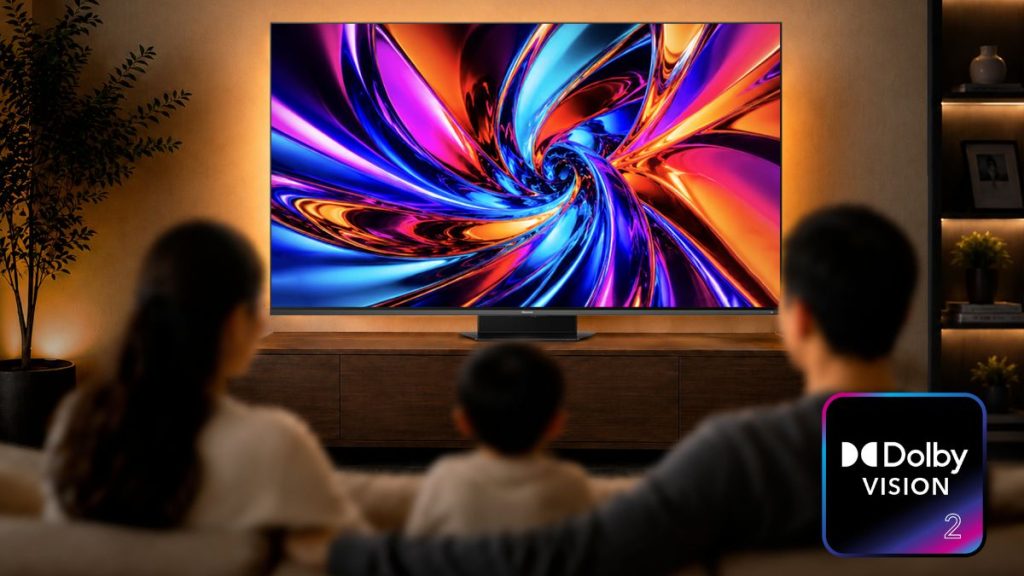
Dolby Vision 2 is finally moving from announcement to actual TVs. Hisense has become the first TV maker to bring Dolby’s new-generation HDR technology to consumer televisions, giving owners of select 2026 models access to the company’s latest picture technology.
Dolby Vision 2 was introduced as a major update to Dolby Vision, with Dolby focusing not just on brighter and more detailed HDR images, but also on better control over how content looks in different viewing environments.
The first Hisense TVs to receive Dolby Vision 2 are its 2026 models. The company is also preparing firmware updates that will bring the technology to additional compatible models.
What makes Dolby Vision 2 different?
Dolby Vision 2 is designed to improve HDR picture quality while giving content creators and TV makers more control over the final image.
One of the biggest changes is Dolby’s new Content Intelligence system. It is designed to understand both the content being played and the conditions in which it is being watched. This could help TVs adjust the picture more intelligently instead of simply increasing brightness or contrast.
That matters because the same HDR content can look very different depending on the room. A movie that looks impressive in a dark room can lose detail when sunlight enters the room. Dolby Vision 2 aims to address some of these limitations.
The new system also includes tools such as Precision Black, which is intended to improve shadow detail and contrast without simply making the entire image brighter.
Hisense is first to bring Dolby Vision 2 to TVs
Hisense’s early adoption makes the company one of the first major TV brands to give consumers access to Dolby’s new HDR technology. For now, Dolby Vision 2 is available on select Hisense 2026 televisions, while more models are expected to receive support through software updates.
This is important because Dolby Vision 2 does not necessarily require consumers to immediately replace their existing television. Where compatible hardware is already present, firmware updates can add support for some of the new features.
The exact availability will depend on the TV model and market, so owners should not assume that every 2026 Hisense television will automatically receive the update.
Dolby Vision 2 is more than a brightness upgrade
HDR TVs have increasingly focused on higher peak brightness, but simply making an image brighter does not always result in a better picture.
Dolby Vision 2 takes a broader approach. Dolby wants the technology to preserve creative intent while also making HDR content look better across different TVs and viewing environments.
That could be particularly useful for people who watch TV during the day. Bright rooms can make dark scenes difficult to see, while aggressive brightness adjustments can wash out parts of an image.
If Dolby’s approach works as intended, Dolby Vision 2 could make HDR performance more consistent rather than simply pushing television brightness even further.
Content will be the next big question
The arrival of Dolby Vision 2 on Hisense TVs is only the first part of the story. The technology will need compatible content to show its full potential. Dolby Vision has already become widely supported across streaming services, movies and televisions, but Dolby Vision 2 will need broader adoption from studios, streaming platforms and other TV manufacturers.
That means the early Hisense rollout is interesting, but it may take time before viewers see the full benefit of Dolby Vision 2 across their entire content library.
Related Posts