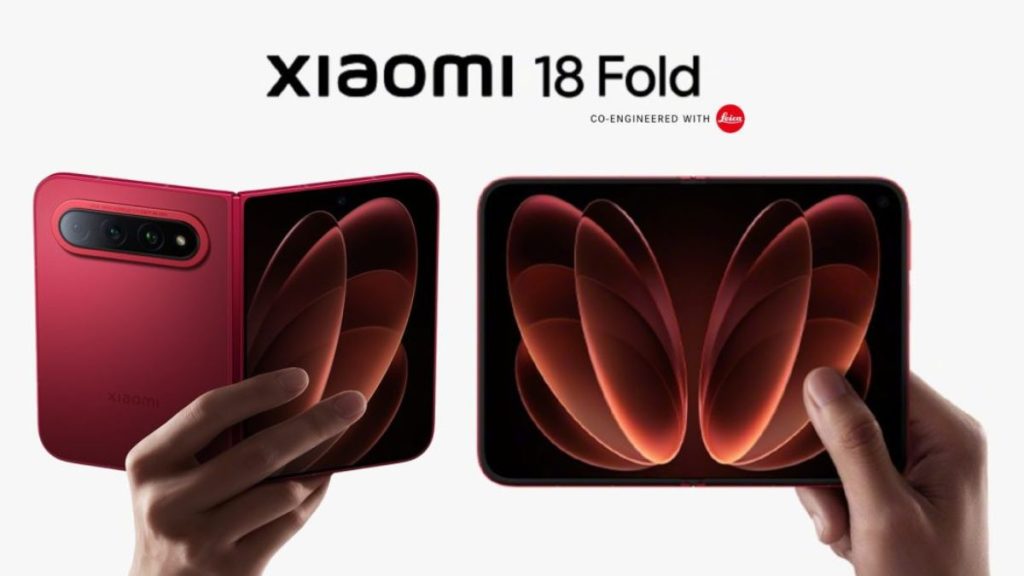
Xiaomi is making a strong case for its in-house smartphone processors. The Xiaomi 18 Fold has topped AnTuTu’s September 2026 Android flagship performance rankings and managed to beat several flagship smartphones. The interesting part is that Xiaomi achieved this with its own Xring O3 processor, rather than relying on a Snapdragon chipset.
According to AnTuTu’s September rankings, the Xiaomi 18 Fold recorded an average score of 4,620,886 points. The iQOO 16 secured second place with 4,449,925 points, followed by the Honor Magic 9 Pro Max with 4,435,489 points. Both phones use Qualcomm’s Snapdragon 8 Elite Extreme Gen 6 processor, which also powers the fourth-ranked Xiaomi 18 Pro Max.
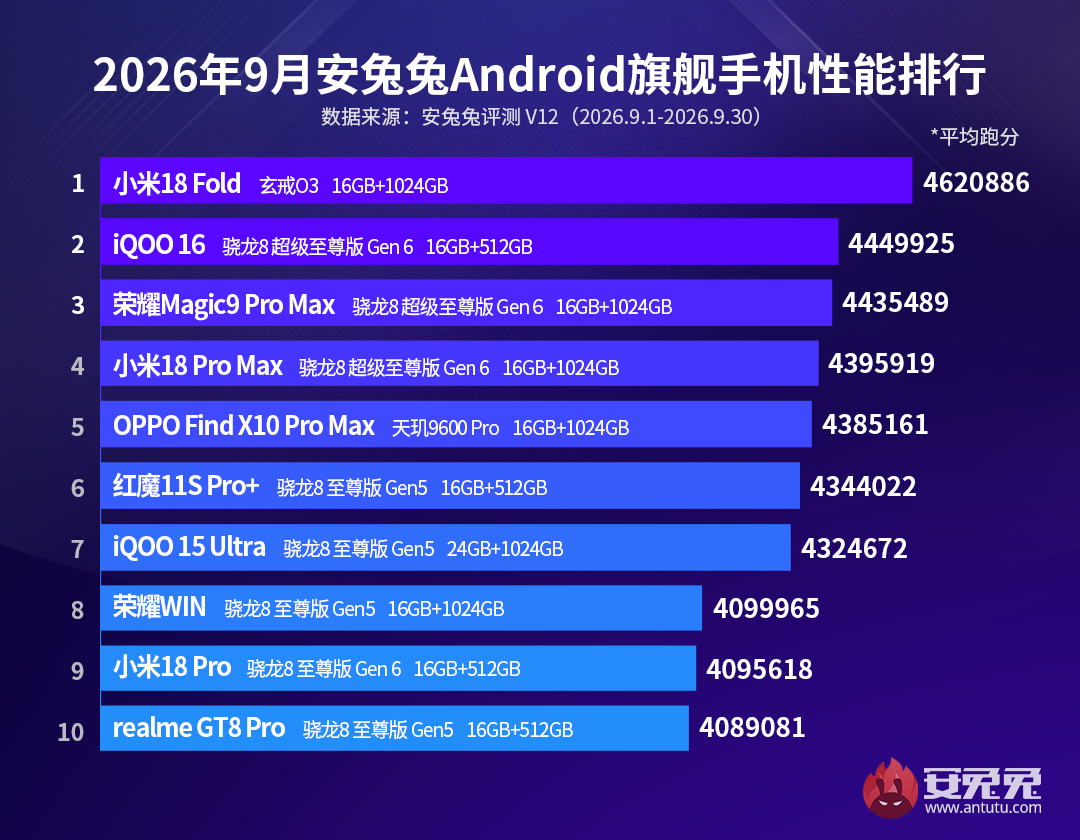
The Oppo Find X10 Pro Max rounded out the top five with MediaTek’s Dimensity 9600 Pro chipset. The results show that Qualcomm continues to have a strong presence in the flagship market, but Xiaomi’s in-house silicon has managed to take the top spot.
The Xring O3 is Xiaomi’s flagship processor, built using TSMC’s second-generation 3nm manufacturing process. It features a 10-core CPU with two Arm C1-Ultra cores clocked at up to 4.35GHz, four C1-Premium cores running at up to 3.6GHz, and four C1-Pro cores reaching 3.15GHz. Graphics are handled by an Arm Mali-G2 Ultra NX MP16 GPU.
The Xiaomi 18 Fold configuration in the ranking also packs 16GB of LPDDR6 RAM and 1TB of UFS 4.1 storage. The faster memory could contribute to the overall score, so it would be unfair to treat this result as a direct comparison of the processors alone.
The Xiaomi 18 Fold scored around 3.8% higher than the iQOO 16. That is a respectable lead, but it does not necessarily mean the Xiaomi phone will feel noticeably faster in everyday use. Benchmark scores combine several performance tests, and actual results depend on factors such as software optimisation, cooling, and power management.
For gamers, sustained performance is important. A phone might deliver an impressive score during a short benchmark run but struggle to maintain the same performance during a long gaming session if temperatures rise. The Xring O3 will need to prove itself in these real-world situations before we can judge how it compares with Qualcomm’s latest silicon.
Can Xiaomi Challenge Qualcomm in the Long Run?
Developing its own flagship processor gives Xiaomi greater control over the hardware inside its phones. It can work more closely on optimising its chips for HyperOS, improve how hardware and software work together, and potentially reduce its dependence on external chip suppliers.
However, competing with Qualcomm involves much more than producing a fast CPU and GPU. Power efficiency, modem performance, graphics drivers, AI capabilities, and developer support are all important parts of a successful flagship platform. Qualcomm has years of experience in these areas, and Xiaomi will need to deliver consistent results across multiple generations before it can challenge that position more broadly.
Xiaomi also needs to show that its custom processors can deliver good results across different devices, rather than just one premium foldable. If the company can maintain strong performance while improving battery life and thermal management, its in-house chips could become a meaningful advantage in the flagship market.
The company’s results in the tablet segment are also worth watching. The Xiaomi Pad 9 Pro Max topped AnTuTu’s September 2026 Android tablet rankings with an average score of 5,233,432 points. This suggests that Xiaomi’s silicon strategy could extend beyond smartphones, although tablet and phone rankings should not be compared directly.
The Xiaomi 18 Fold taking the top position is an encouraging result for the company’s custom silicon efforts. It shows that Xiaomi can compete with smartphones powered by Qualcomm’s latest flagship processor, at least in AnTuTu’s overall performance testing.
However, one monthly ranking is not enough to declare the Xring O3 superior in every area. The real test will be how well it performs in demanding games, sustained workloads, battery efficiency, and everyday use.
If Xiaomi can build on this result with future generations of its Xring processors, it could become a more serious competitor to Qualcomm and MediaTek. For now, the Xring O3 has given Xiaomi something important: a credible reason for buyers to pay attention to the chip inside its flagship phones, rather than looking only at the Snapdragon name.
Related Posts