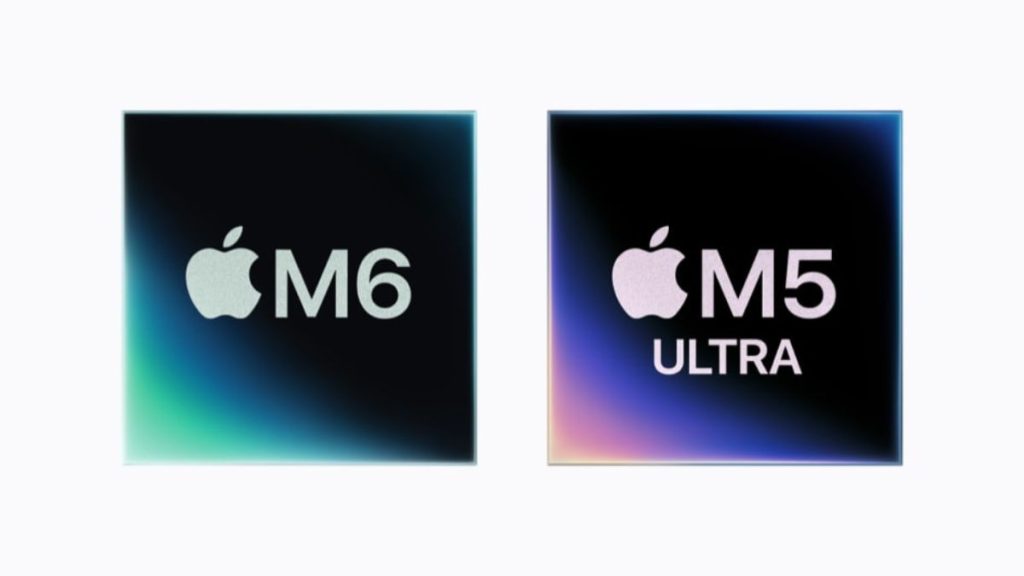
Apple has introduced two new Apple silicon chips, M6 and M5 Ultra, bringing a major performance boost to its desktop lineup.
The M6 is Apple’s first chip built using a 2nm process, while the M5 Ultra is the company’s most powerful M-series chip yet. Apple is focusing heavily on AI with both chips, adding more Neural Engine capacity and Neural Accelerators inside the GPUs.
The M6 is designed for everyday users, developers and AI enthusiasts, while the M5 Ultra targets professional workloads such as 3D rendering, video production, scientific computing and running large AI models locally.
Apple M6
The M6 is built using a 2nm process. The smaller manufacturing process allows Apple to pack more transistors into the chip while improving performance and power efficiency.
The chip gets a new 12-core CPU with two super cores, four performance cores and six efficiency cores. Apple says it delivers the world’s fastest single-threaded performance.
Compared with the M5, Apple claims up to 1.2x faster multithreaded performance. The improvement reaches up to 2.4x compared with the M1.
The new CPU architecture is designed to handle different workloads across different core types. The super cores handle demanding single-threaded tasks, while the performance cores take care of heavier parallel workloads. The efficiency cores handle background tasks while consuming less power. This should help with tasks such as photo editing, compiling code, file indexing and AI agent workloads.
The M6 also gets a larger 12-core GPU, with two more GPU cores than the M5. Apple has added a Neural Accelerator to every GPU core. The company says this provides nearly 30% higher peak GPU compute for AI compared with M5 and more than 8x the peak GPU AI compute compared with M1.
This is important for local AI workloads because more of the processing can happen on the GPU instead of being sent to the cloud.
Apple has also updated the GPU architecture with improvements to its shader cores and Dynamic Caching. Hardware-accelerated ray tracing is included as well.
The chip gets a 50% increase in geometry rates, which should help with complex 3D scenes and games.
Apple is also using the M6 to improve gaming performance on Mac. The combination of the updated GPU, Dynamic Caching and ray tracing is designed to deliver higher frame rates and more detailed visuals in demanding games.
Apple has introduced a Dual 16-core Neural Engine, effectively giving the chip two 16-core Neural Engines. Apple says peak compute can reach up to 2x that of previous generations.
Apple’s system frameworks can use both Neural Engines at the same time. This allows compatible applications to execute AI models faster.
The M6 supports up to 32GB of unified memory and provides up to 170GB/s of memory bandwidth. That is a 10% increase over M5 and 2.5x the bandwidth of M1.
The unified memory architecture is particularly useful for local AI because the CPU, GPU and Neural Engine can access the same memory pool. This reduces the need to move data between separate memory pools.
Apple M5 Ultra
The M5 Ultra is designed for users who need much more performance. It is aimed at professional workloads such as 3D rendering, visual effects, scientific computing, high-resolution video editing and running large AI models locally.
The biggest change is inside the chip itself. Apple is using its UltraFusion technology to connect two dual-die M5 Max chips. This creates a quad-die architecture, which is a first for an Apple silicon SoC.
The UltraFusion connection provides more than 4.4TB/s of inter-die bandwidth. Apple also says connection density has increased by more than six times.
The goal is to make all four dies behave like a single processor instead of separate chips.
M5 Ultra can be configured with up to a 36-core CPU. The CPU has 12 super cores and 24 performance cores. Apple claims up to 1.25x higher single-threaded performance and up to 1.3x higher multithreaded performance compared with M3 Ultra.
The extra CPU performance will be useful for workloads that can take advantage of many cores, including rendering, simulation, compilation and professional applications.
M5 Ultra can have up to 80 GPU cores, and every GPU core includes a Neural Accelerator. Apple says the chip delivers up to 4.5x higher peak GPU AI compute compared with M3 Ultra and more than six times the peak GPU AI compute of M1 Ultra.
The GPU also gets Apple’s latest shader core architecture, second-generation Dynamic Caching, hardware-accelerated mesh shading and third-generation ray tracing. Apple claims up to 40% faster graphics performance compared with M3 Ultra.
This combination should make M5 Ultra particularly useful for professional 3D applications, visual effects and workloads that depend heavily on GPU compute.
The biggest advantage of M5 Ultra for AI may not be its CPU or GPU. It is the memory. M5 Ultra supports up to 512GB of unified memory and provides up to 1.2TB/s of memory bandwidth. Apple says this is 50% more bandwidth than M3 Ultra.
That amount of memory gives developers and researchers the ability to keep much larger datasets and AI models in memory instead of constantly moving data between storage and memory.
It also makes the Mac Studio with M5 Ultra particularly interesting for local AI.
Apple says users can run huge LLMs with hundreds of billions of parameters entirely on the device.
For developers who want to run or fine-tune large models without sending data to cloud services, this could be one of the most useful capabilities of the new chip.
Apple has upgraded the Media Engine in M5 Ultra. It includes dedicated hardware for H.264 and HEVC, along with four ProRes encode and decode engines. It also supports hardware-accelerated AV1 decoding. This makes the chip suitable for demanding video workflows involving multiple high-resolution streams, effects and complex timelines.
Apple is also using Mac Studio with M5 Ultra to demonstrate workflows in applications such as Adobe Premiere Pro. The combination of high CPU performance, a large GPU and 512GB of unified memory gives professional users a lot of room for complex projects.
M5 Ultra also includes a 32-core Neural Engine. Together with the Neural Accelerators in the GPU, it can handle demanding AI workloads locally. Apple says its developer frameworks can automatically distribute workloads across the CPU, GPU and Neural Engine. This includes Apple’s Core AI, Core ML and Metal frameworks, as well as Xcode.
Developers can use these tools to run and fine-tune AI models locally. They can also use Apple’s Foundation Models and App Intents to build applications that integrate with Apple Intelligence.
M6 vs M5 Ultra
The two chips are designed for very different users.
| Feature | M6 | M5 Ultra |
|---|---|---|
| Process | 2nm | Next-generation Apple silicon |
| CPU | Up to 12 cores | Up to 36 cores |
| GPU | Up to 12 cores | Up to 80 cores |
| Neural Engine | Dual 16-core | 32-core |
| Unified memory | Up to 32GB | Up to 512GB |
| Memory bandwidth | Up to 170GB/s | Up to 1.2TB/s |
| Ray tracing | Hardware accelerated | Third-generation |
| Main focus | Everyday work, development, AI | Pro workloads, large AI models |
| Architecture | Single SoC | Quad-die via UltraFusion |
The M6 is a significant upgrade for Apple’s mainstream desktop machines. Its 2nm process, new CPU architecture, Neural Accelerators and Dual Neural Engine make it much more capable for both traditional computing and local AI.
M5 Ultra is in another class. Its 36-core CPU, 80-core GPU, 512GB unified memory and 1.2TB/s bandwidth are designed for workloads that would normally require a dedicated workstation or expensive AI hardware.
Related Posts