NVIDIA has announced DLSS 4.5 Ray Reconstruction, a major upgrade to its AI-powered graphics technology. The company says the new version improves ray-traced visuals with cleaner image quality, more accurate lighting, better motion clarity, and reduced ghosting.
The feature will become available in August through the NVIDIA app and will work on all GeForce RTX graphics cards.
With DLSS 4.5, NVIDIA is continuing its push to use AI for improving gaming performance and visual quality. The latest update introduces a second-generation transformer model that handles both denoising and image reconstruction in ray-traced and path-traced games.
What Is New in DLSS 4.5 Ray Reconstruction?
Ray tracing creates realistic lighting, shadows, and reflections, but it also requires a lot of computing power. To reduce the workload, games often use denoisers that fill in missing visual information.
NVIDIA says DLSS 4.5 replaces many traditional denoising methods with a more advanced AI model trained on its supercomputers. Instead of relying on hand-tuned algorithms, the AI analyzes scenes and reconstructs missing pixels more accurately.
According to NVIDIA, the new transformer model delivers 35% more compute capability and processes 20% more parameters than the previous version while maintaining similar performance.
The company claims players can expect:
- More accurate lighting
- Better image stability during movement
- Reduced ghosting effects
- Cleaner particle effects
- Improved motion clarity
- Better overall image quality in ray-traced games
NVIDIA also says its upscaling technology has received further improvements as part of the update.
27 Games Will Support DLSS 4.5 Ray Reconstruction
NVIDIA confirmed that 27 games will support DLSS 4.5 Ray Reconstruction from day one. The list includes several popular and upcoming titles:
- Alan Wake 2
- Avatar: Frontiers of Pandora
- Backrooms: Escape Together
- Call of Duty: Black Ops 7
- Crimson Desert
- Cyberpunk 2077
- DOOM: The Dark Ages
- Enlisted
- Everspace 2
- F1 25
- FBC: Firebreak
- Half-Life 2 RTX
- Hogwarts Legacy
- Indiana Jones and the Great Circle
- Incursion Red River
- Naraka: Bladepoint
- Neverness to Everness
- Portal with RTX
- Pragmata
- Resident Evil Requiem
- Samson
- Star Wars Outlaws
- Subliminal
- Sword of Justice
- The First Descendant
- Death Relives
- Directive 8020
Several of these games already showcase advanced ray-tracing effects, making them ideal candidates for the new technology.
Visual Improvements
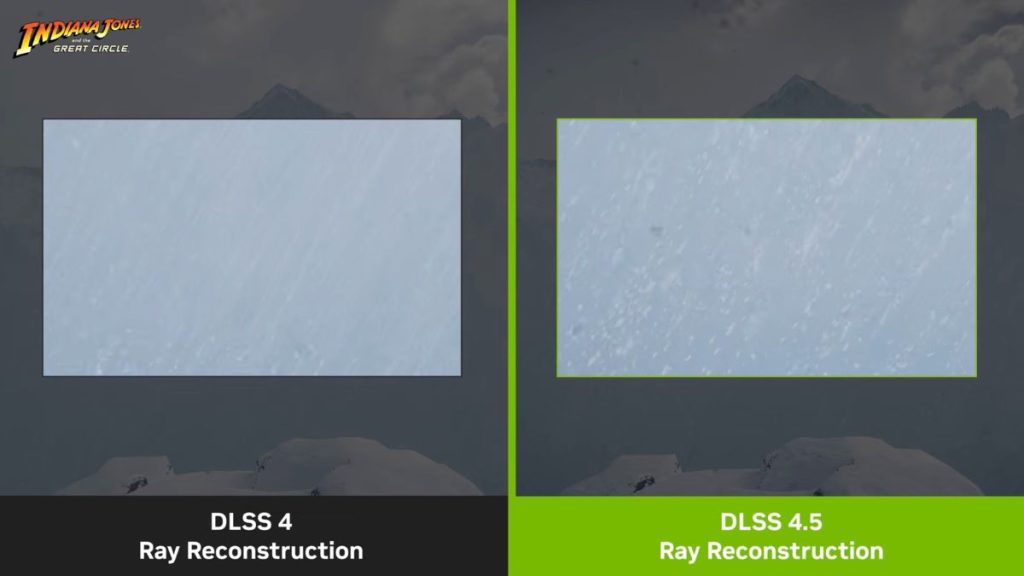
NVIDIA demonstrated the new model in a few games to highlight the improvements. In Indiana Jones and the Great Circle, the company says DLSS 4.5 reduces ghosting around snow effects and improves particle rendering.

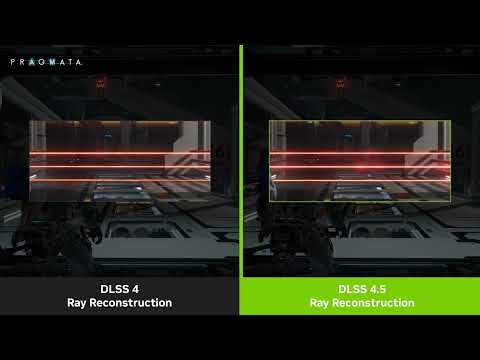
In Pragmata, the technology reportedly delivers cleaner lighting transitions and fewer visual artifacts.
Meanwhile, Alan Wake 2 benefits from improved image stability in scenes featuring CRT screen effects and visual noise.

The company also says the larger training dataset used for the new AI model helps it better understand game-engine data and recreate scenes closer to how developers intended them to look.
Developers will also gain more control over temporal accumulation, allowing them to fine-tune visual effects for different rendering scenarios.
NVIDIA is also bringing DLSS 4.5 Ray Reconstruction to creative applications. Blender 5.3 will add support for the technology later this year as a viewport denoiser. This could help artists and 3D creators preview complex scenes with better image quality and less visual noise.
In addition, several upcoming games are receiving broader DLSS 4.5 support, including Marvel Rivals, Phantom Blade Zero, Squad, Gothic 1 Remake, Cinder City, Duet Night Abyss, and Where Winds Meet.
DLSS started as an AI-powered upscaling technology designed to improve frame rates. Over the years, NVIDIA has expanded it with features such as Frame Generation, Ray Reconstruction, and transformer-based AI models.
The announcement of DLSS 4.5 shows that AI is becoming an increasingly important part of modern game rendering. Instead of simply boosting performance, AI is now being used to improve image quality, lighting accuracy, and visual realism.
One interesting thing missing from NVIDIA’s Computex announcements was any mention of DLSS 5. Rumors had suggested the company might reveal the next major version of its gaming technology, but that did not happen.
Related Posts